Question
Planck constant has the same dimensions as:
  1. Force × time.
  2. Force × distance.
  3. Force × speed.
  4. Force × distance × time.

Answer

  1. Force × distance × time.

Explanation:

Planck's constant

$\text{h}=\frac{\text{E}}{\text{v}}=\frac{\text{Force}\times\text{distanace}}{\text{frequency}}$

$\Rightarrow\text{h}=\text{force}\times\text{distance}\times{\text{times}}.$

Need a full question paper?

Generate a complete, print-ready paper with questions like this in minutes — across 16+ boards, with answer keys.

Start Generating Free

Similar questions

Unit of impulse is
What will be the ratio of the distances moved by a freely falling body from rest in 4th and 5th seconds of journey?
A body is moving with velocity $30\; m/s$ towards east. After $10$ seconds its velocity becomes $40\; m/s$ towards north. The average acceleration of the body is ...... $m/s^2$
An aluminium container of mass $100\,\, gm$ contains $200 \,\,gm$ of ice at $-20^o\,\, C$. Heat is added to the system at the rate of $100 \,\,cal/s$. The temperature of the system after $4$ minutes will be ....... $^oC$ (specific heat of ice $= 0.5$ and $L = 80 \,\,cal/gm$, specific heat of $Al= 0.2\,\, cal/gm/^o C$)
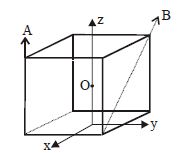
With reference to figure of a cube of edge $a$ and mass $m$, state whether the following
($O$ is the centre of the cube.) option is correct

$(a)$ The moment of inertia of cube about $z-$ axis is $I_z$ = $I_x + I_y$

$(b)$ The moment of inertia of cube about $A-$ axis is $I_A$=${I_z} + \frac{{m{a^2}}}{2}$

$(c)$ The moment of inertia of cube about $B-$ axis is $I_B$=${I_z} + \frac{{m{a^2}}}{2}$

$(d)$  $I_x$ = $I_z$
A particle moves in one dimensional field with total mechanical energy $E$ . If potential energy of particle is $V(x)$ , then
A sphere of mass $50\,gm$ and diameter $20\,cm$ rolls without slipping with a velocity of $5\,cm/sec$ . Its total kinetic energy is
$A$ flexible chain of length $2m$ and mass $1kg$ initially held in vertical position such that its lower end just touches a horizontal surface, is released from rest at time $t = 0$. Assuming that any part of chain which strikes the plane immediately comes to rest and that the portion of chain lying on horizontal surface does not from any heap, the height of its centre of mass above surface at any instant $t = 1/\sqrt 5$ befor it completely comes to rest) is ................ $\mathrm{m}$
Area under velocity time graph represents:
Two wires of same length and radius are joined end to end and loaded. The Young's modulii of the materials of the two wires are $Y_{1}$ and $Y_{2}$. The combination behaves as a single wire then its Young's modulus is: