MCQ
Area under velocity time graph represents:
  • A
    Acceleration.
  • B
    Displacement.
  • C
    Retardation.
  • D
    Average speed.

Answer

  1. Displacement.

Need a full question paper?

Generate a complete, print-ready paper with questions like this in minutes — across 16+ boards, with answer keys.
Start Generating Free

Similar questions

The angle between the vectors $(\hat i + \hat j)$ and $(\hat j + \hat k)$ is ....... $^o$
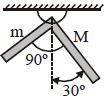
Two uniform rods of equal length but different masses are rigidly joined to form an $L-$ shaped body, which is then pivoted as shown in figure. If in equilibrium the body is in the shown configuration, ratio $M/m$ will be
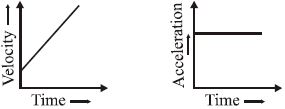
The velocity-time and acceleration-time graphs of a particle are given as Its position-time graph may be gvien as
A spring with spring constant k when stretched through $1\, cm$, the potential energy is $U$. If it is stretched by $4 \,cm.$ The potential energy will be
Two particles are moving along two long straight lines, in the same plane, with the same speed $= 20 \,\,cm/s$. The angle between the two lines is $60^o$, and their intersection point is $O$. At a certain moment, the two particles are located at distances $3\,m$ and $4\,m$ from $O$, and are moving towards $O$. Subsequently, the shortest distance between them will be
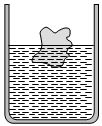
A body floats in a liquid contained in a beaker. If the whole system as shown in figure falls freely under gravity, then the upthrust on the body due to liquid is
A diatomic ideal gas is compressed adiabatically to $\frac{1}{32}$ of its initial volume. If the initial temperature of the gas is $T_1$ (in Kelvin) and the final temperature is $a T_1$, the value of $a$ is
The specific heat of alcohol is about half that of water. Suppose you have identical masses of alcohol and water. The alcohol is initially at temperature $T_A$. The water is initially at a different temperature $T_W.$ Now the two fluids are mixed in the same container and allowed to come into thermal equilibrium, with no loss of heat to the surroundings. The final temperature of the mixture will be :-
If the amount of heat given to a system be $35$ joules and the amount of work done by the system be $ - 15$ joules, then the change in the internal energy of the system is .... $joules$
Let Cv and Cp denote the molar heat capacities of an ideal gas at constant volume and constant pressure respectively. Which of the following is a universal constant?

  1. $\frac{\text{C}_\text{P}}{\text{C}_\text{V}}$

  2. $\text{C}_\text{P}\text{C}_\text{V}$

  3. $\text{C}_\text{P}-\text{C}_\text{V}$

  4. $\text{C}_\text{P}+\text{C}_\text{V}$