Question
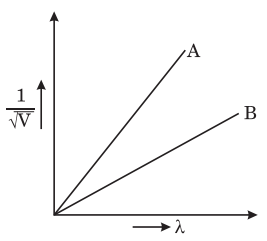
Plot a graph showing variation of de-Broglie wavelength $ \lambda $ versus $ 1/\sqrt{V} $ where V is accelerating potential for two particles A and B carrying same charge but of masses $ m_{1} $ and $ m_{2} $, where $ m_{1}>m_{2} $

Need a full question paper?

Generate a complete, print-ready paper with questions like this in minutes — across 16+ boards, with answer keys.
Start Generating Free

Similar questions

When a glass capillary tube is dipped at one end in water, water rises in the tube. The gravitational potential energy is thus increased. Is it a violation of conservation of energy?
Draw the graph of deviation angle $(\delta)$ versus incidence angle $(i)$ and derive the formula for refractive index $n_{21}=\frac{\sin \left(\frac{A+D_m}{2}\right)}{\sin \left(\frac{A}{2}\right)}$ for the material of prism.
A simple pendulum of length I is suspended from the ceiling of a car moving with a speed v on a circular horizontal road of radius r.
  1. Find the tension in the string when it is at rest with respect to the car.
  2. Find the time period of small oscillation.
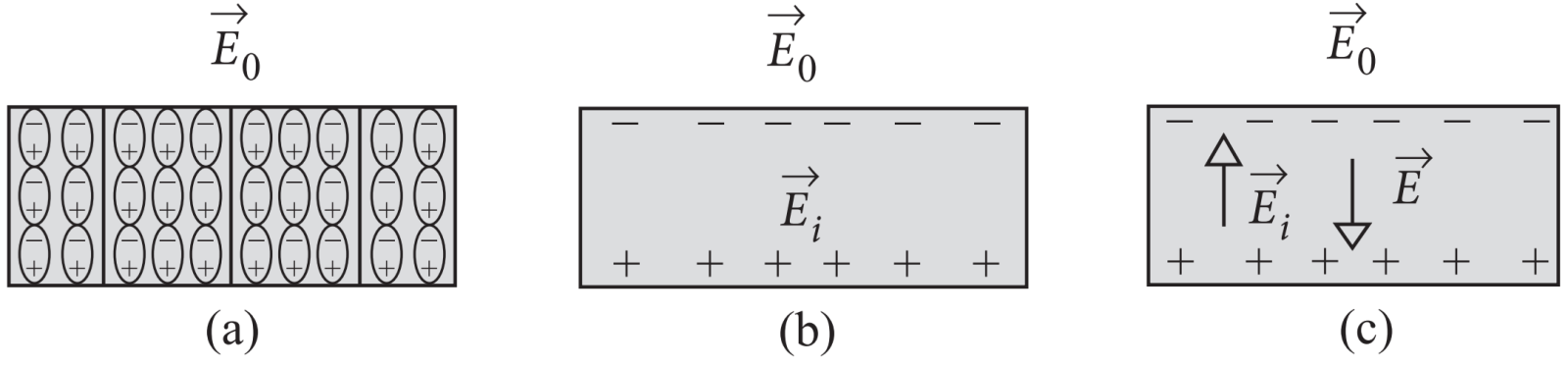
When an insulator is placed in an external field, the dipoles become aligned. Induced surface charges on the insulator establish a polarization field $\vec{\text{E}}_\text{i}$ in its interior. The net field $\vec{\text{E}}$ in the insulator is the vector sum of $\vec{\text{E}}_0$ and $\vec{\text{E}}_\text{i}$ as shown in the figure.
On the application of external electric field, the effect of aligning the electric dipoles in the insulator is called polarisation, and the field $\vec{\text{E}}_\text{i}$ is known as the polarisation field. The dipole moment per unit volume of the dielectric is known as polarisation $(\vec{\text{P}}).$ For linear isotropic dielectrics, $\vec{\text{P}}=\chi\vec{\text{E}},$ where $\chi=$ electrical susceptibility of the dielectric medium.
  1. Which among the following is an example of polar molecule?
  1. $O_2$
  2. $H_2$
  3. $N_2$
  4. $\text{HCI}$
  1. When air is replaced by a dielectric medium of constant $K,$ the maximum force of attraction between two charges separated by a distance:
  1. Increases $K$ times.
  2. Remains unchanged.
  3. Decreases $K$ times.
  4. Increases $2K$ times.
  1. Which of the following is a dielectric?
  1. Copper.
  2. Glass.
  3. Antimony $(Sb)$.
  4. None of these.
  1. For a polar molecule, which of the following statements is true?
  1. The centre of gravity of electrons and protons coincide.
  2. The centre of gravity of electrons and protons do not coincide.
  3. The charge distribution is always symmetrical.
  4. The dipole moment is always zero.
  1. When a comb rubbed with dry hair attracts pieces of paper. This is because the?
  1. Comb polarizes the piece of paper.
  2. Comb induces a net dipole moment opposite to the direction of field.
  3. Electric field due to the comb is uniform.
  4. Comb induces a net dipole moment perpendicular to the direction $o$
  1. f field.
For a circular coil of radius R and N turns carrying current I, the magnitude of the magnetic field at a point on its axis at a distance x from its centre is given by,
$\text{B}=\frac{\mu_{0}\text{IR}^{2}\text{N}}{2(\text{x}^{2}+\text{R}^{2})^{\frac{3}{2}}}$
  1. Show that this reduces to the familiar result for field at the centre of the coil.
  2. Consider two parallel co-axial circular coils of equal radius R, and number of turns N, carrying equal currents in the same direction, and separated by a distance R. Show that the field on the axis around the mid-point between the coils is uniform over a distance that is small as compared to R, and is given by,$\text{B}=0.72\frac{\mu_{0}\text{NI}}{\text{R}}$, approximately.
[Such an arrangement to produce a nearly uniform magnetic field over a small region is known as Helmholtz coils.]
The density of nuclear matter is the ratio of the mass of a nucleus to its volume. As the volume of a nucleus is directly proportional to its mass number $A,$ so the density of nuclear matter is independent of the size of the nucleus. Thus, the nuclear matter behaves like a liquid of constant density. Different nuclei are like drops of this liquid, of different sizes but of same density. Let $A$ be the mass number and $R$ be the radius of a nucleus. If $m$ is the average mass of a nucleon, then. Mass of nucleus $= mA$
Volume of nucleus $=\frac{4}{3}\pi\text{R}^3=\frac{4}{3}\pi\big(\text{R}_0\text{A}\frac{1}{3}\big)=\frac{4}{3}\pi\text{R}^3_0\text{A}$
$\therefore$ Nuclear density $,\rho\text{nu}=\frac{\text{Mass of nucleus}}{\text{Volume of nucleus}}$ or $\ \rho\text{nu}$
$=\frac{\text{MA}}{\frac{4}{3}\pi\text{R}_0^3\text{A}}=\frac{3\text{m}}{4\pi\text{R}_0^3}$
Clearly, nuclear density is independent of mass number $A$ or the size of the nucleus. The nuclear mass density is of the order $10^{17}kg m^{-3}$ This density is very large as compared to the density of ordinary matter, say water, for which $\rho = 1.0 \times 10^3\ kg m^{-3}$
  1. The nuclear radius of $_8^{16}\text{O} is 3 \times 10^{-15}m$. The density of nuclear matter is.
  1. $2.9 \times 10^{34}kg m^{-3}$
  2. $1.2 \times 10^{17}kg m^{-3}$
  3. $16 \times 10^{27}kg m^{-3}$
  4. $2.4 \times 10^{17}kg m^{-3}$
  1. What is the density of hydrogen nucleus in $SI$ units? Given $R_o= 1.1$ fermi and $m_P = 1.007825$ amu.
  1. $1.2 \times 10^{17}kg m^{-3}$
  2. $3.0 \times 10^{34}kg m^{-3}$
  3. $1.99 \times 10^{11}kg m^{-3}$
  4. $7.85 \times 10^{17}kg m^{-3}$
  1. Density of a nucleus is.
  1. More for lighter elements and less for heavier elements.
  2. More for heavier elements and less for lighter elements.
  3. Very less compared to ordinary matter.
  4. A constant.
  1. The nuclear mass of $_{23}^{56}\text{Fe}$ is $55.85$ amu. The its nuclear density is.
  1. $5.0 \times 10^{19}kg m^{-3}$
  2. $1.5 \times 10^{19}kg m^{-3}$
  3. $2.9 \times 10^{17}kg m^{-3}$
  4. $9.2 \times 10^{26}kg m^{-3}$
  1. If the nucleus of $_{13}^{27}\text{Al}$ has s a nuclear radius of about $3.6 fm,$ then $_{52}^{125}\text{Te}$ would have its radius approximately as.
  1. $9.6fm$
  2. $12fm$
  3. $4.8fm$
  4. $6fm$
By mistake, an eye surgeon puts a concave lens in place of the lens in the eye after a cataract operation. Will the patient be able to see clearly any object placed at any distance?
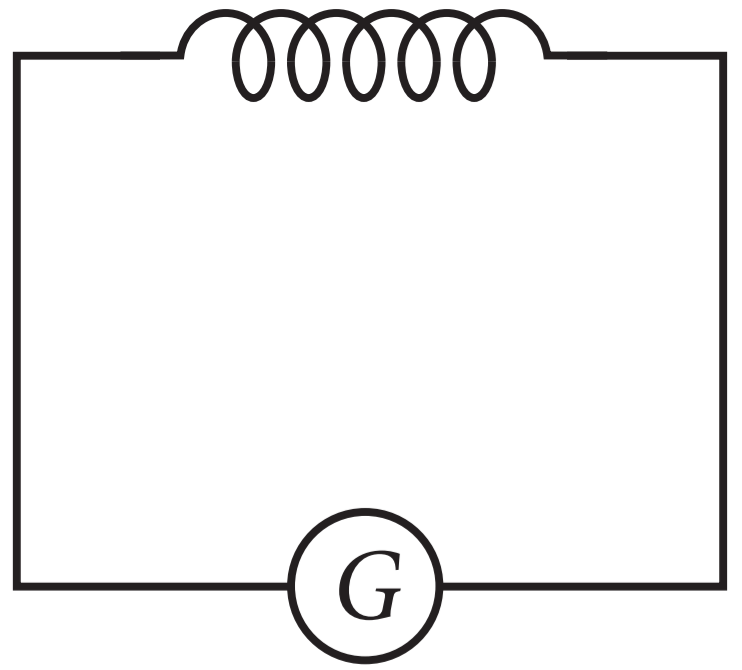
When a current/ flows through a coil, flux linked with it is $\phi=\text{LI},$ where $L$ is a constant known as self inductance of the coil. Any change in current sets up an induced $emf$ in the coil. Tims, self inductance of a coil is the induced emf set up in it when the current passing through it changes at the unit rate. It is a measure of the opposition to the growth or the decay of current flowing through the coil. Also, value of self inductance depends on the number of turns in the solenoid, its area of cross$-$section and the relative permeability of its core material.
  1. The inductance in a coil plays the same role as:
  1. Inertia in mechanics.
  2. Energy in mechanics.
  3. Momentum in mechanics.
  4. Force in mechanics.
  1. A current of $2.5A$ flows through a coil of inductance $5H.$ The magnetic flux linked with the coil is:
  1. $0.5\ Wb$
  2. $12.5\ Wb$
  3. Zero
  4. $2\ Wb$
  1. The inductance $L$ of a solenoid depends upon its radius $R$ as:
  1. $\text{L}\propto\text{R}$
  2. $\text{L}\propto\frac{1}{\text{R}}$
  3. $\text{L}\propto\text{R}^2$
  4. $\text{L}\propto\text{R}^3$
  1. The unit of self$-$inductance is:
  1. Weber ampere
  2. Weber$^{-1}$ ampere
  3. Ohm second
  4. Farad
  1. The induced $e.m.f.$ in a coil of $10$ henry inductance in which current varies from $9A$ to $4A$ in $0.2$ second is:
  1. $200V$
  2. $250V$
  3. $300V$
  4. $500V $
The combination of two bar magnets makes 10 oscillations per second in an oscillation magnetometer when like poles are tied together and 2 oscillations per second when unlike poles are tied together. Find the ratio of the magnetic moments of the magnets. Neglect any induced magnetism.
A short magnet oscillates in an oscillation magnetometern with a time period of 0.10s where the earth's horizontal magnetic field is $24\mu\text{T}.$ A downward current of 18 A is established in a vertical wire placed 20cm east of the magnet. Find the new time period.