Question
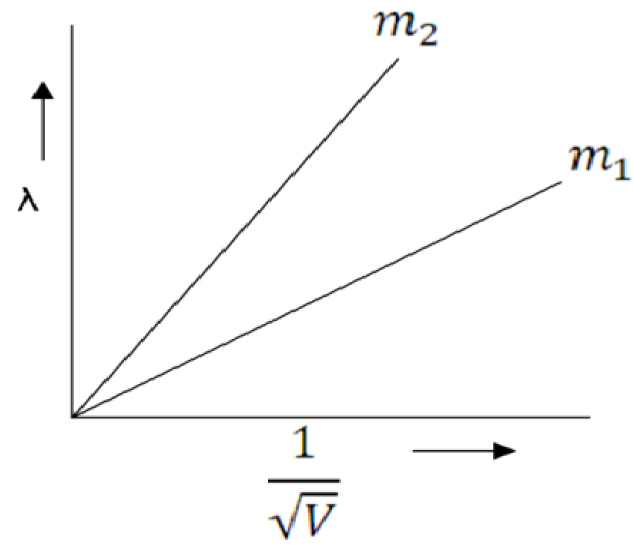
Plot a graph showing variation of de-Broglie wavelength $\lambda$ versus $\frac{1}{\sqrt{V}} ,$ where V is accelerating potential for two particles A and B carrying same charge but of masses m1, m2 (m1 > m2). Which one of the two represents a particle of smaller mass and why?
Answer


As $\lambda = \frac{\hslash}{\sqrt{2\text{mqV}}}$

As the charge of two particles is same, therefore

$\frac{\lambda}{(\frac{1}{\sqrt{\text{V}}})} \alpha\frac{1}{\sqrt{\text{m}}}$ i.e.Slope $\alpha\frac{1}{\sqrt{\text{m}}}$

Hence, particle with lower mass ($\text{m}_{2}$) will have greater slope.

Need a full question paper?

Generate a complete, print-ready paper with questions like this in minutes — across 16+ boards, with answer keys.

Start Generating Free

Similar questions

A body of mass m is placed on a table. The earth is pulling the body with a force mg. Taking this force to be the action what is the reaction?
An e.m. wave is travelling in a medium with a velocity v = $v \hat{i}$. The electric field oscillations, of this e.m. wave, are along the $y$-axis.
a. Identify the direction in which the magnetic field oscillations are taking place, of the e.m. wave.
b. How are the magnitudes of the electric field and magnetic fields in the electromagnetic wave related to each other?
Why is the orientation of the portable radio with respect to broadcasting station important?
Explain the physical effect of displacement current.
Can a process on an ideal gas be both adiabatic and isothermal?
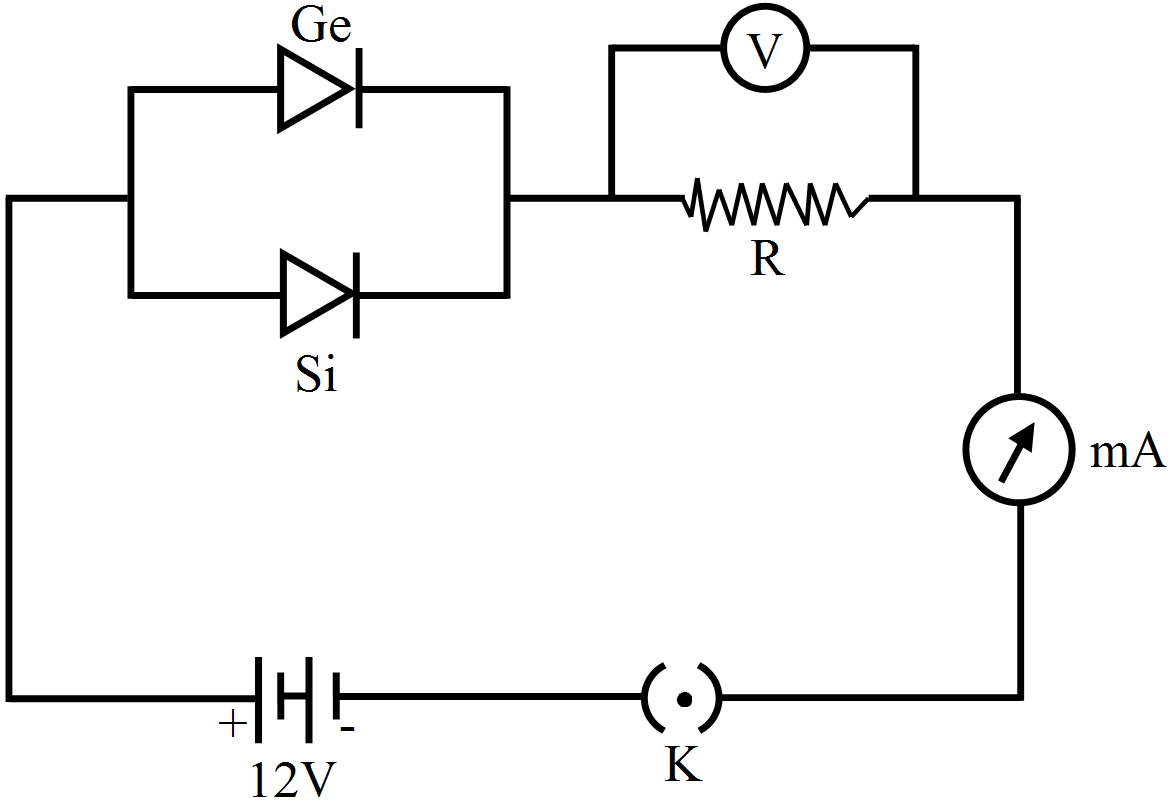
Germanium and silicon junction diodes are connected in parallel. A resistance R, a 12V battery, a milliammeter (mA) and key (K) are connected in series with them (figure). When key (K) is closed, a current begins to flow in the milliammeter. What will be the maximum reading of voltmeter connected across resistance R?

Two thin lenses, whose power is +5 D and $-3 D$. are kept in mutual contact. Find the focal length of the combination.
A positive charge q is placed in front of a conducting solid cube at a distance d from its centre. Find the electric field at the centre of the cube due to the charges appearing on its surface.
Draw the graph of variation in potential difference and electric field with distance ' $r$ ' for a point electric charge $Q$.
Is it possible for a particle to describe a curved path if no force acts on it? Does your answer depend on the frame of reference chosen to view the particle?