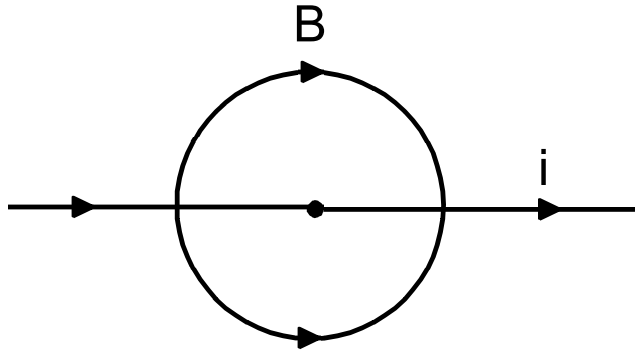
Question
Explain the physical effect of displacement current.

Answer

→The displacement current has the same physical effect(s) as the conduction current.
→In some cases, for example steady electric fields in a conducting wire, the displacement current will be zero, since the electric field E does not change with time.
→In other cases, for example the charging capacitor above, both conduction and displacement currents may be present in different regions of space.
→In most of the cases, they both may be present in the same region of space, as there exists no perfectly conducting or perfectly insulating medium.
→Most interesting, there may be large regions of space where there is no conduction current, but there is only a displacement current due to time-varying electric fields. In such a region,we expect a magnetic field, through there is no (conduction) current source nearby.
→For example, a magnetic field at a point between the plates of a capacitor is seen to be the same as field at a point just outside the capacitor plates.
Need a full question paper?

Generate a complete, print-ready paper with questions like this in minutes — across 16+ boards, with answer keys.

Start Generating Free

Similar questions

Ultraviolet light is incident on two photosensitive materials having work functions W1 and W2 (W1 > W2). In which case will the kinetic energy of the emitted electrons be greater? Why?
A proton and an a-particle have the same de-Broglie wavelength. Determine the ratio of (i) Their accelerating potentials and (ii) Their speeds.
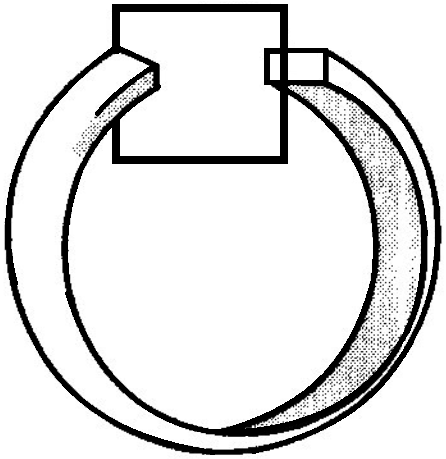
Figure shows a conducting square loop placed parallel to the pole faces of a ring magnet. The Pole-faces have an area of 1cm2 each and the field between the poles is 0.10T. The wires making the loop are all outside the magnetic field. If the magnet is removed in 1.0s, what is the average emf induced in the loop?

Draw the energy band diagram of (i) n-type, and (ii) p-type semiconductors at temperature T > 0 K. In the case of n-type Si-semiconductor, the donor energy level is slightly below the bottom of conduction band whereas in p-type semiconductor, the acceptor energy level is slightly above the top of valence band. Explain, giving examples, what role do these energy levels play in conduction and valence bands.
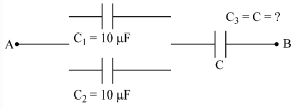
Calculate the capacitance of capacitor C if the equivalent capacitance of the connection between $A$ and $B$ is $15 \mu F$.
Image
Prove that the electric field at the surface of a charged conductor is $\overrightarrow{ E }=\frac{\sigma}{\varepsilon_0} \hat{n}$. Where, $\sigma$ - Surface charge density, $\hat{n}$ - unit vector normal to the surface and in going outward direction.
A conducting circular loop of radius a is connected to two Iong, straight wires. The straight wires carry current I as shown in figure. Find the magnetic field B at the centre of the loop.

Why cannot longitudinal waves be polarized?
Can there be a potential difference between two adjacent conductors carrying the same charge?
Does the polarising angle for any transparent medium depend on the wavelength of light?