Question
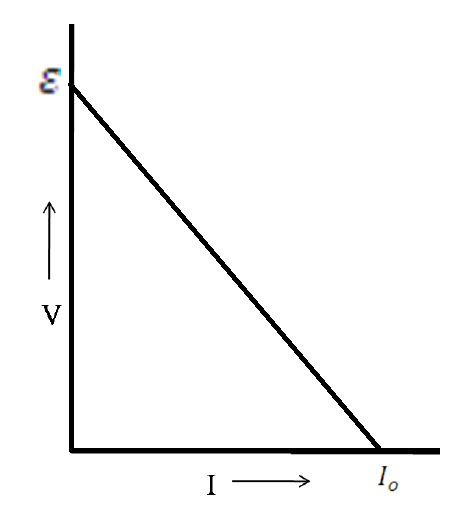
  1. Plot a graph showing variation of voltage vs the current drawn from the cell. How can one get information from this plot about the emf of the cell and its internal resistance?
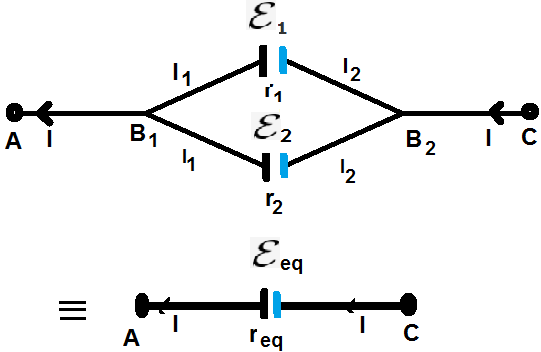
  2. Two cells of emf’s $E_1$ and $E_2$ and internal resistance $r_1$ and $r_2$ are connected in parallel. Obtain the expression for the emf and internal resistance of a single equivalent cell that can replace this combination?
Answer

  1.  

$V=\varepsilon-Ir$
When current is zero $(I = 0), \text{V}=\epsilon$
And when $V = 0, \text{I}=\text{I}_0,\text{ }r=\frac{\epsilon}{I_0}$
  1.  

$\text{V}=\text{V}(\text{B}_1)-\text{V}(\text{B}_2)=\varepsilon_1-I_1r_1$
$\text{V}=\text{V}(\text{B}_1)-\text{V}(\text{B}_2)=\varepsilon_2-I_2r_2$
$I=I_1+I_2$
$=​​​​​\frac{​\varepsilon_1-\text{V}}{r_1}+\frac{​\varepsilon_2-\text{V}}{r_2}=\Big(\frac{​\varepsilon_1}{r_1}+\frac{\varepsilon_2}{r_2}\Big)-\text{V}\Big(\frac{1}{r_1}+\frac{1}{r_2}\Big)$
$\text{V}=\frac{\varepsilon_1r_2+\varepsilon_2r_1}{r_1+r_2}-I\frac{r_1r_2}{r_1+r_2}$
On comparing with
$\text{V}=\varepsilon_{eq}-Ir_{eq}$
we get
$\varepsilon_{eq}=\frac{\varepsilon_1r_2+\varepsilon_2r_1}{r_1+r_2}$
$r_{eq}=\frac{r_1r_2}{r_1+r_2}$
Alternate Answer
A student may write the last two results in the following form.
$\frac{1}{r_{eq}}=\frac{1}{r_1}+\frac{1}{r_2}$
$\frac{\varepsilon_{eq}}{r_{eq}}=\frac{\varepsilon_1}{r_1}+\frac{\varepsilon_2}{r_2}$

Need a full question paper?

Generate a complete, print-ready paper with questions like this in minutes — across 16+ boards, with answer keys.

Start Generating Free

Similar questions

Consider an electron in front of metallic surface at a distance $d \ ($treated as an infinite plane surface$)$. Assume the force of attraction by the plate is given as $\frac{1}{2}\frac{\text{q}^2}{4\pi\epsilon_0\text{d}^2}$
Calculate work in taking the charge to an infinite distance from the plate. Taking $d = 0.1\ nm,$ find the work done in electron volts. $[$Such a force law is not valid for $d < 0.1nm]$.
A magnetic field of $(4.0\times10^{-3}\vec{\text{k}})$ T exerts a force of $(4.0\vec{\text{i}}+3.0\vec{\text{j}})\times10^{-10}$ N on a particle with a charge of $1.0\times10^{-9}\text{C}$ and going in the x−y plane. Find the velocity of the particle.
(a) Estimate the average drift speed of conduction electrons in a copper wire of cross-sectional area $1.0 \times 10^{-7} m ^2$ carrying a current of 1.5 A. Assume that each copper atom contributes roughly one conduction electron. The density of copper is $9.0 \times 10^3 kg / m ^3$, and its atomic mass is $63.5 u$. (b) Compare the drift speed obtained above with, (i) thermal speeds of copper atoms at ordinary temperatures, (ii) speed of propagation of electric field along the conductor which causes the drift motion.
Show that the force on each plate of a parallel plate capacitor has a magnitude equal to $\frac{1}{2}$ QE, where Q is the charge on the capacitor, and E is the magnitude of electric field between the plates. Explain the origin of the factor $\frac{1}{2}$.
Find the maximum magnifying power of a compound Microscope having a $25$ diopter lens as the objective, a $5$ diopter lens as the eyepiece and the separation $30\ cm$ between the two lenses. The least distance for clear vision is $25\ cm$.
Suppose the entire system of the previous question is kept inside an elevator which is coming down with an acceleration $a < g.$ Repeat parts $(a)$ and $(b).$
A bucket full of water is placed in a room at $15^\circ C$ with initial relative humidity $40\%$. The volume of the room is $50m^3$.
  1. How much water will evaporate?
  2. lf the room temperature is increased by $5^\circ C,$ how much more water will evaporate? The saturation vapour pressure of water at $15^\circ C$ and $20^\circ C$ are $1.6\ kPa$ and $2.4\ kPa$ respectively.
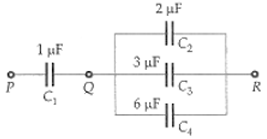
In Fig. the energy stored in $C _4$ is 27 J . Calculate the total energy stored in the system.
Image
$a$. Show that an ideal inductor does not dissipate power in an ac circuit.
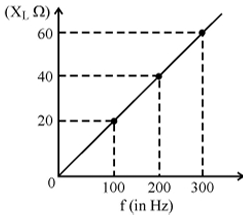
$b$. The variation of inductive reactance $\left( X _{ L }\right)$ of an inductor with the frequency $(f)$ of the ac source of $100 V$ and variable frequency is shown in the fig.
Image

$i$. Calculate the self-inductance of the inductor.
$ii.$ When this inductor is used in series with a capacitor of unknown value and a resistor of $10 \Omega$ at $300 s^{-1},$ maximum power dissipation occurs in the circuit. Calculate the capacitance of the capacitor.
A capacitor of capacitance $8.0\mu\text{F}$ is connected to a battery of emf 6.0V through a resistance of $24\Omega.$ Find the current in the circuit (a) just after the connections are made and (b) one time constant after the connections are made.