Question
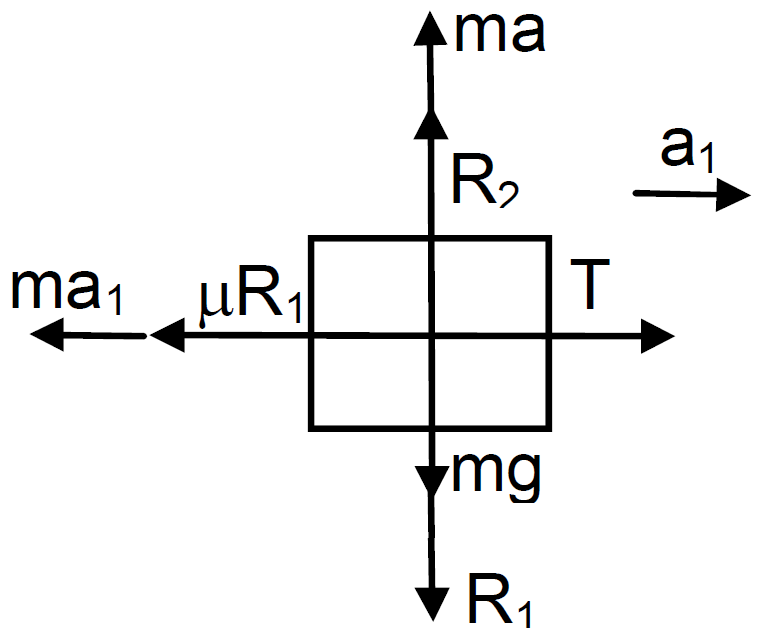
Suppose the entire system of the previous question is kept inside an elevator which is coming down with an acceleration $a < g.$ Repeat parts $(a)$ and $(b).$
Answer


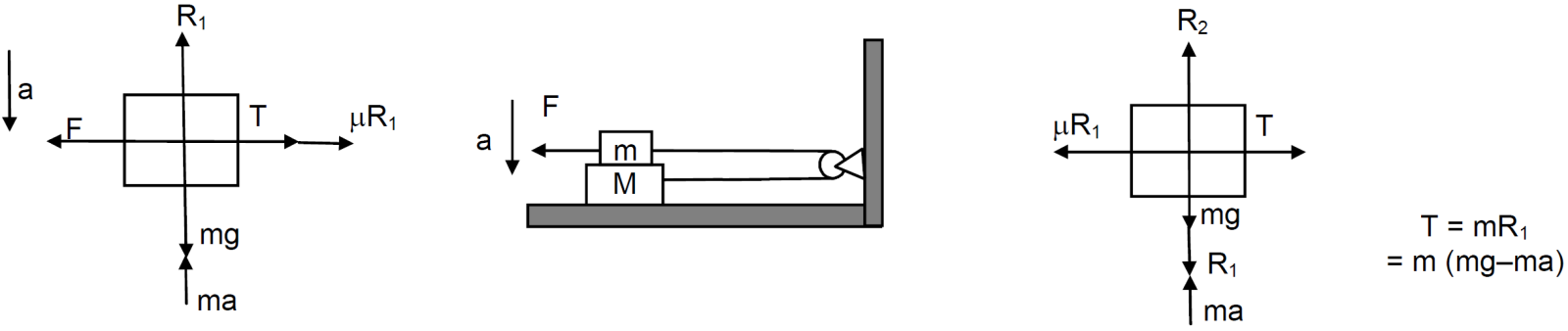
$\text{R}_1+\text{ma}-\text{mg}=0$
$\Rightarrow\text{R}_1=\text{m(g}-\text{a) = mg}-\text{ma} \ ...(\text{i})$
$\text{T}-\mu\text{R}_1=0\Rightarrow\text{T = m(mg}-\text{ma}) \ ...(\text{ii})$
Again, $\text{F}-\text{T}-\mu\text{R}_1=0$
$\Rightarrow\text{F}-\{\mu(\text{mg}-\text{ma})\}-\text{u}(\text{mg}-\text{ma})=0$
$\Rightarrow\text{F}-\mu\text{mg}+\mu\text{ma}-\mu\text{mg}+\mu\text{ma}=0$
$\Rightarrow\text{F}=2\mu\text{mg}-2\mu\text{ma}$
$\Rightarrow\text{F}=2\mu\text{m(g}-\text{a})$
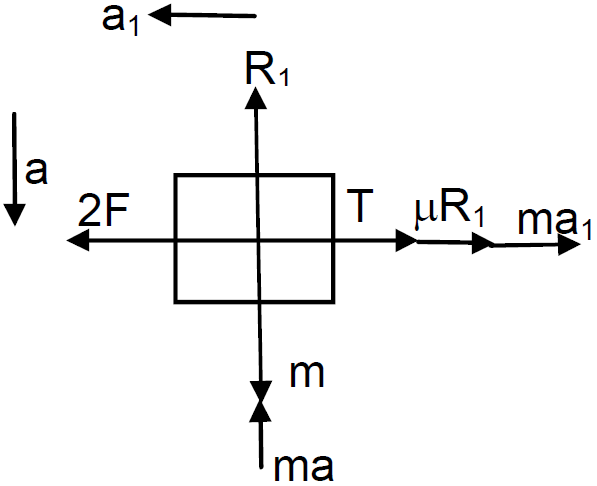
  1. Acceleration of the block be $a_1$

$\text{R}_1=\text{mg}-\text{ma} \ ...(\text{i})$
$2\text{F}-\text{T}-\mu\text{R}_1-\text{ma}_1=0$
$\Rightarrow2\text{F}-\text{t}-\mu\text{mg}+\mu\text{a}-\text{ma}_1=0 \ ...(\text{ii})$

$\text{T}-\mu\text{R}_1-\text{Ma}_1=0$
$\Rightarrow\text{T}=\mu\text{R}_1+\text{Ma}_1$
$\Rightarrow\text{T}=\mu(\text{mg}-\text{ma})+\text{Ma}_1$
$\Rightarrow\text{T}=\mu\text{mg}-\mu\text{ma + Ma}_1$
Subtracting values of $F\  T, $ we get
$2(2\mu\text{m(g}-\text{a}))-2(\mu\text{mg}-\mu\text{ma}+\text{Ma}_1)$
$-\mu\text{mg}+\mu\text{ma}-\mu\text{a}_1=0$
$\Rightarrow4\mu\text{mg}-4\mu\text{ma}-2\mu\text{mg}+2\mu\text{ma = ma}_1+\text{Ma}_1$
$\Rightarrow\text{a}_1=\frac{2\mu\text{m(g}-\text{a})}{\text{M + m}}$
Both blocks move with this acceleration but in opposite directions.

Need a full question paper?

Generate a complete, print-ready paper with questions like this in minutes — across 16+ boards, with answer keys.
Start Generating Free

Similar questions

Find the time period of the oscillation of mass $m$ in figure What is the equivalent spring constant of the pair of springs in each case?
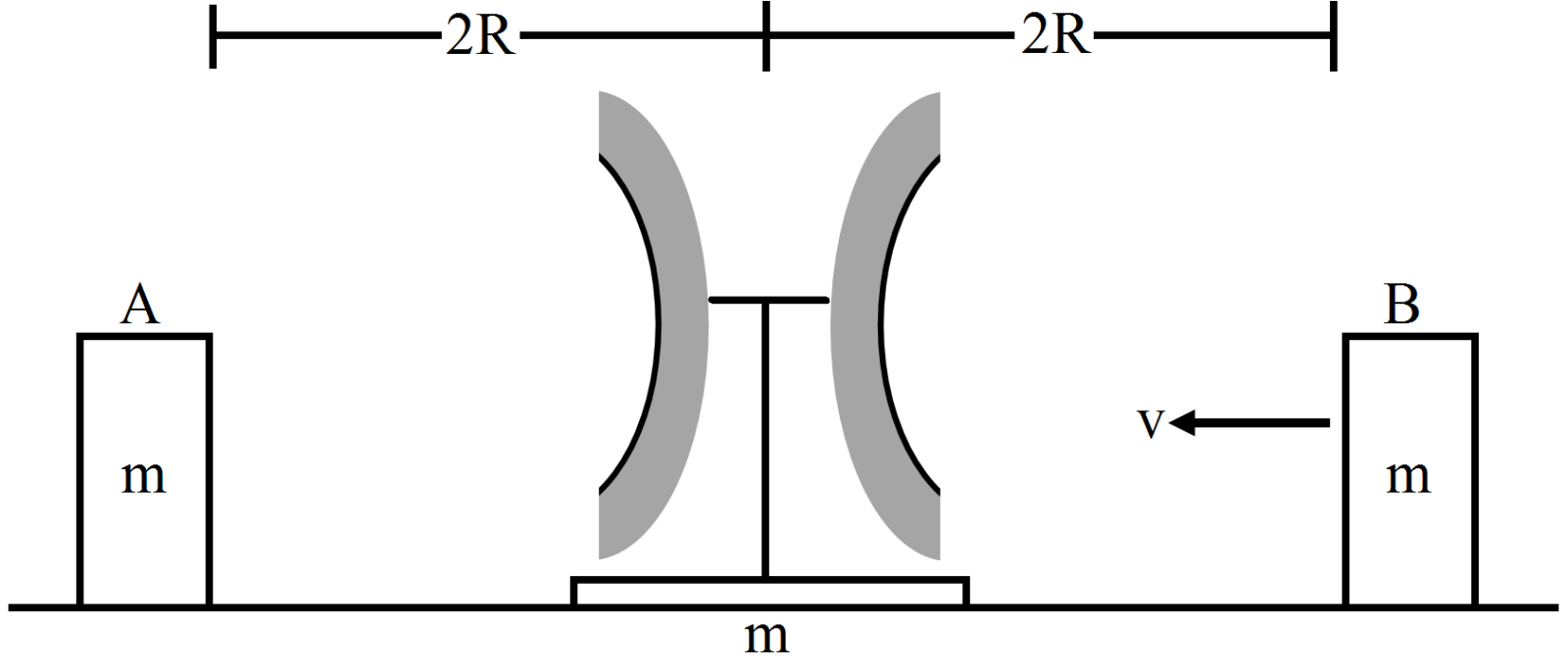
Two concave mirrors of equal radii of curvature R are fixed on a stand facing opposite directions. The whole system has a mass m and is kept on a frictionless horizontal table.

Two blocks A and B, each of mass m, are placed on the two sides of the stand. At t = 0, the separation between A and the mirrors is 2 R and also the separation between B and the mirrors is 2 R. The block B moves towards the mirror at a speed v. All collisions which take place are elastic. Taking the original position of the mirrors-stand system to be x = 0 and X-axis along AB, find the position of the images of A and B at t =
  1. $\frac{\text{R}}{\text{v}}$
  2. $\frac{3\text{R}}{\text{v}}$
  3. $\frac{5\text{R}}{\text{v}}$
When a circuit element ‘X’ is connected across an a.c. source, a current of $\sqrt{2}\text{A}$ flows through it and this current is in phase with the applied voltage. When another element ‘Y’ is connected across the same a.c. source, the same current flows in the circuit but it leads the voltage by $\frac{\pi}{2}$ radians.
  1. Name the circuit element X and Y.
  2. Find the current that flows in the circuit when the series combination of X and Y is connected across the same a.c. voltage.
  3. Net impedance.
A student is studying a book placed near the edge of a circular table of radius $R$. A point source of light is suspended directly above the centre of the table. What should be the height of the source above the table so as to produce maximum illuminance at the position of the book?
A small object is placed at the centre of the bottom of a cylindrical vessel of radius 3cm and height 4cm filled completely with water. Consider the ray leaving the vessel through a corner. Suppose this ray and the ray along the axis of the vessel are used to trace the image. Find the apparent depth of the image and the ratio of real depth to the apparent depth under the assumptions taken. Refractive index of water = 1.33
Consider a metallic pipe with an inner radius of 1cm. If a cylindrical bar magnet of radius 0.8cm is dropped through the pipe, it takes more time to come down than it takes for a similar unmagnetised cylindrical iron bar dropped through the metallic pipe. Explain.
Explain the laws of refraction of light waves on the basis of Huygen's theory of secondary wavelets.
Define resonance. Explain resonant frequency and write characteristics of resonant circuit.
Write first and second postulates of Bohr's Atomic Model. Obtain the expression for radius and velocity of stable orbit of electron.###Explain Bohr's two postulates for hydrogen atom.
Derive an expression for magnetic field intensity due to a magnetic dipole at a point lies on its equatorial line.