Question
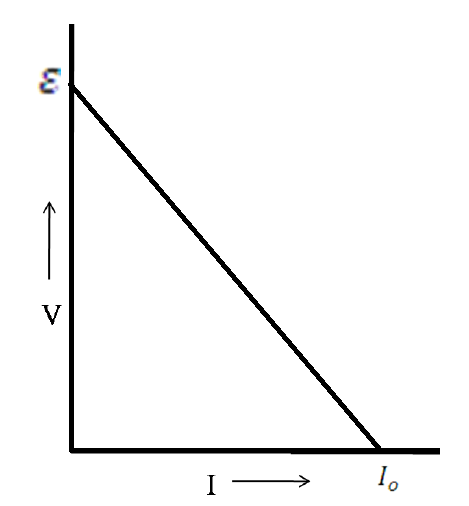
  1. Plot a graph showing variation of voltage vs the current drawn from the cell. How can one get information from this plot about the emf of the cell and its internal resistance?
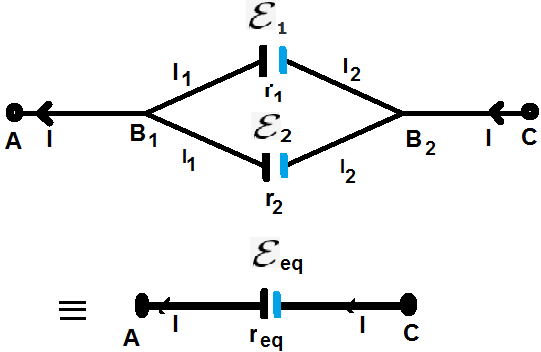
  2. Two cells of emf’s E1 and E2 and internal resistance r1 and r2 are connected in parallel. Obtain the expression for the emf and internal resistance of a single equivalent cell that can replace this combination?

Answer

  1.  

$V=\varepsilon-Ir$

When current is zero (I = 0), $\text{V}=\in$

And when V = 0, $\text{I}=\text{I}_0,\text{ }r=\frac{\in}{I_0}$

  1.  

$\text{V}=\text{V}(\text{B}_1)-\text{V}(\text{B}_2)=\varepsilon_1-I_1r_1$

$\text{V}=\text{V}(\text{B}_1)-\text{V}(\text{B}_2)=\varepsilon_2-I_2r_2$

$I=I_1+I_2$

$=​​​​​\frac{​\varepsilon_1-\text{V}}{r_1}+\frac{​\varepsilon_2-\text{V}}{r_2}=\Big(\frac{​\varepsilon_1}{r_1}+\frac{\varepsilon_2}{r_2}\Big)-\text{V}\Big(\frac{1}{r_1}+\frac{1}{r_2}\Big)$

$\text{V}=\frac{\varepsilon_1r_2+\varepsilon_2r_1}{r_1+r_2}-I\frac{r_1r_2}{r_1+r_2}$

On comparing with

$\text{V}=\varepsilon_{eq}-Ir_{eq}$

we get

$\varepsilon_{eq}=\frac{\varepsilon_1r_2+\varepsilon_2r_1}{r_1+r_2}$

$r_{eq}=\frac{r_1r_2}{r_1+r_2}$

Alternate Answer

A student may write the last two results in the following form.

$\frac{1}{r_{eq}}=\frac{1}{r_1}+\frac{1}{r_2}$

$\frac{\varepsilon_{eq}}{r_{eq}}=\frac{\varepsilon_1}{r_1}+\frac{\varepsilon_2}{r_2}$
Need a full question paper?

Generate a complete, print-ready paper with questions like this in minutes — across 16+ boards, with answer keys.

Start Generating Free

Similar questions

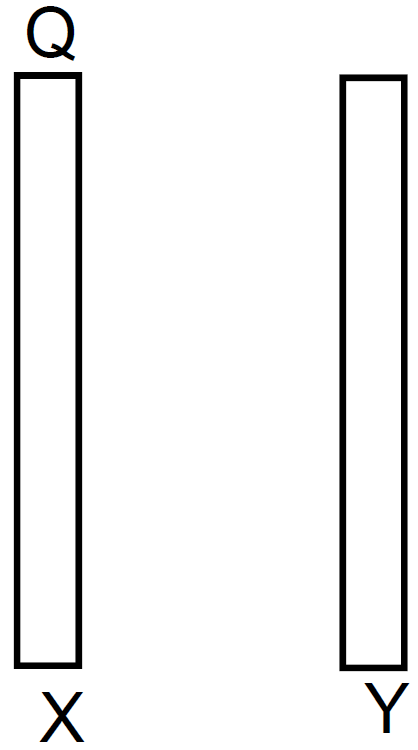
Two conducting plates X and Y, each having large surface area A (on one side), are placed parallel to each other as shown in figure. The plate X is given a charge Q whereas the other is neutral. Find:

  1. The surface charge density at the inner surface of the plate X.
  2. The electric field at a point to the left of the plates.
  3. The electric field at a point in between the plates.
  4. The electric field at a point to the right of the plates.
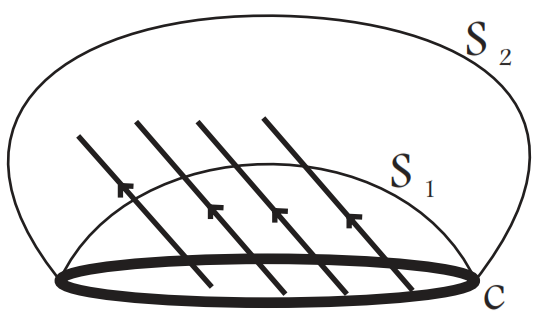
Consider a closed loop C in a magnetic field (Fig). The flux passing through the loop is defined by choosing a surface whose edge coincides with the loop and using the formula $\phi=\text{B}_1.\text{dA}_1+\text{B}_2.\text{dA}_2+ .....$. Now if we chose two different surfaces S1 and S2 having C as their edge, would we get the same answer for flux. Jusity your answer.

A plane electromagnetic wave travels in vacuum along z - direction. What can you say about the directions of its electric and magnetic field vectors? If the frequency of the wave is 30 MHz, what is its wavelength?
Draw a labelled circuit diagram of a common emitter amplifier using a p-n-p transistor. Define the term voltage gain and write an expression for it. Explain how the input and output voltages are out of phase by 180° for a common-emitter transistor amplifiers.
The heavier block in an Atwood machine has a mass twice that of the lighter one. The tension in the string is 16.0N when the system is set into motion. Find the decrease in the gravitational potential energy during the first second after the system is released from rest.
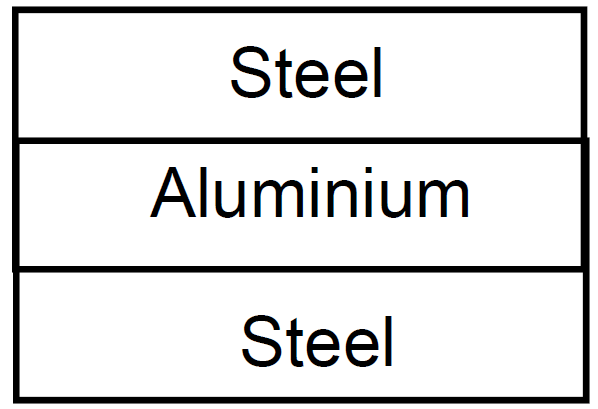
Two steel rods and an aluminium rod of equal length l0 and equal cross section are joined rigidly at their ends as shown in the figure below. All the rods are in a state of zero tension at 0°C. Find the length of the system when the temperature is raised to $\theta$. Coefficient of linear expanaion of aluminium and steel are $\alpha_\text{a}$ and $\alpha_\text{s}$respectively. Young's modulus of aluminium is Ya and of steel is Ys.

An aluminium plate fixed in a horizontal position has a hole of diameter 2.000cm. A steel sphere of diameter 2.005cm rests on this hole. All the lengths refer to a temperature of 10°C. The temperature of the entire system is slowly increased. At what temperature willl the ball fall down? Coefficient of linear expansion of aluminium is 23 × 10-6 °C-1 and that of steel is 11 × 10-6 °C-1.
An electron is projected horizontally with a kinetic energy of 10keV. A magnetic field of strength 1.0 × 10⁻⁷T exists in the vertically upward direction.
  1. Will the electron deflect towards the right or left of its motion?
  2. Calculate the sideways deflection of the electron while travelling through 1m. Make appropriate approximations.
An electric current flows in a wire from north to south. What will be the direction of the magnetic field due to this wire at a point east of the wire? West of the wire? Vertically above the wire? Vertically below the wire?
An empty plastic box of mass m is found to accelerate up at the rate of $\frac{\text{g}}{6}$ when placed deep inside water. How much sand should be put inside the box so that it may accelerate down at the rate of $\frac{\text{g}}{6}?$