Question
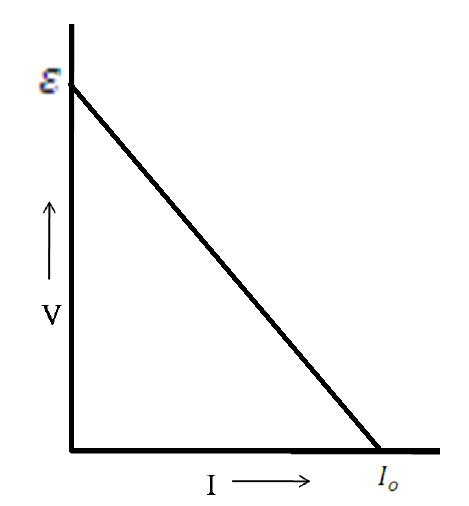
  1. Plot a graph showing variation of voltage vs the current drawn from the cell. How can one get information from this plot about the emf of the cell and its internal resistance?
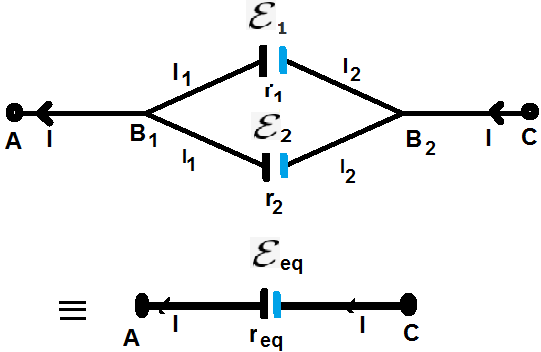
  2. Two cells of emf’s $E_1$ and $E_2$ and internal resistance $r_1$ and $r_2$ are connected in parallel. Obtain the expression for the emf and internal resistance of a single equivalent cell that can replace this combination?
Answer

  1.  

$V=\varepsilon-Ir$
When current is zero (I = 0), $\text{V}=\in$
And when V = 0, $\text{I}=\text{I}_0,\text{ }r=\frac{\in}{I_0}$
  1.  

$\text{V}=\text{V}(\text{B}_1)-\text{V}(\text{B}_2)=\varepsilon_1-I_1r_1$
$\text{V}=\text{V}(\text{B}_1)-\text{V}(\text{B}_2)=\varepsilon_2-I_2r_2$
$I=I_1+I_2$
$=​​​​​\frac{​\varepsilon_1-\text{V}}{r_1}+\frac{​\varepsilon_2-\text{V}}{r_2}=\Big(\frac{​\varepsilon_1}{r_1}+\frac{\varepsilon_2}{r_2}\Big)-\text{V}\Big(\frac{1}{r_1}+\frac{1}{r_2}\Big)$
$\text{V}=\frac{\varepsilon_1r_2+\varepsilon_2r_1}{r_1+r_2}-I\frac{r_1r_2}{r_1+r_2}$
On comparing with
$\text{V}=\varepsilon_{eq}-Ir_{eq}$
we get
$\varepsilon_{eq}=\frac{\varepsilon_1r_2+\varepsilon_2r_1}{r_1+r_2}$
$r_{eq}=\frac{r_1r_2}{r_1+r_2}$
Alternate Answer
A student may write the last two results in the following form.
$\frac{1}{r_{eq}}=\frac{1}{r_1}+\frac{1}{r_2}$
$\frac{\varepsilon_{eq}}{r_{eq}}=\frac{\varepsilon_1}{r_1}+\frac{\varepsilon_2}{r_2}$

Need a full question paper?

Generate a complete, print-ready paper with questions like this in minutes — across 16+ boards, with answer keys.

Start Generating Free

Similar questions

A wire of resistance $15.0\Omega$ is bent to form a regular hexagon ABCDEFA. Find the equivalent resistance of the loop between the points (a) A and B (b) A and C and (c) A and D.
The magnetic field existing in a region is given by $\overrightarrow{\text{B}}=\text{B}_0\Big(1+\frac{\text{x}}{\text{l}}\Big)\overrightarrow{\text{k}}.$ A square loop of edge land carrying a current i, is placed with its edges parallel to the x - y axes. Find the magnitude of the net magnetic force experienced by the loop.
Monochromatic light of wavelength 632.8 nm is produced by a helium-neon laser. The power emitted is 9.42 mW.
  1. Find the energy and momentum of each photon in the light beam,
  2. How many photons per second, on the average, arrive at a target irradiated by this beam? (Assume the beam to have uniform cross-section which is less than the target area), and
  3. How fast does a hydrogen atom have to travel in order to have the same momentum as that of the photon?
A 100kg block is started with a speed of $2.0ms^{-1}$ on a long, rough belt kept fixed in a horizontal position. The coefficient of kinetic friction between the block and the belt is $0.20$.
  1. Calculate the change in the internal energy of the block-belt system as the block comes to a stop on the belt.
  2. Consider the situation from a frame of reference moving at $2.0ms^{-1}$ along the initial velocity of the block. As seen from this frame, the block is gently put on a moving belt and in due time the block starts moving with the belt at $2.0ms^{-1}$ Calculate the increase in the kinetic energy of the block as it stops slipping past the belt.
  3. Find the work done in this frame by the external force holding the belt.
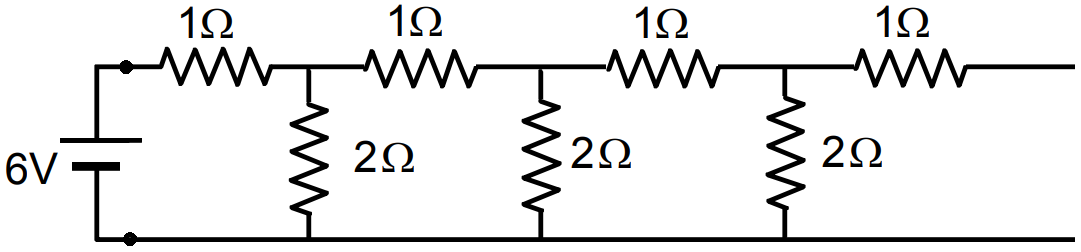
An infinite ladder is constructed with $1\Omega$ and $2\Omega$ resistors, as shown in the figure. (a) Find the effective resistance between the points A and B. (b) Find the current that passes through the $2\Omega$ resistor nearest to the battery.
A glass vessel measures exactly $10 \mathrm{~cm} \times 10 \mathrm{~cm} \times 10 \mathrm{~cm}$ at $0^{\circ} \mathrm{C}$. It is filled completely with mercury at this temperature. When the temperature is raised to $10^{\circ} \mathrm{C}, 1.6 \mathrm{~cm}^3$ of mercury overflows. Calculate the coefficient of volume expansion of mercury. Coefficient of linear expansion of glass $=6.5 \times 10^{-6}{ }^{\circ} \mathrm{C}$.
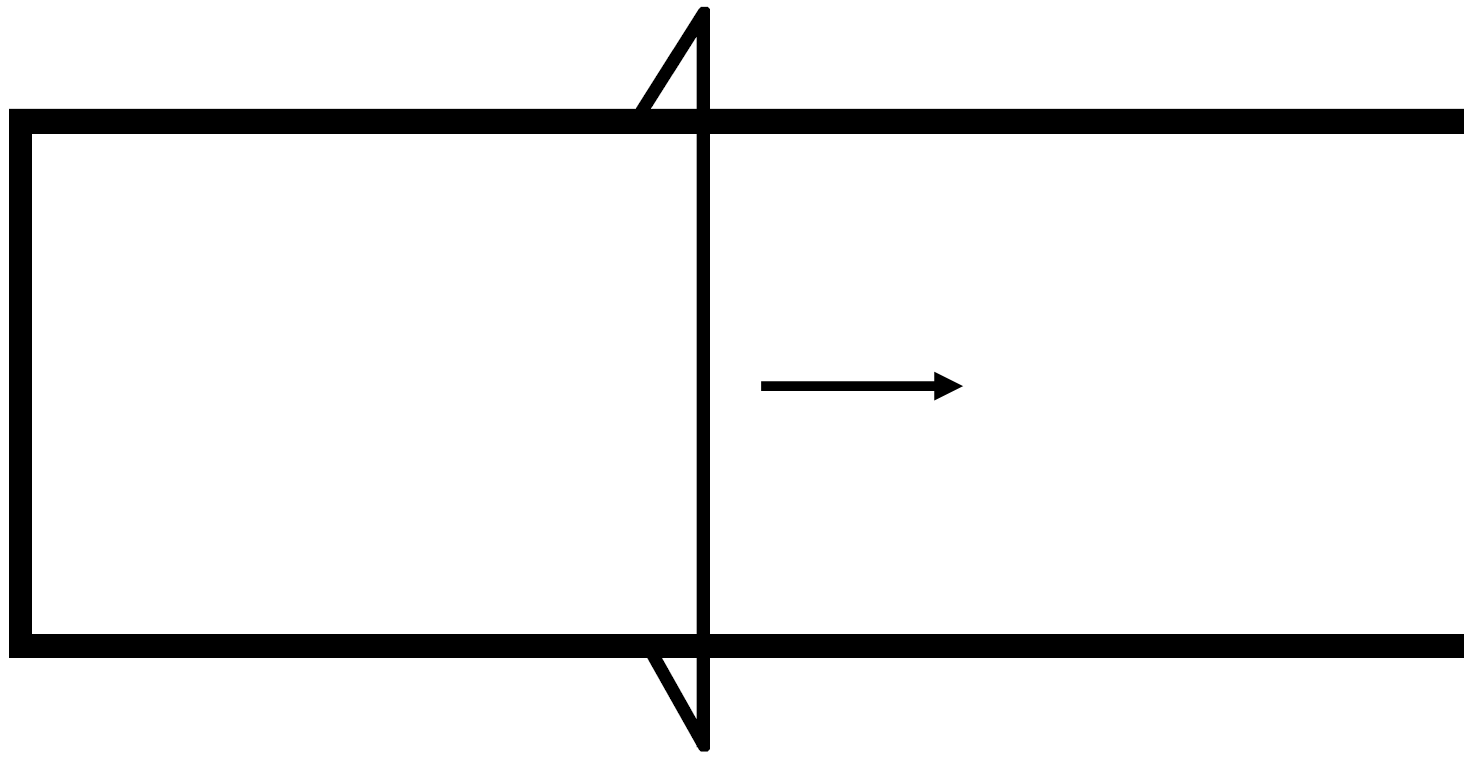
Figure shows a metallic wire of resistance $0.20\Omega$ sliding on a horizontal, U-shaped metallic rail. The separation between the parallel arms is 20cm. An electric current of $2.0\mu\text{A}$ passes through the wire when it is slid at a rate of $20cms^{-1}$. If the horizontal component of the earth's magnetic field is $3.0 \times 10^{-5} T$, calculate the dip at the place.
  1. Draw a ray diagram to show the image formation by a combination of two thin convex lenses in contact. Obtain the expression for the power of this combination in terms of the focal lengths of the lenses.
  2. A ray of light passing from air through an equilateral glass prism undergoes minimum deviation when the angle of incidence is $\frac{3}{4}^{th}$ of the angle of prism. Calculate the speed of light in the prism.
Ajit had a high tension tower erected on his farm land. He kept complaining to the authorities to remove it as it was occupying a large portion of his land. His uncle, who was a teacher, explained to him the need for erecting these towers for efficient transmission of power. As Ajit realised its significance, he stopped complaining.
Answer the following questions:
  1. Why is it necessary to transport power at high voltage?
  2. A low power factor implies large power loss. Explain.
  3. Write two values each displayed by Ajit and his uncle.
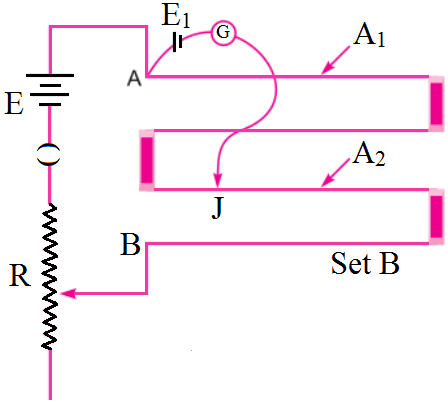
You are given two sets of potentiometer circuits to measure the emf $E_1 $ of a cell. Set A: consists of a potentiometer wire of a material of resistivity $\rho_1$, area of cross-section $A_1$ and length l. Set B: consists of a potentiometer of two composite wire of equal lengths $\frac{\text{l}}2{}$ each, of resistivity $\rho_1,\rho_2$ and area of cross-section $A _1,A_2$ respectively.

Find the relation between resistivity of the two wires with respect to their area of cross section, if the current flowing in the two sets is same. Compare the balancing length obtained in the two sets.