- Draw a ray diagram to show the image formation by a combination of two thin convex lenses in contact. Obtain the expression for the power of this combination in terms of the focal lengths of the lenses.
- A ray of light passing from air through an equilateral glass prism undergoes minimum deviation when the angle of incidence is $\frac{3}{4}^{th}$ of the angle of prism. Calculate the speed of light in the prism.
CBSE OUTSIDE DELHI - SET 1 2017
Download our app for free and get started
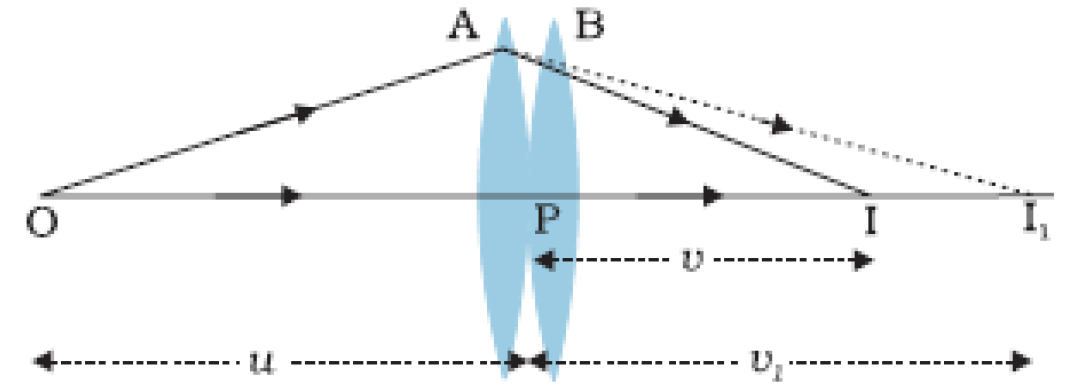
Two thin lenses, of focal length $f_1$ and $f_2$ are kept in contact. Let O be the position of object and let u be the object distance. The distance of the image (which is at $I_1$), for the first lens is $v_1$. This image serves as object for the second lens.
Let the final image be at I. We then have
$\frac{1}{f_1}=\frac{1}{v_1}-\frac{1}{u}$
$\frac{1}{f_2}=\frac{1}{v}-\frac{1}{v_1}$
Adding, we get
$\frac{1}{f_1}+\frac{1}{f_2}=\frac{1}{v}-\frac{1}{u}=\frac{1}{f}$
$\therefore\frac{1}{f}=\frac{1}{f_1}+\frac{1}{f_2}$
$\therefore P=P_1+P_2$
At minimum deviation
$r=\frac{A}{2}=30^\circ$
We are given that
$i=\frac{3}{4}A=45^\circ$
$\therefore\text{ }\mu=\frac{\sin 45^\circ}{\sin 30^\circ}=\sqrt{2}$
$\therefore$ Speed of light in the prism $=\frac{c}{\sqrt{2}}$
$(\cong2.1\times10^8 \text{ms}^{-1})$

Download our appand get started for free
Experience the future of education. Simply download our apps or reach out to us for more information. Let's shape the future of learning together!No signup needed.*
Similar Questions
- 1View SolutionA 5mm high pin is placed at a distance of 15cm from a convex lens of focal length 10cm. A second lens of focal length 5cm is placed 40cm from the first lens and 55cm from the pin. Find
- The position of the final image.
- Its nature.
- Its size.
- 2View SolutionAn angular magnification (magnifying power) of 30X is desired using an objective of focal length 1.25 cm and an eyepiece of focal length 5 cm. How will you set up the compound microscope?
- 3View SolutionA convex lens of focal length 20cm and a concave lens of focal length 10cm are placed 10cm apart with their principal axes coinciding. A beam of light travelling parallel to the principal axis and having a beam diameter 5.0mm, is incident on the combination. Show that the emergent beam is parallel to the incident one. Find the beam diameter of the emergent beam.
- 4View SolutionA myopic adult has a far point at 0.1m. His power of accomodation is 4 diopters.
- What power lenses are required to see distant objects?
- What is his near point without glasses?
- What is his near point with glasses? (Take the image distance from the lens of the eye to the retina to be 2cm.)
- 5View Solution
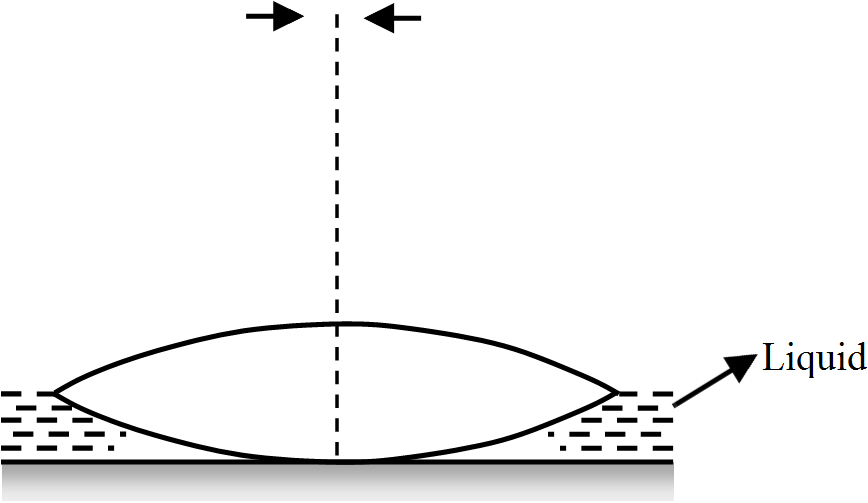
- An equiconvex lens with radii of curvature of magnitude r each, is put over a liquid layer poured on top of a plane mirror. A small needle, with its tip on the principal axis of the lens, is moved along the axis until its inverted real image coincides with the needle itself. The distance of the needle from the lens is measured to be 'a'. On removing the liquid layer and repeating the experiment the distance is found to be 'b'.
- If r = 10cm, a = 15cm, b = 10cm, find the refractive index of the liquid.
- 6View SolutionDefine magnifying power of a telescope. Write its expression.
A small telescope has an objective lens of focal length 150 cm and an eye piece of focal length 5 cm. If this telescope is used to view a 100m high tower 3 km away, find the height of the final image when it is formed 25 cm away from the eye piece. - 7View Solution
- Draw a labelled ray diagram to obtain the real image formed by an astronomical telescope in normal adjustment position. Defineits magnifying power.
- You are given three lenses of power 0.5 D, 4 D and 10 D to design a telescope.
- Which lenses should he used as objective and eyepiece? Justify your answer.
- Why is the aperture of the objective preferred to be large?
- 8Show that for a material with refractive index $\mu\geq\sqrt{2}$, light incident at any angle shall be guided along a length perpendicular to the incident face.View Solution
- 9A point object 'O' is kept in a medium of refractive index $n_1$ in front of a convex spherical surface of radius of curvature R which separates the second medium of refractive index $n_2$ from the first one, as shown in the figure.View Solution
- Draw the ray diagram showing the image formation and deduce the relationship between the object distance and the image distance in terms of $n_1, n_2$ and R.
- When the image formed above acts as a virtual object for concave spherical, surface separating the medium $n_2$ from $n_1 (n_2> n_1)$, draw this ray diagram and write the similar (similar to (a) relation. Hence obtain the expression for the lens maker's formula.
- 10View SolutionA small bulb is placed at the bottom of a tank containing water to a depth of 80cm. What is the area of the surface of water through which light from the bulb can emerge out? Refractive index of water is 1.33. (Consider the bulb to be a point source).