Question
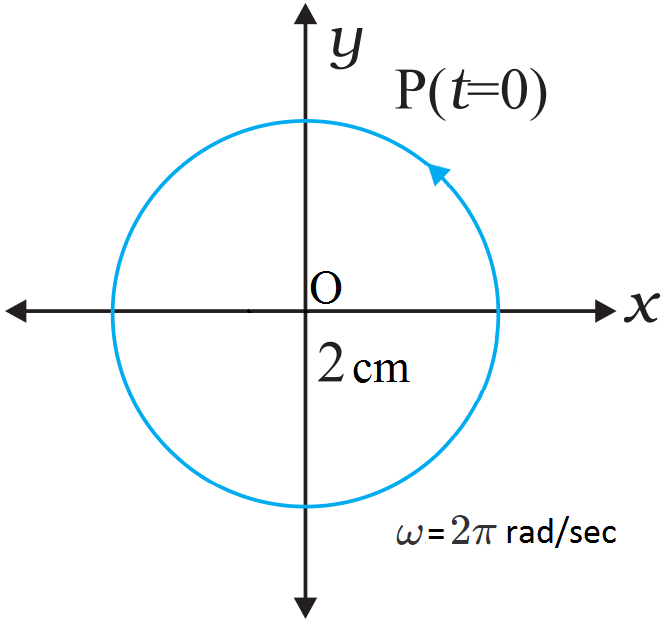
Plot the corresponding reference circle for each of the following simple harmonic motions. Indicate the initial (t = 0) position of the particle, the radius of the circle, and the angular speed of the rotating particle. For simplicity, the sense of rotation may be fixed to be anticlockwise in every case: (x is in cm and t is in s).
$\text{x}=2\cos\pi\text{t}$

Answer

$\text{x}=2\cos\pi\text{t}$If this equation is compared with the standard SHM equation $\text{x}=\text{A}\cos\bigg(\Big(\frac{2\pi}{\text{T}}\Big)\text{t}+\phi\bigg),$ then we get:
Amplitude, A = 2cm Phase angle, $\phi=0$ Angular velocity, $\omega=\pi\text{ rad/s}$The motion of the particle can be plotted as shown in the following figure.

Need a full question paper?

Generate a complete, print-ready paper with questions like this in minutes — across 16+ boards, with answer keys.

Start Generating Free

Similar questions

Find a relation for kinetic energy of a rolling body.
A jet airplane travelling at the speed of $500 km\ h^{–1}$ ejects its products of combustion at the speed of $1500km\ h^{–1}$ relative to the jet plane. What is the speed of the latter with respect to an observer on the ground?
Can we have magnetic hysteresis in paramagnetic or diamagnetic substances?
Let $A_1A_2A_3 A_4 A_5 A_6 A_1$ be a regular hexagon. Write the x-components of the vectors represented by the six sides taken in order. Use the fact that the resultant of these six vectors is zero, to prove that$\cos0+\cos\frac{\pi}{3}+\cos\frac{2\pi}{3}+\cos\frac{3\pi}{3}+\cos\frac{4\pi}{3}+\cos\frac{5\pi}{3}=0.$
Use the known cosine values to verify the result.
Suppose Swarglok (heaven) is in constant motion at a speed of 0.9999c with respect to the earth. According to the earth's frame, how much time passes on the earth before one day passes on Swarglok?
By suddenly compressing a gas at a temperature of 300 K, its pressure is made 8 times the initial pressure. Calculate the temperature increase due to compression $(\gamma=1.5)$.
How should one kg of water at 5°C be so divided that one part of it when converted into ice at 0°C, would by this change of state provide a quantity of heat that would be sufficient to vaporize the other part?
Two vessels have the same base area but different shapes. The first vessel takes twice the volume of water that the second vessel requires to fill upto a particular common height. Is the force exerted by the water on the base of the vessel the same in the two cases ? If so, why do the vessels filled with water to that same height give different readings on a weighing scale?
Estimate the number of electrons in 100g of water. How much is the total negative charge on these electrons?
Show that the child’s new kinetic energy of rotation is more than the initial kinetic energy of rotation. How do you account for this increase in kinetic energy?