Question
Can we have magnetic hysteresis in paramagnetic or diamagnetic substances?

Answer

No, magnetic hysteresis is the lagging of intensity of magnetization (I) behind magnetising force (H). When diamagnetic and paramagnetic materials are placed in a magnetic field they get weekly magnetised. Also, they lose their magnetization as the magnetic field is removed (low retentively). Therefore, they do not form magnetic hysteresis curve.

Need a full question paper?

Generate a complete, print-ready paper with questions like this in minutes — across 16+ boards, with answer keys.
Start Generating Free

Similar questions

Prove that the average kientic energy of molecule is equal to $\frac{3}{2} kT$
A 20 cm thick layer of ice has been formed on the surface of a freshwater lake during extreme winter. The temperature of the air is $-10^{\circ} C$. Find how long will it take for another 1 mm layer of water to freeze? Thermal conductivity of ice $=2.1 W m ^{-1} K^{-1}$, latent heat of fusion of water $=3.36 \times 10^5 J kg ^{-1}$ and density of ice $=10^3$ $kg m ^{-3}$.
To determine acceleration due to gravity, the time of 20 oscillations of a simple pendulum of length 100cm was observed to be 40s. Calculate the value of g and maximum percentage error in the measured value of g.
A hot gas emits radiation of wavelengths 46.0nm, 82.8nm and 103.5nm only. Assume that the atoms have only two excited states and the difference between consecutive energy levels decreases as energy is increased. Taking the energy of the highest energy state to be zero, find the energies of the ground state and the first excited state.
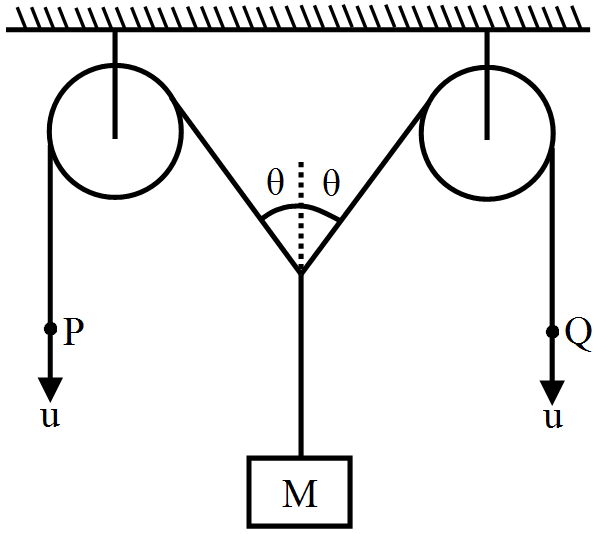
In the given arrangement, if the points P and Q move down with a velocity u, find the velocity of M?
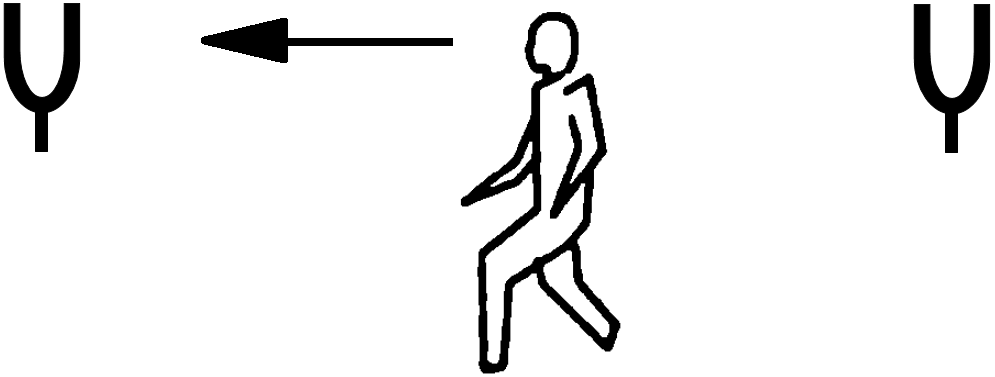
Two identical tuning forks vibrating at the same frequency 256Hz are kept fixed at some distance apart. A listener runs between the forks at a speed of 3.0m/s so that he approaches one tuning fork and recedes from the other figure. Find the beat frequency observed by the listener. Speed of sound in air = 332ms/s.
A bus starts with a constant acceleration $1\ ms^{-2}$. At the same time a car moving with a constant velocity of $5\ ms^{-1}$ overtakes the bus.
  1. How far from the starting point, the bus overtakes the car.
  2. How fast the bus was moving at the time of overtake?
A uniform wire of resistance $100\Omega$ is melted and recast as a wire of length is double that of the original. What would be the resistance of the wire?
Can you associate vectors with $(a)$ the length of a wire bent into a loop, $(b)$ a plane area, $(c)$ a sphere? Explain
Equal torqueses are applied on a cylinder and a sphere. Both have same mass and radius. The cylinder rotates about its axis and the sphere rotates about one of its diameters. Which will acquire greater speed? Explain why.