Question
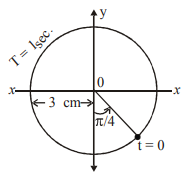
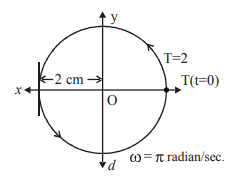
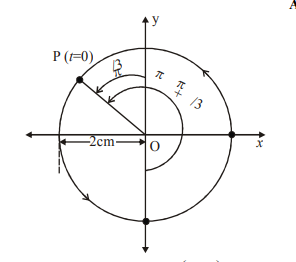
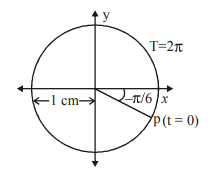
Plot the corresponding reference circle for each of the following simple harmonic motions. Indicate the initial $(t=0)$ position of the particle, the readius of the circle, and the angular speed of the rotating particle. For simplicity, the sense of rotation may be fixed to be anticlockwise in every case ( $x$ is in cm and $t$ is in s).
(a) $x=-2 \sin (3 t+\pi / 3)$
(b) $x=\cos (\pi / 6-t)$
(c) $x=3 \sin (2 \pi t+\pi / 4)$
(d) $x=2 \cos \pi t$
Need a full question paper?

Generate a complete, print-ready paper with questions like this in minutes — across 16+ boards, with answer keys.

Start Generating Free

Similar questions

Find the expression for the position of the center of mass of the system of two particles.
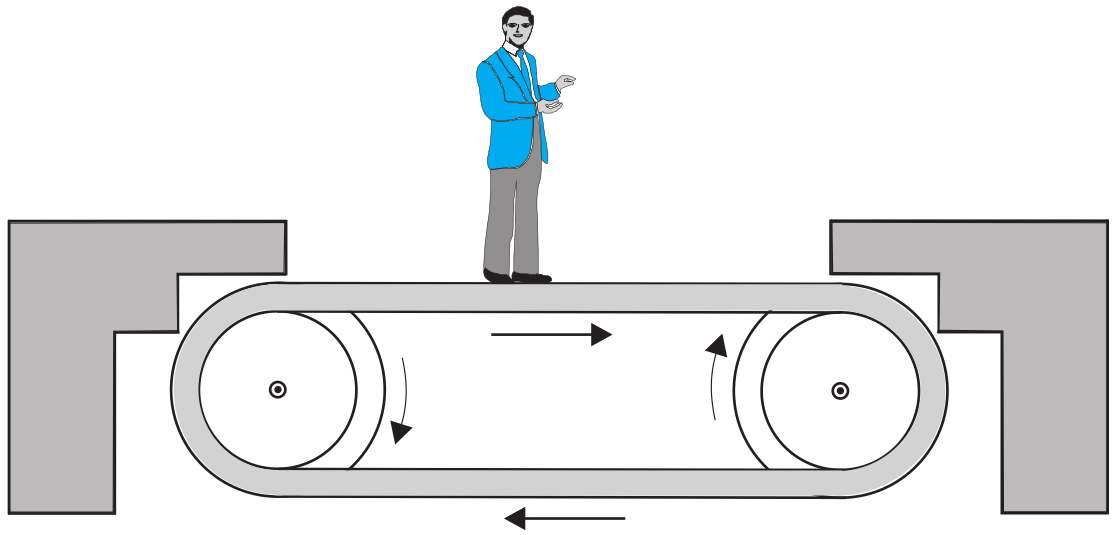
Figure. shows a man standing stationary with respect to a horizontal conveyor belt that is accelerating with 1ms-2. What is the net force on the man? If the coefficient of static friction between the man’s shoes and the belt is 0.2, up to what acceleration of the belt can the man continue to be stationary relative to the belt? (Mass of the man = 65kg.)

A circular loop carrying a current i is made of a wire of length L. A uniform magnetic field B exists parallel to the plane of the loop.
  1. Find the torque on the loop.
  2. If the same length of the wire is used to form a square loop, what would be the torque? Which is larger?
A drunkard walking in a narrow lane takes 5 steps forward and 3 steps backward, followed again by 5 steps forward and 3 steps backward, and so on. Each step is 1m long and requires 1s. Plot the x-t graph of his motion. Determine graphically and otherwise how long the drunkard takes to fall in a pit 13m away from the start.
A block of mass 25kg is raised by a 50kg man in two different ways as shown in Fig. What is the action on the floor by the man in the two cases? If the floor yields to a normal force of 700N, which mode should the man adopt to lift the block without the floor yielding?

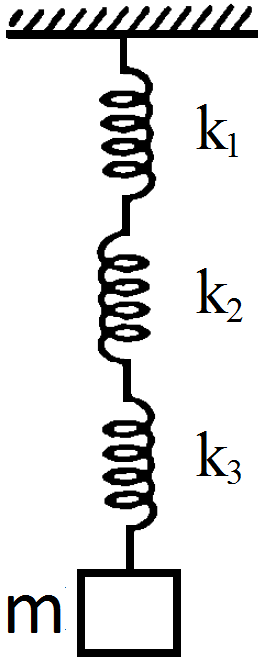
Find the elastic potential energy stored in each spring shown in figure when the block is in equilibrium. Also find the time period of vertical oscillation of the block.

An electron of mass 9 × 10-31kg revolves in a circle of radius $0.53\mathring{\text{A}}$ around the nucleus of hydrogen with a velocity of 2.2 × 10⁶ms. Show that angular momentum of elect ron is $\frac{\text{h}}{2\pi}$ where h is Planck's constant.
The block of mass m1 shown in figure is fastened to the spring and the block of mass m2 is placed against it.

  1. Find the compression of the spring in the equilibrium position.
  2. The blocks are pushed a further distance $\big(\frac{2}{\text{k}}\big)(\text{m}_1+\text{m}_2)\text{g}\sin\theta$ sine against the spring and released. Find the position where the two blocks separate.
  3. What is the common speed of blocks at the time of separation?

A square plate of edge d and a circular disc of diameter d are placed touching each other at the midpoint of an edge of the plate as shown in figure. Locate the centre of mass of the combination, assuming same mass per unit area for the two plates.

A closed circular wire hung on a nail in a wall undergoes small oscillations of amplitude 20 and time period 2s. Find,
  1. The radius of the circular wire,
  2. The speed of the particle farthest away from the point of suspension as it goes through its mean position,
  3. The acceleration of this particle as it goes through its mean position and
  4. The acceleration of this particle when it is at an extreme position. Take $\text{g}=\pi^2\text{m/s}^2.$