Question
Plot the corresponding reference circle for each of the following simple harmonic motions. Indicate the initial (t = 0) position of the particle, the radius of the circle, and the angular speed of the rotating particle. For simplicity, the sense of rotation may be fixed to be anticlockwise in every case: (x is in cm and t is in s).

$\text{x}=3\sin\Big(2\pi\text{t}+\frac{\pi}{4}\Big)$
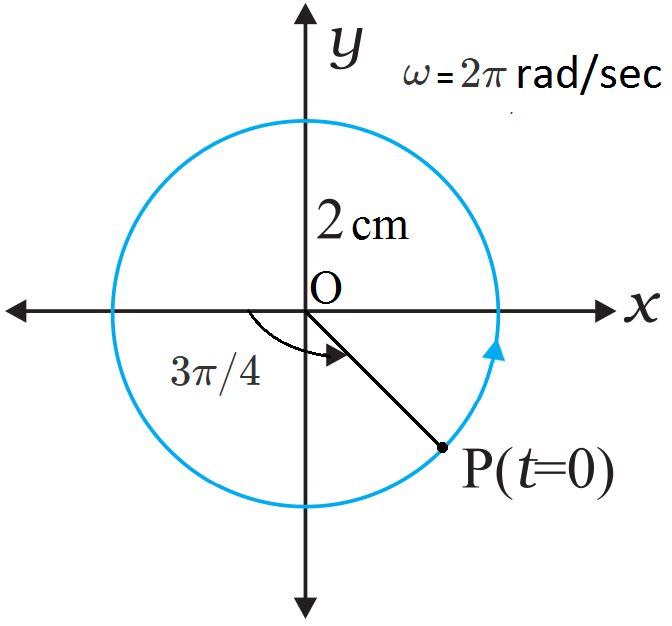
Answer

$\text{x}=3\sin\Big(2\pi\text{t}+\frac{\pi}{4}\Big)$
$=-3\cos\bigg[\Big(2\pi\text{t}+\frac{\pi}{4}\Big)+\frac{\pi}{2}\bigg]=-3\cos\Big(2\pi\text{t}+\frac{3\pi}{4}\Big)$

If this equation is compared with the standard SHM equation $\text{x}=\text{A}\cos\bigg(\Big(\frac{2\pi}{\text{T}}\Big)\text{t}+\phi\bigg),$ then we get:

Amplitude, A = 3cm

Phase angle, $\phi=\frac{3\pi}{4}=135^\circ$

Angular velocity, $\omega=\frac{2\pi}{\text{T}}=2\pi\text{ rad/s}$

The motion of the particle can be plotted as shown in the following figure.

Need a full question paper?

Generate a complete, print-ready paper with questions like this in minutes — across 16+ boards, with answer keys.

Start Generating Free

Similar questions

A dumb-bell consists of two identical small balls of mass $\frac{1}{2}\text{kg}$ each connected to the two ends of a 50cm long light rod. The dumb-bell is rotating about a fixed axis through the centre of the rod and perpendicular to it at an angular speed of 10rad/s. An impulsive force of average magnitude 5.0N acts on one of the masses in the direction of its velocity for 0.10s. Find the new angular velocity of the system.
Molar volume is the volume occupied by 1mol of any (ideal) gas at standard temperature and pressure:
(STP: 1 atmospheric pressure, 0°C). Show that it is 22.4 litres.
A liquid is in streamlined flow through a tube of non uniform cross-section. Prove that sum of its kinetic energy, pressure energy and potential energy per unit volume remain constant.
The moon takes about 27.3 days to revolve round the earth in a nearly circular orbit of radius 3.84 x 10⁵km. Calculate the mass of the earth from these data.
Theory of relativity reveals that mass can be converted into energy. The energy E so obtained is proportional to certain powers of mass m and the speed c of light. Guess a relation among the quantities using the method of dimensions.
A ball of mass m, moving with a speed 2v0, collides inelastically (e > 0) with an identical ball at rest. Show that:
For head-on collision, both the balls move forward.
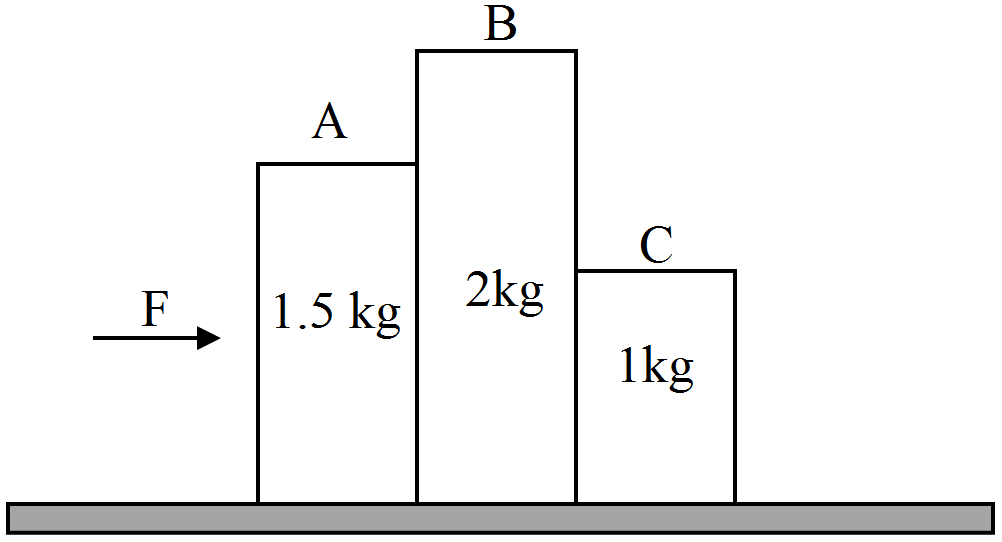
In the system of three blocks A, B and C shown in figure, (i) how large a force F is needed to give the blocks an acceleration of 3m/s2, if the coefficient of friction between blocks and table is 0.27 (ii) how large a force does the block A exert on the block B?

In an experiment, refractive index of glass was observed to be 1.45, 1.56, 1.54, 1.44, 1.54 and 1.53.

Calculate:

  1. Mean value of refractive index.
  2. Mean absolute error.
  3. Fractional error.
  4. Percentage error.
Express the result in terms of absolute error and percentage error.

Calculate the change in energy of a 500kg satellite when it falls from an altitude of 200km to 199km. If this change takes place during one orbit, calculate the retarding force on the satellite. [Given : mass of earth = 6 × 1024kg and radius of earth = 6400km]
A police van moving on a highway with a speed of 30km h–1 fires a bullet at a thief’s car speeding away in the same direction with a speed of 192km h–1. If the muzzle speed of the bullet is 150m s–1, with what speed does the bullet hit the thief’s car?
(Note: Obtain that speed which is relevant for damaging the thief’s car).