Question
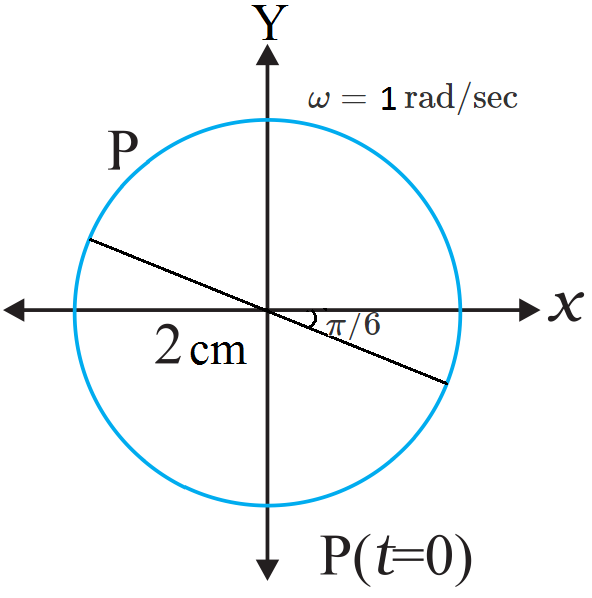
Plot the corresponding reference circle for each of the following simple harmonic motions. Indicate the initial (t = 0) position of the particle, the radius of the circle, and the angular speed of the rotating particle. For simplicity, the sense of rotation may be fixed to be anticlockwise in every case: (x is in cm and t is in s).

$\text{x}=\cos\Big(\frac{\pi}{6}-\text{t}\Big)$
Answer

$\text{x}=\cos\Big(\frac{\pi}{6}-\text{t}\Big)=\cos\Big(\text{t}-\frac{\pi}{6}\Big)$

If this equation is compared with the standard SHM equation $\text{x}=\text{A}\cos\bigg(\Big(\frac{2\pi}{\text{T}}\Big)\text{t}+\phi\bigg),$ then we get:

Amplitude, A = 1

Phase angle, $\phi=-\frac{\pi}{6}=-30^\circ$

Angular velocity, $\omega=\frac{2\pi}{\text{T}}=1\text{rad/s}$

The motion of the particle can be plotted as shown in the following figure.

Need a full question paper?

Generate a complete, print-ready paper with questions like this in minutes — across 16+ boards, with answer keys.

Start Generating Free

Similar questions

A trolley of mass 20kg rests on a horizontal surface. A massless string tied to the trolley passes over a frictionless pulley and a load of 5kg is suspended from other end of string. If coefficient of kinetic friction between trolley and surface be 0.1, find the acceleration of trolley and tension in the string. (Take g = 10ms-2).
Calculate the efficiency of Carnot's engine working between steam point and ice point.
Find (i) the radius of gyration and (ii) the moment of inertia of a rod of mass 100g and length 100cm about an axis passing through its centre and perpendicular to its length.
A uniform circular disc of radius R is rolling on a horizontal surface. Determine the tangential velocity at:
  1. Upper most point.
  2. At centre of mass.
  3. At point of contact.
A wheel rotating with uniform angular acceleration covers 50 revolutions in the first five seconds after the start. Find the angular acceleration and the angular velocity at the end of five seconds.
Two stars each of one solar mass (= 2 × 1030kg) are approaching each other for a head on collision. When they are a distance 109km, their speeds are negligible. What is the speed with which they collide? The radius of each star is 104km. Assume the stars to remain undistorted until they collide. (Use the known value of G).
A 10 kW drilling machine is used to drill a bore in a small aluminium block of mass 8.0 kg. How much is the rise in temperature of the block in 2.5 minutes, assuming $50 \%$ of power is used up in heating the machine itself or lost to the surroundings. Specific heat of aluminium $=0.91 Jg ^{-1}$ $K ^{-1}$.
State with reasons, whether the following algebraic operations with scalar and vector physical quantities are meaningful :
(a) adding any two scalars, (b) adding a scalar to a vector of the same dimensions, (c) multiplying any vector by any scalar, (d) multiplying any two scalars, (e) adding any two vectors, (f) adding a component of a vector to the same vector.
The density of an ideal gas is 1.25 × 10⁻³gcmat STP. Calculate the molecular weight of the gas.
A concrete slab has a length of 10m on a winter night when the temperature is 0°C. Find the length of the slab on a summer day when the temperature is 35­°C. The coefficient of linear expansion of concrete is 1.0 × 10⁻⁵­°C-1.