Question
Plot the corresponding reference circle for each of the following simple harmonic motions. Indicate the initial (t = 0) position of the particle, the radius of the circle, and the angular speed of the rotating particle. For simplicity, the sense of rotation may be fixed to be anticlockwise in every case: (x is in cm and t is in s).

$\text{x}=3\sin\Big(2\pi\text{t}+\frac{\pi}{4}\Big)$
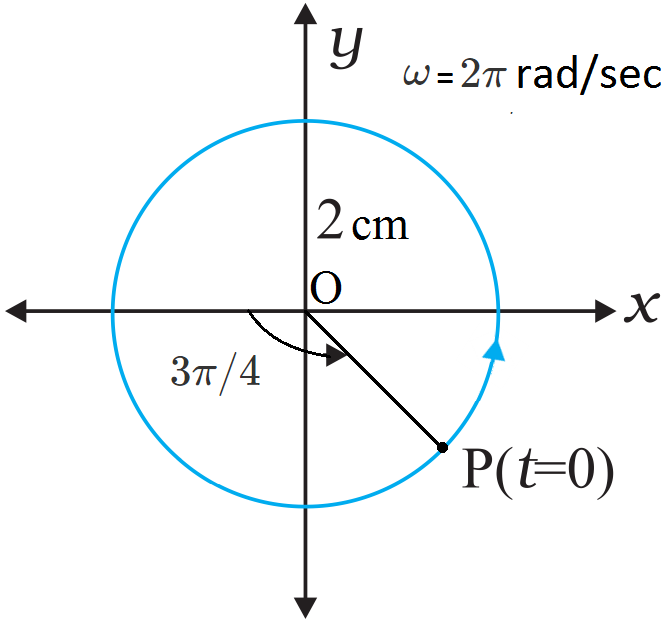
Answer

$\text{x}=3\sin\Big(2\pi\text{t}+\frac{\pi}{4}\Big)$
$=-3\cos\bigg[\Big(2\pi\text{t}+\frac{\pi}{4}\Big)+\frac{\pi}{2}\bigg]=-3\cos\Big(2\pi\text{t}+\frac{3\pi}{4}\Big)$

If this equation is compared with the standard SHM equation $\text{x}=\text{A}\cos\bigg(\Big(\frac{2\pi}{\text{T}}\Big)\text{t}+\phi\bigg),$ then we get:

Amplitude, A = 3cm

Phase angle, $\phi=\frac{3\pi}{4}=135^\circ$

Angular velocity, $\omega=\frac{2\pi}{\text{T}}=2\pi\text{ rad/s}$

The motion of the particle can be plotted as shown in the following figure.

Need a full question paper?

Generate a complete, print-ready paper with questions like this in minutes — across 16+ boards, with answer keys.

Start Generating Free

Similar questions

The density of an ideal gas is 1.25 × 10⁻³gcmat STP. Calculate the molecular weight of the gas.
A man of mass 70kg stands on a weighing scale in a lift which is:
  1. Moving upwards with a uniform speed of 10m/ s.
  2. Moving down with a uniform acceleration of 5m/ s2.
  3. Freely falling under gravity.
What would be reading on the scale in each case?
If stretch in a spring of force constant k is doubled, calculate:
  1. Ratio of final to initial force in the spring.
  2. Ratio of elastic energies stored in the two cases.
  3. Work done in changing to the state of double stretch.
Suppose white light falls on a double slit but one slit is covered by a violet filter (allowing $\lambda=400\text{nm}$). Describe the nature of the fringe pattern observed.
A block of mass 5.0kg is suspended from the end of a vertical spring which is stretched by 10cm under the load of the block. The block is given a sharp impulse from below so that it acquires an upward speed of 2.0m/s. How high will it rise? Take g = 10m/s2.
Two rods of the same area of cross-section, but of lengths l1 and l2 and conductivities K1 and K2 are joined in series. Show that the combination is equivalent of a material of conductivity,
$\text{K}=\frac{\text{l}_1+\text{l}_2}{\Big(\frac{\text{l}_1}{\text{K}_1}\Big)\Big(\frac{\text{l}_2}{\text{K}_2}\Big)}$
A block of mass 2kg is pulled up on a smooth incline of angle 30° with horizontal. If the block moves with an acceleration of 1m/ s2, find the power delivered by the pulling force at a time 4 seconds after motion starts. What is the/ frac delivered during these four seconds after the motion starts?
A cart of mass M is at rest on a frictionless horizontal surface and a pendulum bob of mass m hangs from the roof of the cart. The string breaks, the bob falls on the floor, makes several collisions on the floor and finally lands up in a small slot made in the floor. The horizontal distance between the string and the slot is L. Find the displacement of the cart during this process.

A simple pendulum in a stationary lift has time period T. What would be the effect on the time period when the left
  1. Moves up with uniform velocity v.
  2. Moves down with uniform velocity v.
  3. Moves up with uniform acceleration a.
  4. Moves down with uniform acceleration a.
  5. Beings to fall freely under gravity?
One mole of an ideal gas at standard temperature and pressure occupies 22.4 L (molar volume). What is the ratio of molar volume to the atomic volume of a mole of hydrogen? (Take the size of hydrogen molecule to be about $1\mathring{\text{A}}$). Why is this ratio so large?