MCQ
Ploughing help to retain water by soil ...........
  • A
    By creating capillaries
  • By breaking capillaries
  • C
    By turning the soil upside down
  • D
    None of these

Answer

Correct option: B.
By breaking capillaries
b
(b)

By breaking capillaries as they do not allow water to seep inside.

Need a full question paper?

Generate a complete, print-ready paper with questions like this in minutes — across 16+ boards, with answer keys.
Start Generating Free

Similar questions

The net applied force on a body in uniform circular motion should always be
Roads are banked on curves so that
The potential energy of a particle with displacement $X$ is $U(X)$. The motion is simple harmonic, when ($K$ is a positive constant)
If the kinetic energy of a body becomes four times of its initial value, then new momentum will
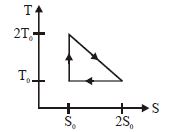
The temperature-entropy diagram of a reversible engine cycle is given in the figure. Its efficiency is
Which scientific principle is 'electric generator' based on:
A car is moving along a straight road with a uniform acceleration. It passes through two points $P$ and $Q$ separated by a distance with velocity $30\; km / h$ and $40\; km / h$ respectively. The velocity of the car midway between $P$ and $Q$
Water of volume $2$ litre in a container is heated with a coil of $1\ kW$ at $27^\circ C.$ The lid of the container is open and energy dissipates at the rate of $160 Js$ In how much time temperature will rise from $27^\circ C$ to $77^\circ C? [$Given specific heat of water $= \text{4.2kJ/kg]}$
A cylindrical rod with one end in a steam chamber and the other end in ice results in melting of $0.1$ gm of ice per second. If the rod is replaced by another with half the length and double the radius of the first and if the thermal conductivity of material of second rod is $\frac{1}{4}$ that of first, the rate at which ice melts in $gm/\sec $will be
The two ends of a rod of length $L$ and a uniform cross-sectional area $A$ are kept at two temperatures $T_1$ and $T_2 (T_1 > T_2)$. The rate of heat transfer,$\frac{ dQ }{dt}$, through the rod in a steady state is given by