MCQ
Ploughing help to retain water by soil ...........
  • A
    By creating capillaries
  • By breaking capillaries
  • C
    By turning the soil upside down
  • D
    None of these

Answer

Correct option: B.
By breaking capillaries
b
(b)

By breaking capillaries as they do not allow water to seep inside.

Need a full question paper?

Generate a complete, print-ready paper with questions like this in minutes — across 16+ boards, with answer keys.
Start Generating Free

Similar questions

A person pushes a box on a rough horizontal platform surface. He applies a force of $200\, N$ over a distance of $15\, m .$ Thereafter, he gets progressively tired and his applied force reduces linearly with distance of $100\, N$. The total distance through which the box has been moved is $30\, m$. What is the work done by the person during the total movement of the box$........J$$?$
Gas obey $P^2V =$ constant. The initial temperature and volume are $T_0$ and $V_0$. If gas expands to volume $2V_0$, the final temp is
Three capacitors, each of $3\,\mu F$, are provided. These cannot be combined to provide the resultant capacitance of.........$\mu F$
The percentage error in measurement of a physical quantity $m$ given by $m = \pi \tan \theta $ is minimum when $\theta $ $=$ .......... $^o$ (Assume that error in $\theta $ remain constant)
Rising and setting sun appears to be reddish because :
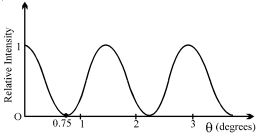
Light of wavelength $520\, nm$ passing through a double slit, produces interference pattern of relative intensity versus deflection angle $\theta$ as shown in the figure. The separation $d$ between the slits is
The refractive index of water in a biology laboratory tank varies as $1.33+0.002 / \lambda^2$, where $\lambda$ is the wavelength of light. Small pieces of organic matter of different colours are seen at the bottom of the tank using a travelling microscope. Then, the image of the organic matter appears
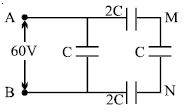
In the circuit shown, a potential difference of $60\,V$ is applied across $AB$. The potential difference between the point $M$ and $N$ is.....$V$
A particle moving along the circular path with a speed $v$ and its speed increases by $g$ in one second. If the radius of the circular path be $r$, then the net acceleration of the particle is:
Three forces $\vec{F}_1=(2 \hat{i}+4 \hat{j}) \,N ; \vec{F}_2=(2 \hat{j}-\hat{k}) \,N$ and $\vec{F}_3=(\hat{k}-4 \hat{i}-2 \hat{j}) \,N$ are applied on an object of mass $1 kg$ at rest at origin. The position of the object at $t=2 s$ will be