Question
Point A is at a lower electrical potential than point B. An electron between them on the line joining them will:

Answer

  1. Move towards B
Explanation:
Given that point A is at lower electric potential than point B. The electron between them on line joining will move.
We have to find where this electron moves.
Since we know that electric currents move from a higher potential or a lower potential. Also, electrons move in the direction opposite to electric current. So the electron on the line joining two points A and B will move from lower to higher potential i.e, it will move towards B.

Need a full question paper?

Generate a complete, print-ready paper with questions like this in minutes — across 16+ boards, with answer keys.
Start Generating Free

Similar questions

An electron of charge e moves parallel to uniform lines of force in magnetic field B with velocity v. Force acting on electron is :
The magnetic susceptibility of any paramagnetic material changes with absolute temperature T as(a) Directly proportional to T(b) Remains constant(c) Inversely proportional to T(d) Exponentially decaying with T
   
   
A 25 watt, 220 volt bulb and a 100 watt, 220 volt bulb are connected in series across a 220 volt lines. Which electric bulb will glow more brightly(a) 25 watt bulb(b) 100 watt bulb(c) First 25 watt and then 100 watt(d) Both with same brightness
   
   
If an ammeter is to be used in place of a voltmeter then we must connect with the ammeter a(a) Low resistance in parallel(b) High resistance in parallel(c) High resistance in series(d) Low resistance in series
   
   
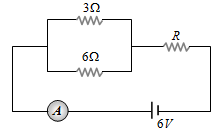
If the ammeter in the given circuit reads $2 A,$ the resistance $R$ is
$X-$ray from a Coolidge tube is incident on a thin aluminium foil. The intensity of the $X-$ray transmitted by the foil is found to be $I_0.$ The heating current is increased to increase the temperature of the filament. The intensity of the $X-$ray transmitted by the foil will be$:$
Which of the following type of radiations are radiated by on oscillating electric charge?
The wavelengths involved in the spectrum of deuterium $\big(\frac 21 \big)D$ are slightly different from that of hydrogen spectrum, because
When objects at different distances are seen by the eye, which of the following remain constant?
  1. The focal length of the eye-lens.
  2. The object-distance from the eye-lens.
  3. The radii of curvature of the eye-lens.
  4. The image-distance from the eye-lens.
A sodium atom is in one of the states labeled 'Lowest excited levels'. It remains in that state for an average time of $10^{–8} \sec,$ before it makes a transition back to a ground state. What is the uncertainty in energy of that excited state