MCQ
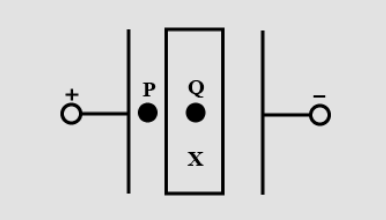
Point A is at a lower electrical potential than point B. An electron between them on the line joining them will:
- AMove towards A
- BMove towards B
- CMove at right angles to the line joining A and B
- DRemain at rest
Explanation:
Given that point A is at lower electric potential than point B. The electron between them on line joining will move.
We have to find where this electron moves.
Since we know that electric currents move from a higher potential or a lower potential. Also, electrons move in the direction opposite to electric current. So the electron on the line joining two points A and B will move from lower to higher potential i.e, it will move towards B.
Generate a complete, print-ready paper with questions like this in minutes — across 16+ boards, with answer keys.
A lens behaves as a converging lens in air and a diverging lens in water. The refractive index of the material is
|
(a) Equal to unity |
(b) Equal to 1.33 |
|
(c) Between unity and 1.33 |
(d) Greater than 1.33 |
A lens (focal length 50 cm) forms the image of a distant object which subtends an angle of 1 milliradian at the lens. What is the size of the image
|
(a) 5 mm |
(b) 1 mm |
(c) 0.5 mm |
(d) 0.1 mm |
Minimum energy required to takeout the only one electron from ground state of  is
is
|
(a) 13.6 eV |
(b) 54.4 eV |
(c) 27.2 eV |
(d) 6.8 eV |
A plane mirror reflecting a ray of incident light is rotated through an angle θ about an axis through the point of incidence in the plane of the mirror perpendicular to the plane of incidence, then
|
(a) The reflected ray rotates through an angle 2θ |
| (b) The incident ray is fixed |
| (c) The reflected ray does not rotate |
| (d) a, b |
Rate of change of torque τ with deflection θ is maximum for a magnet suspended freely in a uniform magnetic field of induction B, when
| (a) θ = 0° | (b) θ = 45° | (c) θ = 60° | (d) θ = 90° |
Conditions of diffraction is
|
(a) |
(b) |
(c) |
(d) None of these |
If the current is doubled, the deflection is also doubled in
|
(a) A tangent galvanometer |
(b) A moving coil galvanometer |
|
(c) Both (a) and (b) |
(d) None of these |


