MCQ
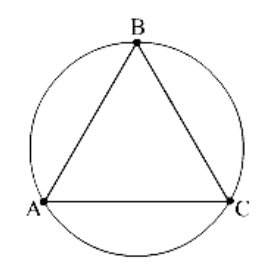
Points A, B, C are on a circle, such that m(arc AB) = m(arc BC) = 120°. No point, except point B, is common to the arcs. Which is the type of ∆ ABC?
  • Equilateral triangle
  • B
    Scalene triangle
  • C
    Right angled triangle
  • D
    Isosceles triangle

Answer

Correct option: A.
Equilateral triangle

Image
$m(\operatorname{arc} A B)=m(\operatorname{arc~BC})=120^{\circ}$
Now,
$m(\operatorname{arc} A B)+m(\operatorname{arc} B C)+m(\operatorname{arc} C A)=360^{\circ}$
$\Rightarrow 120^{\circ}+120^{\circ}+m(\operatorname{arc} C A)=360^{\circ}$
$\Rightarrow 240^{\circ}+m(\operatorname{arc} C A)=360^{\circ}$
$\Rightarrow m(\operatorname{arc} C A)=360^{\circ}-240^{\circ}=120^{\circ}$
$\therefore m(\operatorname{arc} A B)=m(\operatorname{arc} B C)=m(\operatorname{arc} C A)$
$\Rightarrow \operatorname{arc} A B \cong \operatorname{arc} B C \cong \operatorname{arc} C A$
(Two arcs are congruent if their measures are equal)
$\Rightarrow$ chord $A B \cong$ chord $B C \cong$ chord $C A$ (Chords corresponding to congruent arcs of a circle are congruent)
$\therefore \triangle \mathrm{ABC}$ is an equilateral triangle. ..(All sides of equilateral triangle are equal)
Hence, the correct answer is option Equilateral triangle.

Need a full question paper?

Generate a complete, print-ready paper with questions like this in minutes — across 16+ boards, with answer keys.
Start Generating Free