Questions · Page 1 of 2

Select The Correct Option (MCQ)

🎯

Test yourself on this topic

50 questions · timed · auto-graded

MCQ 21 Mark
If point P divides segment AB in the ratio 1:3 where A(-5 , 3) and B(3 , -5) then the coordinates of P are -----------------
  • A
    ( -2, -2 )
  • B
    ( -1 , -1 )
  • (-3 , 1 )
  • D
    ( 1, - 3 )
Answer
Correct option: C.
(-3 , 1 )
$(-3,1)$

$\text { Let } A\left(x_1, y_1\right)=A(-5,3) \text { and } B\left(x_2, y_2\right)=B(3,-5) \text {, }$

$a: b=1: 3$

$\therefore x_1=-5, y_1=3, x_2=3, y_2=-5, a=1, b=3 .$

$\therefore$ By section formula,

$\begin{array}{l|l}

\therefore \mathrm{x}=\frac{a x_2+b x_1}{a+b} & \therefore \mathrm{y}=\frac{a y_2+b y_1}{a+b} \\

\therefore \mathrm{x}=\frac{1(3)+3(-5)}{1+3} & \therefore \mathrm{y}=\frac{1(-5)+3(3)}{1+3} \\

\therefore \mathrm{x}=\frac{3-15}{4} & \therefore \mathrm{y}=\frac{-5+9}{4} \\

\therefore \mathrm{x}=\frac{-12}{4} & \therefore \mathrm{y}=\frac{4}{4} \\

\therefore \mathrm{x}=-3 & \therefore \mathrm{y}=1

\end{array}$

$\therefore$ Co-ordinates of $P$ are $(-3,1)$.
View full question & answer
MCQ 31 Mark
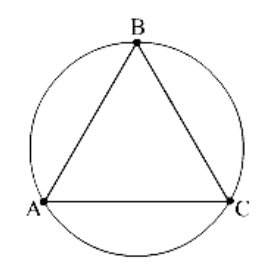
Points A, B, C are on a circle, such that m(arc AB) = m(arc BC) = 120°. No point, except point B, is common to the arcs. Which is the type of ∆ ABC?
  • Equilateral triangle
  • B
    Scalene triangle
  • C
    Right angled triangle
  • D
    Isosceles triangle
Answer
Correct option: A.
Equilateral triangle

Image
$m(\operatorname{arc} A B)=m(\operatorname{arc~BC})=120^{\circ}$
Now,
$m(\operatorname{arc} A B)+m(\operatorname{arc} B C)+m(\operatorname{arc} C A)=360^{\circ}$
$\Rightarrow 120^{\circ}+120^{\circ}+m(\operatorname{arc} C A)=360^{\circ}$
$\Rightarrow 240^{\circ}+m(\operatorname{arc} C A)=360^{\circ}$
$\Rightarrow m(\operatorname{arc} C A)=360^{\circ}-240^{\circ}=120^{\circ}$
$\therefore m(\operatorname{arc} A B)=m(\operatorname{arc} B C)=m(\operatorname{arc} C A)$
$\Rightarrow \operatorname{arc} A B \cong \operatorname{arc} B C \cong \operatorname{arc} C A$
(Two arcs are congruent if their measures are equal)
$\Rightarrow$ chord $A B \cong$ chord $B C \cong$ chord $C A$ (Chords corresponding to congruent arcs of a circle are congruent)
$\therefore \triangle \mathrm{ABC}$ is an equilateral triangle. ..(All sides of equilateral triangle are equal)
Hence, the correct answer is option Equilateral triangle.
View full question & answer
MCQ 41 Mark
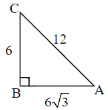
In ∆ABC, AB =$6 \sqrt{3}$ cm, AC = 12 cm, and BC = 6 cm then $m \angle A$ = ?
  • 30°
  • B
    60°
  • C
    90°
  • D
    45°
Answer
Correct option: A.
30°

$30^{\circ}$
Image
We know that, $6=\frac{1}{2}(12)$ and
$6 \sqrt{3}=\frac{\sqrt{3}}{2}(12)$
$\therefore \mathrm{BC}=\frac{1}{2} \mathrm{AC}$ and $\mathrm{AB}=\frac{\sqrt{3}}{2} \mathrm{AC}$
$\therefore \angle A=30^{\circ} \quad \ldots\left(\right.$ Converse of $30^{\circ}-60^{\circ}-90^{\circ}$ theorem)
View full question & answer
MCQ 51 Mark
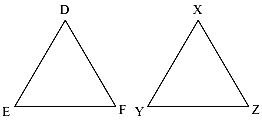
In $\triangle DEF$ and $\triangle XYZ , \frac{ DE }{ XY }=\frac{ FE }{ YZ }$ and $\angle E \cong \angle Y$.___ __ test gives similarity between $\triangle DEF$ and $\triangle XYZ$
.
  • A
    AAA
  • SAS
  • C
    SAA
  • D
    SSS
Answer
Correct option: B.
SAS
SASIn $\triangle D E F$ and $\triangle X Y Z$,
$\frac{D E}{X Y}=\frac{F E}{Y Z} \quad \ldots(\text { Given }$
$\angle E \cong \angle Y \quad \ldots(\text { Given }$
$\therefore \triangle D E F \cong \triangle X Y Z \quad \ldots(\text { SAS Similarity triangle test) }$
View full question & answer
MCQ 61 Mark
$\sin \theta=\frac{1}{2}$ then $\theta=?$
  • 30°
  • B
    45°
  • C
    60°
  • D
    90°
Answer
Correct option: A.
30°
$30^{\circ}$

$\sin \theta=\frac{1}{2}$

$\therefore \theta=30^{\circ} \quad \ldots\left[\sin 30^{\circ}=\frac{1}{2}\right]$

View full question & answer
MCQ 71 Mark
If point P is midpoint of segment joining point A (-4, 2) and point B(6, 2 ) then the coordinates of P are ------------
  • A
    ( -1, 2 )
  • ( 1 , 2 )
  • C
    (1 , -2)
  • D
    (-1, - 2)
Answer
Correct option: B.
( 1 , 2 )
$(1,2)$

$A\left(x_1, y_1\right)=A(-4,2), B\left(x_2, y_2\right)=B(6,2)$

Here, $x_1=-4, y_1=2, x_2=6, y_2=2$

$\therefore$ Co-ordinates of the midpoint of seg $A B$

$=\left(\frac{x_1+x_2}{2}, \frac{y_1+y_2}{2}\right)$

$=\left(\frac{-4+6}{2}, \frac{2+2}{2}\right)$

$=\left(\frac{2}{2}, \frac{4}{2}\right)$

$=(1,2)$
View full question & answer
MCQ 81 Mark
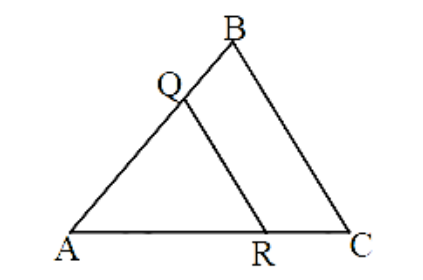
$\triangle ABC \sim \triangle AQR . \quad \frac{A B}{A Q}=\frac{7}{5}$ then which of the following option is true.
  • A-Q-B
  • B
    A-B-Q
  • C
    A-C-B
  • D
    A-R-B
Answer
Correct option: A.
A-Q-B

$A-Q-B$
Image
$\triangle \mathrm{ABC} \sim \triangle \mathrm{AQR}$ and $\frac{\mathrm{AB}}{\mathrm{AQ}}=\frac{7}{5}$
$\Rightarrow \triangle A B C$ is greater and $\triangle A Q R$ is smaller.
$\angle \mathrm{A}$ is a common angle.
$\therefore$ We get, A-Q-B
View full question & answer
MCQ 91 Mark
Two circles having diameters 8 cm and 6 cm touch each other internally. Find the distance between their centres.
  • A
    2
  • B
    14
  • C
    7
  • 1
Answer
Correct option: D.
1
View full question & answer
MCQ 101 Mark
If length of sides of triangle are a ,b, c and $a ^2+ b ^2= c ^2$ then which type of triangle it is ?
  • A
    Obtuse angled triangle
  • B
    Acute angled triangle
  • C
    Equilateral triangle
  • Right angled triangle
Answer
Correct option: D.
Right angled triangle
View full question & answer
MCQ 111 Mark
If ∆ABC~ ∆LMN and ⦟A = 60° then ⦟L =?
  • A
    45°
  • 60°
  • C
    25°
  • D
    40°
Answer
Correct option: B.
60°
$60^{\circ}$

In $\triangle A B C$ and $\triangle L M N$,

$\triangle A B C \sim \triangle L M N$

$\therefore \angle A \cong \angle L \quad \ldots$ (Corresponding angles of similar triangles)

But $\angle A=60^{\circ} \quad \ldots$ (Given)

$\therefore \angle L=60^{\circ}$.

View full question & answer
MCQ 121 Mark
$\frac{1+\cot ^2 A }{1+\tan ^2 A }=?$
  • A
    $\tan ^2 \mathring A$
  • B
    $\sec ^2 \mathring A$
  • C
    $\operatorname{cosec}^2 \mathring A$
  • $\cot ^2 \mathring A$
Answer
Correct option: D.
$\cot ^2 \mathring A$
$\cot ^2 \mathrm{~A}$$\frac{1+\cot ^2 \mathrm{~A}}{1+\tan ^2 \mathrm{~A}}$
$=\frac{\operatorname{cosec}^2 \mathrm{~A}}{\sec ^2 \mathrm{~A}}$
$=\frac{\frac{1}{\sin ^2 \mathrm{~A}}}{\frac{1}{\cos ^2 \mathrm{~A}}}$
$=\frac{\cos ^2 \mathrm{~A}}{\sin ^2 \mathrm{~A}}$
$=\cot ^2 \mathrm{~A}$
View full question & answer
MCQ 131 Mark
If segment AB is parallel Y-axis and coordinates of A are (1, 3) then the coordinates of B are -------------
  • A
    ( 3 ,1 )
  • B
    ( 5, 3)
  • C
    (3, 0)
  • (1, -3)
Answer
Correct option: D.
(1, -3)
$(1,-3)$

Since, seg $A B \| Y$-axis.

$\therefore \mathrm{x}$ co-ordinate of all points on seg $\mathrm{AB}$ will be the same. $x$ co-ordinate of $A(1,3)=1$

$x$ co-ordinate of $B(1,-3)=1$

$\therefore(1,-3)$ is option correct.
View full question & answer
MCQ 141 Mark
$\triangle PQR \sim \triangle ABC , \frac{P R}{A C}=\frac{5}{7}$ then
  • ∆ABC is greater.
  • B
    ∆ PQR is greater.
  • C
    Both triangles are congruent.
  • D
    Can’t say.
Answer
Correct option: A.
∆ABC is greater.
ΔABC is greater
View full question & answer
MCQ 151 Mark
What is the measurement of angle inscribed in a semicircle?
  • 90°
  • B
    120°
  • C
    100°
  • D
    60°
Answer
Correct option: A.
90°
90°
View full question & answer
MCQ 161 Mark
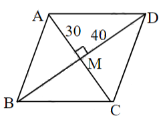
If length of both diagonals of rhombus are 60 and 80 then what is the length of side?
  • A
    100
  • 50
  • C
    200
  • D
    400
Answer
Correct option: B.
50

50
Image
Let $\triangle A B C D$ be the rhombus, diagonal $A C=60$ and $B D=80$ we know that the diagonals of a rhombus are perpendicular bisectors of each other.
$\therefore$ Diagonals $\mathrm{AC}$ and $\mathrm{BD}$ bisect each other at point $\mathrm{M}$.
$\therefore \ln \triangle \mathrm{AMD}, \angle \mathrm{M}=90^{\circ}, \mathrm{AM}=30, \mathrm{DM}=40$
$\therefore \mathrm{AM}^2+\mathrm{DM}^2=\mathrm{AD}^2 \quad \ldots[\text { Pythagoras theorem }]$
$\therefore(30)^2+(40)^2=A D^2$
$\therefore 900+1600=\mathrm{AD}^2$
$\therefore A D^2=2500$
$\therefore A D=50 \text { units }$
View full question & answer
MCQ 171 Mark
If $\triangle X Y Z \sim \triangle P Q R$ then $\frac{X Y}{P Q}=\frac{Y Z}{Q R}=$ ?
  • $\frac{ XZ }{ PR }$
  • B
    $\frac{ XZ }{ PQ }$
  • C
    $\frac{ XZ }{ QR }$
  • D
    $\frac{Y Z}{P Q}$
Answer
Correct option: A.
$\frac{ XZ }{ PR }$
$\frac{X Z}{P R}$

In $\triangle X Y Z$ and $\triangle P Q R$,

$\triangle X Y Z \sim \triangle P Q R \quad \ldots \text { (Given) }$

$\frac{X Y}{P Q}=\frac{Y Z}{Q R}=\frac{X Z}{P R} \quad$...[Corresponding sides of similar triangles. $]$


View full question & answer
MCQ 181 Mark
$\sin ^2 \theta+\sin ^2(90-\theta)=?$
  • A
    0
  • 1
  • C
    2
  • D
    $\sqrt{2}$
Answer
Correct option: B.
1
1

$\sin ^2 \theta+\sin ^2(90-\theta)=\sin ^2 \theta+\cos ^2 \theta=1$.

View full question & answer
MCQ 191 Mark
If point P ( 1 , 1 ) divide segment joining point A and point B ( -1 , -1 ) in the ratio 5 : 2 then the coordinates of A are ---------
  • A
    ( 3 ,3 )
  • ( 6, 6 )
  • C
    (2, 2 )
  • D
    (1, 1 )
Answer
Correct option: B.
( 6, 6 )
$(6,6)$

Let $A\left(x_1, y_1\right)$ and $B\left(x_2, y_2\right)=B(-1,-1)$

$P(x, y)=P(1,1)$ divides $A B$ in ratio $5: 2$.

$\therefore \mathrm{x}_1=1, \mathrm{y}_1=1, \mathrm{x}_2=-1, \mathrm{y}_2=-1, \mathrm{a}=5, \mathrm{~b}=2 \text {. }$

$\therefore$ By section formula,

$\therefore \mathrm{x}=\frac{a x_2+b x_1}{a+b}$

$\therefore 1=\frac{5(-1)+2 x_1}{5+2}$

$\therefore 7=-5+2 x_1$

$\therefore 7=-5+2 x_1$

$\therefore 2 \mathrm{x}_1=7+5$

$\therefore 2 \mathrm{x}_1=12$

$\therefore \mathrm{x}_1=\frac{12}{2}$

$\therefore \mathrm{x}_1=6$

$\therefore$ Co-ordinates of A are $(6,6)$.
View full question & answer
MCQ 201 Mark
Which theorem is used while constructing a tangent to the circle by using center of a circle?
  • tangent – radius theorem.
  • B
    Converse of tangent – radius theorem.
  • C
    Pythagoras theorem
  • D
    Converse of Pythagoras theorem.
Answer
Correct option: A.
tangent – radius theorem.
Tangent – radius theorem
View full question & answer
MCQ 211 Mark
Two circles of radii 5.5 cm and 4.2 cm touch each other externally. Find the distance between their centres
  • 9.7
  • B
    1.3
  • C
    2.6
  • D
    4.6
Answer
Correct option: A.
9.7

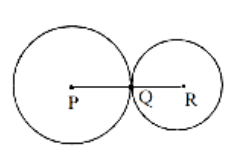
Let the two circles having centres $P$ and $R$ touch each other externally at point $Q$.
Image
Here, $P Q=5.5 \mathrm{~cm}, Q R=4.2 \mathrm{~cm}$
The two circles touch each other externally...(P-Q-R)
If the circles touch each other externally, distance between their centres is equal to the sum of their radii.
$\therefore$ By theorem of touching circles,
$\therefore P R=P Q+Q R$
$\therefore P R=5.5+4.2$
$\therefore P R=9.7 \mathrm{~cm}$
$\therefore$ The distance between the centres of the circles is $9.7 \mathrm{~cm}$.
View full question & answer
MCQ 221 Mark
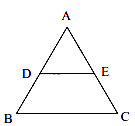
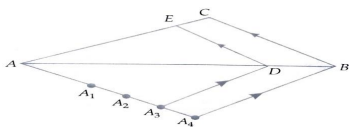
In fig, seg DE || sec BC, identify the correct statement.
  • A
    $\frac{A D}{D B}=\frac{A E}{A C}$
  • B
    $\frac{A D}{D B}=\frac{A B}{A C}$
  • C
    $\frac{A D}{D B}=\frac{E C}{A C}$
  • D
    $\frac{A D}{D B}=\frac{A E}{E C}$
Answer
3: 5
Let $\triangle ABC$ and $\triangle PQR$ be two similar triangles.
According to the given condition,
$
\frac{ A (\Delta ABC )}{ A (\Delta PQR )}=\frac{9}{25}
$
But $\frac{ A (\Delta ABC )}{ A (\Delta PQR )}=\frac{ AB ^2}{ PQ ^2}$
...(By the theorem of areas of similar triangles)
$
\therefore \frac{ AB ^2}{ PQ ^2}=\frac{9}{25}
$
$
\therefore \frac{ AB }{ PQ }=\frac{3}{5}
$
$\therefore 3: 5$ is the ratio of their corresponding sides.
View full question & answer
MCQ 231 Mark
$\sec ^2 \theta-\tan ^2 \theta=?$
  • A
    0
  • 1
  • C
    2
  • D
    $\sqrt{2}$
Answer
Correct option: B.
1
1

$1+\tan ^2 \theta=\sec ^2 \theta$

$\because \sec ^2 \theta-\tan ^2 \theta=1 .$

View full question & answer
MCQ 241 Mark
Find distance between point A ( -3 , 4 ) and origin O.
  • A
    7 cm
  • B
    10 cm
  • 5 cm
  • D
    -5 cm
Answer
Correct option: C.
5 cm
$5 \mathrm{~cm}$

Let $A\left(x_1, y_1\right)=A(-3,4)$ and $O\left(x_2, y_2\right)=O(0,0)$

Here, $x_1=-3, y_1=4, x_2=0, y_2=0$

By distance formula,

$d(A, O)=\sqrt{\left(x_2-x_1\right)^2+\left(y_2-y_1\right)^2}$

$\therefore d(A, O)=\sqrt{[0-(-3)]^2+(0-4)^2}$

$\therefore d(A, O)=\sqrt{9+16}$

$\therefore d(A, O)=\sqrt{25}$

$\therefore d(A, O)=5 \mathrm{~cm}$
View full question & answer
MCQ 251 Mark
Image
In the figure ∆ ABC ~∆ ADE then the ratio of their corresponding sides is --------.
  • A
    $\frac{3}{1}$
  • B
    $\frac{1}{3}$
  • C
    $\frac{3}{4}$
  • $\frac{4}{3}$
Answer
Correct option: D.
$\frac{4}{3}$

$\frac{4}{3}$
Image
From the given figure, we get that
$A D=3$ units, $D B=1$ units, and $A B=4$ units ...(i)
As $\triangle \mathrm{ABC} \sim \triangle \mathrm{ADE}$, we get
$\frac{A B}{A D}=\frac{B C}{D E}=\frac{A C}{A E}$ $\quad$ $\ldots$ [Ratio of Corresponding sides of similar triangles$
...[Ratio of Corresponding sides of similar triangles]
$\therefore \frac{4}{3}=\frac{\mathrm{BC}}{\mathrm{DE}}=\frac{\mathrm{AC}}{\mathrm{AE}}$ $\quad$ $\ldots[$ From (i)]
View full question & answer
MCQ 261 Mark
How many circles can drawn passing through three non -collinear points?
  • A
    0
  • B
    Infinite
  • C
    2
  • One and only one(unique)
Answer
Correct option: D.
One and only one(unique)
One and only one (unique)
View full question & answer
MCQ 271 Mark
If the length of diagonal of square is $\sqrt{2}$ then what is the length of each side ?
  • A
    2
  • B
    $\sqrt{3}$
  • 1
  • D
    4
Answer
Correct option: C.
1

1
Image
Let $\square A B C D$ be the given square.
In $\triangle \mathrm{ABC}$
$\angle B=90^{\circ}$
$\therefore A C^2=A B^2+B C^2 \quad \ldots[\text { Pythagoras theorem] }$
$\therefore(\sqrt{ } 2)^2=A B^2+A B^2 \quad \ldots[\text { Sides of the square] }$
$\therefore 2=2 A B^2$
$\therefore A B^2=1$
$\therefore A B=1 \text { unit }$
View full question & answer
MCQ 281 Mark
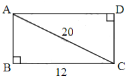
A rectangle having length of a side is 12 and length of diagonal is 20 then what is length of other side?
  • A
    2
  • B
    13
  • C
    5
  • 16
Answer
Correct option: D.
16

16
Image
Let $\square A B C D$ be the given rectangle.
$A C=20 \text { units and } B C=12 \text { units }$
In $\triangle \mathrm{ABC}_x$
$\angle B=90^{\circ}$
$\therefore A C^2=A B^2+B C^2 \quad \ldots[\text { Pythagoras theorem }]$
$\therefore 20^2=A B^2+12^2$
$\therefore 400=A B^2+144$
$\therefore A B^2=256$
$\therefore A B=16 \text { units }$
View full question & answer
MCQ 291 Mark
𝐺𝑖𝑣𝑒𝑛 ∆ABC~ ∆DEF, if ⦟A = 45° and ⦟E = 35° then ⦟B =?
  • A
    45°
  • 35°
  • C
    25°
  • D
    40°
Answer
Correct option: B.
35°
$35^{\circ}$

In $\triangle \mathrm{ABC}$ and $\triangle \mathrm{DEF}$,

$\triangle \mathrm{ABC} \sim \triangle \mathrm{DEF}$...(Given)

$\therefore \angle B \cong \angle \mathrm{E}$ ...(Corresponding angles of similar triangles)

But $\angle \mathrm{E}=35^{\circ}$...(Given)

$\therefore \angle B=35^{\circ} \text {. }$

View full question & answer
MCQ 301 Mark
cot θ . tan θ = ?
  • 1
  • B
    0
  • C
    2
  • D
    $\sqrt{2}$
Answer
Correct option: A.
1
$1$

$\cot \theta \cdot \tan \theta=\frac{1}{\tan \theta} \cdot \tan \theta=1$

View full question & answer
MCQ 311 Mark
If the length of the segment joining point L (x , 7 ) and point M( 1, 15 ) is 10 cm then the value of x is ---------
  • A
    7
  • 7 or -5
  • C
    -1
  • D
    1
Answer
Correct option: B.
7 or -5
7 or -5

Here, $x_1=x_1 y_1=7, x_2=1, y_2=15$

By distance formula,

$d(L, M)=\sqrt{\left(x_2-x_1\right)^2+\left(y_2-y_1\right)^2}$

$\therefore d(L, M)=\sqrt{(1-x)^2+(15-7)^2}$

$\therefore 10=\sqrt{(1-x)^2+8^2}$

$\therefore 100=(1-x)^2+64$ $\quad$ $\ldots$[ Squaring both sides ]

$\therefore(1-x)^2=100-64$

$\therefore(1-x)^2=36$

$\therefore 1-x= \pm \sqrt{36}$ $\quad$ $\ldots$[ Taking square root of both sides ]

$\therefore 1-x= \pm 6$

$\therefore 1-x=6 \text { or } 1-x=-6$

$\therefore x=-5 \text { or } x=7$ $\quad$ $\ldots$[ Squaring both sides ]

$\therefore$ The value of $x$ is -5 or 7 .
View full question & answer
MCQ 321 Mark
……………….number of tangents can be drawn to a circle from the point outside the circle.
  • 2
  • B
    1
  • C
    one and only one
  • D
    0
Answer
Correct option: A.
2
2
View full question & answer
MCQ 331 Mark
In a cyclic ⬜ABCD, twice the measure of ∠A is thrice the measure of ∠C. Find the measure of ∠C?
  • A
    36°
  • 72°
  • C
    90°
  • D
    108°
Answer
Correct option: B.
72°

$A B C D$ is a cyclic quadrilateral.
$2 \angle A=3 \angle C$
Now,
$\angle \mathrm{A}+\angle \mathrm{C}=180^{\circ}$ $\quad$.......(Opposite angles of a cyclic quadrilateral are supplementary$
$\left.\Rightarrow \frac{3}{2} \angle C+\angle C=180^{\circ} \quad \text { [From }(1)\right]$
$\Rightarrow \frac{5}{2} \angle C=180^{\circ}$
$\Rightarrow \angle C=\frac{2 \times 180^{\circ}}{5}=72^{\circ}$
Thus, the measure of $\angle \mathrm{C}$ is $72^{\circ}$.
Hence, the correct answer is $72^{\circ}$.
View full question & answer
MCQ 341 Mark
In right angled triangle, if sum of square of sides of right angle is 169 then what is the length of hypotenuse?
  • A
    15
  • 13
  • C
    5
  • D
    12
Answer
Correct option: B.
13

13
Image
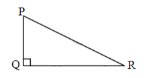
In $\triangle P Q R_1$
$\angle Q=90^{\circ}$
$\therefore \mathrm{PR}^2=\mathrm{PQ}^2+\mathrm{QR}^2 \quad \ldots[$ Pythagoras theorem $]$
$\therefore P R^2=169 \quad \ldots[$ Given $]$
$\therefore \mathrm{PR}=\sqrt{169}$
Taking square root both the sides,
$\therefore \mathrm{PR}=13$
View full question & answer
MCQ 351 Mark
Ratio of areas of two similar tringles is 9:25. _____ is the ratio of their corresponding sides
  • A
    $3: 4$
  • $3: 5$
  • C
    $5: 3$
  • D
    $25: 81$
Answer
Correct option: B.
$3: 5$
3 : 5

Let $\triangle A B C$ and $\triangle P Q R$ be two similar triangles.

According to the given condition,

$\frac{\mathrm{A}(\triangle \mathrm{ABC})}{\mathrm{A}(\triangle \mathrm{PQR})}=\frac{9}{25}$

But $\frac{A(\triangle A B C)}{A(\triangle P Q R)}=\frac{A B^2}{P Q^2} \ldots(B y$ the theorem of areas of similar triangles)

$\therefore \frac{A B^2}{P Q^2}=\frac{9}{25}$

$\therefore \frac{A B}{P Q}=\frac{3}{5}$

$\therefore 3: 5$ is the ratio of their corresponding sides.

View full question & answer
MCQ 361 Mark
$1+\cot ^2 \theta=?$
  • A
    $\tan ^2 \theta$
  • B
    $\sec ^2 \theta$
  • $\operatorname{cosec}^2 \theta$
  • D
    $\cos ^2 \theta$
Answer
Correct option: C.
$\operatorname{cosec}^2 \theta$
View full question & answer
MCQ 371 Mark
The distance between points P ( -1 , 1 ) and Q(5, -7 ) is ------------..
  • A
    11 cm
  • 10 cm
  • C
    5 cm
  • D
    7 cm
Answer
Correct option: B.
10 cm
$10 \mathrm{~cm}$

Let $P\left(x_1, y_1\right)=P(-1,1)$ and $Q\left(x_2, y_2\right)=Q(5,-7)$

Here, $x_1=-1, y_1=1, x_2=5, y_2=-7$

By distance formula,

$d(P, Q)=\sqrt{\left(x_2-x_1\right)^2+\left(y_2-y_1\right)^2}$

$\therefore d(P, Q)=\sqrt{[5-(-1)]^2+(-7-1)^2}$

$\therefore d(P, Q)=\sqrt{36+64}$

$\therefore d(P, Q)=\sqrt{100}$

$\therefore d(P, Q)=10 \mathrm{~cm}$
View full question & answer
MCQ 381 Mark
$\Delta LMN \sim \Delta HIJ$ and $\frac{L M}{H I}=\frac{2}{3}$ then
  • ∆ LMN is a smaller triangle.
  • B
    ∆ HIJ is a smaller triangle.
  • C
    Both triangles are congruent.
  • D
    Can’t say.
Answer
Correct option: A.
∆ LMN is a smaller triangle.
$\Delta \mathrm{LMN}$ is a smaller triangle

View full question & answer
MCQ 391 Mark
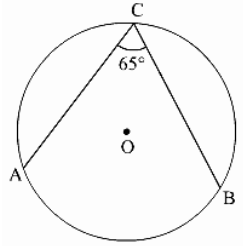
∠ACB is inscribed in arc ACB of a circle with centre O. If ∠ ACB = 65°, find m(arc ACB).
  • A
    65°
  • B
    130°
  • C
    295°
  • 230°
Answer
Correct option: D.
230°

$230^{\circ}$
Explanation:
Image
The measure of an inscribed angle is half of the measure of the arc intercepted by it. By inscribed angle theorem,
$\therefore m \angle A C B=\frac{1}{2} m(\operatorname{arc} A B)$
$\therefore \mathrm{m}(\operatorname{arc} A B)=2 \mathrm{~m} \angle A C B$
$=2 \times 65^{\circ}$
$=130^{\circ}$
$\therefore \mathrm{m}(\operatorname{arc} A C B)=360^{\circ}-\mathrm{m}(\operatorname{arc} A B)$
$=360^{\circ}-130^{\circ}$
$\left.=230^{\circ} \ldots \ldots \text{[ Measure of a circle is } 360^{\circ}\right ]$
Hence, the correct answer is $230^{\circ}$.
View full question & answer
MCQ 401 Mark
Out of given triplets, which is not a Pythagoras triplet ?
  • A
    (9,40,41)
  • B
    (11,60,61)
  • (6,14,15)
  • D
    (6,8,10)
Answer
Correct option: C.
(6,14,15)
$(6,14,15)$

Here, $15^2=225$

$6^2+14^2=36+196=232$

$\therefore 15^2 \neq 6^2+14^2$

The square of the largest number is not equal to the sum of the squares of the other two numbers.

$\therefore(6,14,15)$ is not a Pythagoras triplet.

View full question & answer
MCQ 411 Mark
If $\triangle XYZ \sim \triangle PQR$ and $A (\Delta XYZ )=25 cm ^2, A (\Delta PQR )=4 cm ^2$ then $XY : PQ =$ ?
  • A
    $4: 25$
  • B
    $2: 5$
  • $5: 2$
  • D
    $25: 4$
Answer
Correct option: C.
$5: 2$

5 : 2
In $\triangle X Y Z$ and $\triangle P Q R$
$\triangle X Y Z \sim \triangle P Q R$
$A(\triangle X Y Z)=25 \mathrm{~cm}^2, A(\triangle P Q R)=4 \mathrm{~cm}^2$
by the theorem of areas of similar triangles,
$\frac{A(\Delta X Y Z)}{A(\triangle P Q R)}=\frac{X Y^2}{P Q^2}$
$\therefore \frac{25}{4}=\frac{X Y^2}{P Q^2}$
$\therefore \frac{X Y}{P Q}=\frac{5}{2}$
$\therefore X Y: P Q=5: 2 .$
View full question & answer
MCQ 431 Mark
The distance between Point P ( 2 , 2 ) and Q ( 5, x ) is 5 cm then the value of x = ----------
  • A
    2
  • 6
  • C
    3
  • D
    1
Answer
Correct option: B.
6
6

Let $P\left(x_1, y_1\right)=P(2,2)$ and $Q\left(x_2, y_2\right)=Q(5, x)$

Here, $x_1=2, y_1=2, x_2=5, y_2=x$

By distance formula,

$d(P, Q)=\sqrt{\left(x_2-x_1\right)^2+\left(y_2-y_1\right)^2}$

$\therefore 5=\sqrt{(5-2)^2+(x-2)^2}$

$\therefore 5=\sqrt{9+x^2-4 x+4}$

$\therefore 5^2=x^2-4 x+13 \quad \ldots[\text { Squaring both sides] }$

$\therefore 25=x^2-4 x+13$

$\therefore x^2-4 x+13-25=0$

$\therefore x^2-4 x-12=0$

$\therefore(x-6)(x+2)=0$

$\therefore x-6=0 \text { or } x+2=0$

$\therefore x=6 \text { or } x=-2$ $\quad$[..Squaring both sides]
View full question & answer
MCQ 441 Mark
The tangents drawn at the end of a diameter of a circle are…………..
  • A
    Perpendicular
  • parallel
  • C
    congruent
  • D
    can’t say
Answer
Correct option: B.
parallel
parallel
View full question & answer
MCQ 451 Mark
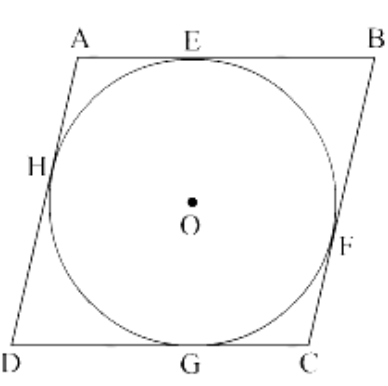
A circle touches all sides of a parallelogram. So the parallelogram must be a, ......... .
  • A
    rectangle
  • rhombus
  • C
    square
  • D
    trapezium
Answer
Correct option: B.
rhombus

ABCD is a parallelogram. A circle with centre $O$ touches the parallelogram at $E, F, G$ and $H$.
Image
$A B C D$ is a parallelogram.
$\therefore A B=C D\quad ...(1)$ (Opposite sides of parallelogram are equal$
$\mathrm{AD}=\mathrm{BC}\quad ...(2)$ (Opposite sides of parallelogram are equal)
Tangent segments drawn from an external point to a circle are congruent.
$\mathrm{AE}=\mathrm{AH} \quad ...(3)$
$\mathrm{DG}=\mathrm{DH} \quad ...(4)$
$\mathrm{BE}=\mathrm{BF} \quad ...(5)$
$\mathrm{CG}=\mathrm{CF} \quad ...(6)$
Adding (3), (4), (5) and (6), we get
$A E+B E+C G+D G=A H+D H+B F+C F$
$\Rightarrow A B+C D=A D+B C\quad ...(7)$
From (1), (2) and (7), we ahve
$2 A B=2 B C$
$\Rightarrow A B=B C \quad ...(8)$
From (1), (2) and (8), we have
$A B=B C=C D=A D$
$\therefore$ Parallelogram $A B C D$ is a rhombus. $\quad$ (A rhombus is a parallelogram with all sides equal)
Hence, the correct answer is rhombus.
View full question & answer
MCQ 461 Mark
Out of given triplets, which is not a Pythagoras triplet ?
  • A
    (5,12,13)
  • B
    (8,15,17)
  • (7,8,15)
  • D
    (24,25,7)
Answer
Correct option: C.
(7,8,15)
$(7,8,15)$

Here, $15^2=225$

$7^2+8^2=49+64=113$

$\therefore 15^2 \neq 7^2+8^2$

The square of the largest number is not equal to the sum of the squares of the other two numbers.

$\therefore(7,8,15)$ is not a Pythagoras triplet.

View full question & answer
MCQ 481 Mark
cos θ . sec θ = ?
  • 1
  • B
    0
  • C
    $\frac{1}{2}$
  • D
    $\sqrt{2}$
Answer
Correct option: A.
1
1

$\cos \theta \cdot \sec \theta=\cos \theta \cdot \frac{1}{\cos \theta}=1$.

View full question & answer
MCQ 491 Mark
Point P is midpoint of segment AB where A(- 4,2) and B(6,2) then the coordinates of P are ---------
  • A
    ( -1, 2 )
  • ( 1, 2 )
  • C
    (1, - 2)
  • D
    ( -1, - 2)
Answer
Correct option: B.
( 1, 2 )
$(1,2)$

$A\left(x_1, y_1\right)=A(-4,2), B\left(x_2, y_2\right)=B(6,2)$

Here, $x_1=-4, y_1=2, x_2=6, y_2=2$

$\therefore$ Co-ordinates of the midpoint of seg $A B$

$=\left(\frac{x_1+x_2}{2}, \frac{y_1+y_2}{2}\right)$

$=\left(\frac{-4+6}{2}, \frac{2+2}{2}\right)$

$=\left(\frac{2}{2}, \frac{4}{2}\right)$

$=(1,2)$

View full question & answer
MCQ 501 Mark
…………… number of tangents can be drawn to a circle from the point on the circle.
  • A
    3
  • B
    2
  • 1
  • D
    0
Answer
Correct option: C.
1
1
View full question & answer