Question
Polarisation of light establishes:

Answer

  1. Transverse nature of light
Explanation:
Polarisation of light establishes that light are transverse in nature, otherwise it was believed that they are longitudinal waves, like the sound waves.

Need a full question paper?

Generate a complete, print-ready paper with questions like this in minutes — across 16+ boards, with answer keys.
Start Generating Free

Similar questions

Assertion  : Radio waves can be polarised.
Reason     : Sound waves in air are longitudinal in nature. (a) If both assertion and reason are true and the reason is the correct explanation of the assertion.(b) If both assertion and reason are true but reason is not the correct explanation of the assertion.(c) If assertion is true but reason is false.(d) If the assertion and reason both are false.


Which among the following is not attracted by magnets?
In an elastic collision:
  1. The initial kinetic energy is equal to the final kinetic energy.
  2. The final kinetic energy is less than the initial kinetic energy.
  3. The kinetic energy remains constant.
  4. The kinetic energy first increases then decreases.
Which among the following materials display higher magnetic susceptibility?
An alternating voltage$\text{V}=200\sqrt{2}\sin100\text{t},$ Where V is in volt and t is in seconds, is connected to a series combination of $1\mu\text{F}$ capacitor and $10\text{k}\Omega$ resistor through an AC ammeter. The reading of the ammeter will be_____.
A current carrying coil is placed with its axis perpendicular to $N-S$ direction. Let horizontal component of earth's magnetic field be $\mathrm{H}_{\mathrm{o}}$ and magnetic field inside the loop is $H.$ If a magnet is suspended inside the loop, it makes angle $\theta$ with $H .$ Then $\theta=$
The photoelectric current does not depend upon the:
  1. Frequency of incident light.
  2. Work function of the metal.
  3. Stopping potential.
  4. Intensity of incident light.
If cathode rays are projected at right angles to a magnetic field, their trajectory is (a) Ellipse(b) Circle(c) Parabola(d) None of these
       
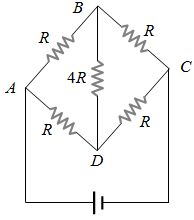
Five resistors of given values are connected together as shown in the figure. The current in the arm $BD$ will be
Huygens's concept of secondary wave: