MCQ
Polyphosphates are used as softening agents since
- ✓They forms soluble complex with cationic species
- BThey forms soluble complex with anionic species
- CThey forms ppt with cationic species.
- DThey forms ppt with anionic species.
It forms a soluble complex with cation and removes the hardness of the water.
The reactions involved are:
$2 CaSO _4+ Na _2\left[ Na _4\left( PO _3\right)_6\right] \rightarrow Na _2\left[ Ca _2\left( PO _3\right)_6\right]+2 Na _2 SO _4$
$2 MgSO _4+ Na _2\left[ Na _4\left( PO _3\right)_6\right] \rightarrow Na _2\left[ Mg _2\left( PO _3\right)_6\right]+2 Na _2 SO _4$
Polyphosphate makes a soluble complex with $Ca ^{+2}$ and $Mg ^{+2}$ and removes the hardness of water caused by calcium sulfate and magnesium sulphate.
Generate a complete, print-ready paper with questions like this in minutes — across 16+ boards, with answer keys.
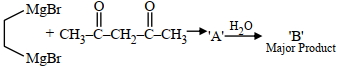
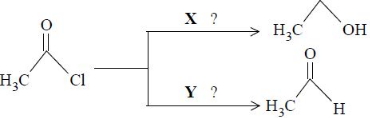
| (a) Pure nitrogen | (i) Chlorine |
| (b) Haber process | (ii) Sulphuric acid |
| (c) Contact process | (iii) Ammonia |
| (d) Deacon's process | (iv) Sodium azide or Barium azide |
Which of the following is the correct option ?
$(a)\quad (b)\quad (c) \quad (d)$
Reason : Zinc forms complex with $CuSO_4$