MCQ
Positive Tollen's test is observed for
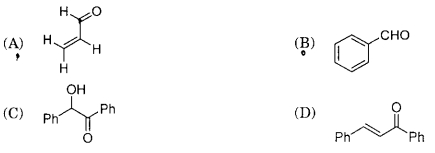
  • $A,B,C$
  • B
    $A,B,D$
  • C
    $B,C$
  • D
    $A,B$

Answer

Correct option: A.
$A,B,C$
a
$\alpha, \beta$-unsaturated aldehydes, aromatic aldehydes and $\alpha$-hydroxyketones all give tollens' test but ketones (including $\alpha, \beta$-unsaturated) do not give this test. Thus, option ( $a , b$ and $c$ ) are correct.

Need a full question paper?

Generate a complete, print-ready paper with questions like this in minutes — across 16+ boards, with answer keys.
Start Generating Free

Similar questions

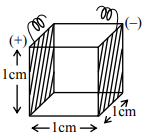
A conductivity cell with two electrodes (dark side) are half filled with infinitely dilute aqueous solution of a weak electrolyte. If volume is doubled by adding more water at constant temperature, the molar conductivity of the cell will -
Image
Reason of lanthanoid contraction is
On analysis, a saturated hydrocarbon is found to contain $83.70 $ percent carbon and $16.30\%$ hydrogen. The empirical formula will be (at. wt. of $C=12,$ at. wt. of $H = 1$)
Conside the following reactions:

$\mathrm{NaCl}+\mathrm{K}_{2} \mathrm{Cr}_{2} \mathrm{O}_{7}+\mathrm{H}_{2} \mathrm{SO}_{4}(\mathrm{Conc} .) \rightarrow(\mathrm{A})+$ Side products

$(\mathrm{A})+\mathrm{NaOH} \rightarrow(\mathrm{B})+$ side product

$(\mathrm{B})+\mathrm{H}_{2} \mathrm{SO}_{4}(\mathrm{dilute})+\mathrm{H}_{2} \mathrm{O}_{2} \rightarrow(\mathrm{C})+$ Side product

The sum of the total number of atoms in one molecule each of $(A), (B)$ and $(C)$ is
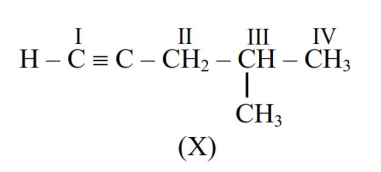
Which alkyne will give $3$ -ethylhexane on catalytic hydrogenation ?
Consider the following compound (X)
Image
The most stable and least stable carbon radicals, respectively, produced by homolytic cleavage of corresponding C - H bond are :
The dissociation constant of acetic acid is $1.6 \times 10^{-5}$ and molar conductance at  infinite dilution is $380 \times 10^{-4} \,S \,m^2 \,mol^{-1}$. The specific conductance of $0.01 \,M$ acid solution is
Assertion : Alkylbenzene is not prepared by Friedel-Craft alkylation of benzene.

Reason : Alkyl halides are less reactive than acyl halides.

${\left[ {Co{{\left( {N{H_3}} \right)}_4}C{l_2}} \right]^ + }$ exhibits
$\begin{array}{*{20}{c}}
{\,\,\,\,\,\,\,C{H_3}}\\
{\,|\,\,}\\
{C{H_3} - C - N{H_2}}\\
|\\
{\,\,\,\,\,\,\,\,C{H_3}}
\end{array}$ $\xrightarrow{{NaN{O_2} + HCl}}$ Product

Which one is not formed in product?