MCQ
Potassium manganate is not formed in
  • A
    $KMnO \xrightarrow{\Delta }$
  • B
    $KMn{O_4} + \mathop {KOH}\limits_{\left( {conc.} \right)} \xrightarrow{\Delta }$
  • C
    $Mn{O_2} + KOH + {O_2}\xrightarrow{\Delta }$
  • $KMn{O_4} + \mathop {{H_2}S{O_4}}\limits_{\left( {conc.} \right)} \xrightarrow{\Delta }$
Answer

Correct option: D.
$KMn{O_4} + \mathop {{H_2}S{O_4}}\limits_{\left( {conc.} \right)} \xrightarrow{\Delta }$
d
$2 \mathrm{KMnO}_{4} \stackrel{\Delta}{\longrightarrow} \mathrm{K}_{2} \mathrm{MnO}_{4}+\mathrm{MnO}_{2}+\mathrm{O}_{2}$

$4 \mathrm{KMnO}_{4}+4 \mathrm{KOH} \stackrel{\Delta}{\longrightarrow} 4 \mathrm{K}_{2} \mathrm{MnO}_{4}+\mathrm{O}_{2}+2 \mathrm{H}_{2} \mathrm{O}$

$2 \mathrm{MnO}_{2}+4 \mathrm{KOH}+\mathrm{O}_{2} \stackrel{\Delta}{\longrightarrow} 2 \mathrm{K}_{2} \mathrm{MnO}_{4}+2 \mathrm{H}_{2} \mathrm{O}$

$\mathrm{KMnO}_{4}+\mathrm{H}_{2} \mathrm{SO}_{4}(\mathrm{con}) \stackrel{\Delta}{\longrightarrow} \mathrm{K}_{2} \mathrm{SO}_{4}+\mathrm{Mn}_{2} \mathrm{O}_{7}+\mathrm{H}_{2} \mathrm{O}$

Need a full question paper?

Generate a complete, print-ready paper with questions like this in minutes — across 16+ boards, with answer keys.

Start Generating Free

Similar questions

Decreasing the concentration of an electrophile in a typical $S_N\,^2$ reaction by a factor of $3$ will cause the reaction ratio to
The compound$(s)$ that exhibit$(s)$ geometrical isomerism is$(are)$

$(A)$ $\left[\mathrm{Pt}(\mathrm{en}) \mathrm{Cl}_2\right]$ $(B)$ $\left[\mathrm{Pt}(\mathrm{en})_2\right] \mathrm{Cl}_2$

$(C)$ $\left[\mathrm{Pt}(\text { en })_2 \mathrm{Cl}_2\right] \mathrm{Cl}_2$ $(D)$ $\left[\mathrm{Pt}\left(\mathrm{NH}_3\right)_2 \mathrm{Cl}_2\right]$

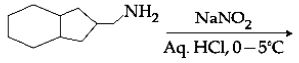
The major product formed in the reaction given below will be
The following solutions were prepared by dissolving $10\, \mathrm{~g}$ of glucose $\left(\mathrm{C}_{6} \mathrm{H}_{12} \mathrm{O}_{6}\right)$ in $250 \,\mathrm{ml}$ of water $\left(\mathrm{P}_{1}\right)$, $10\, \mathrm{~g}$ of urea $\left(\mathrm{CH}_{4} \mathrm{~N}_{2} \mathrm{O}\right)$ in $250\, \mathrm{ml}$ of water $\left(\mathrm{P}_{2}\right)$ and $10\, \mathrm{~g}$ of sucrose $\left(\mathrm{C}_{12} \mathrm{H}_{22} \mathrm{O}_{11}\right)$ in $250\, \mathrm{ml}$ of water $\left(\mathrm{P}_{3}\right)$. The right option for the decreasing order of osmotic pressure of these solutions is :
An element exists as hexagonal close packed structure as well as cubic closed packed structure. In which case the element would have higher density?
The vapour pressure of acetone $(CH_3COCH_3)$ at $20\,^oC$ is $185\, torr$. When $1.2\, g$ of non volatile substance was dissolved in $100\, g$ of acetone at $20\,^oC$, its vapour pressure was $183\, torr$. The molar mass $(g\, mol^{-1})$ of the substance is
Which type of crystals contains more than one Bravais lattice?
How many isomers are possible in $[Co{(en)_2}C{l_2}]$
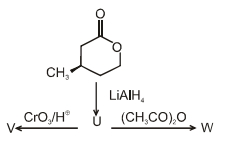
With reference to the scheme given, which of the given statments$(s)$ about $T , U , V$ and $W$ is (are) correct?

$(A)$ $T$ is soluble in hot aqueous $NaOH$

$(B)$ $U$ is optically active

$(C)$ Molecular formula of $W$ is $C _{10} H _{18} O _4$

$(D)$ $V$ gives effervescence on treatment with aqueous $NaHCO _3$

The rate of reaction is determined by slow step reaction. The step is called