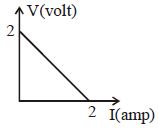
Potential difference across a cell and current through a cell is shown in graph. A battery consists of such identical $40$ cells. Max current supplied by the battery through a load of $2.5\,\Omega $ equal to .............. $A$
A$20$
B$12$
C$4$
D$15$
Medium
Download our app for free and get started
C$4$
c $\varepsilon=2$ $\mathrm{volt},$ $\mathrm{r}=1 \,\Omega$
Experience the future of education. Simply download our apps or reach out to us for more information. Let's shape the future of learning together!No signup needed.*
In the box shown current $i$ enters at $H$ and leaves at $C$. If $i_{AB} = \frac{{\text{i}}}{6}$ , $i_{DC} = \frac{{\text{2i}}}{3}$ ,$i_{HA} = \frac{{\text{i}}}{2} , i_{GF} = \frac{{\text{i}}}{6} , i_{HE} = \frac{{\text{i}}}{6}$ , choose the branch in which current is zero
The current in a conductor is expressed as $I=3 t^2+4 t^3$, where $I$ is in Ampere and $t$ is in second. The amount of electric charge that flows through a section of the conductor during $t=1$ s to $t=2 \mathrm{~s}$ is_______ C.
A potentiometer circuit shown in the figure is set up to measure $e.m.f.$ of a cell $E$. As the point $P$ moves from $X$ to $Y$ the galvanometer $G$ shows deflection always in one direction, but the deflection decreases continuously until $Y$ is reached. In order to obtain balance point between $X$ and $Y$ it is necessary to
What equal length of an iron wire and a copper-nickel alloy wire, each of $2 \; {mm}$ diameter connected parallel to give an equivalent resistance of $3 \Omega ?$
(Given resistivities of iron and copper-nickel alloy wire are $12 \;\mu \Omega {cm}$ and $51\; \mu \Omega {cm}$ respectively) (in ${m}$)