If temperature of gas increases from $27°C$ to $927°C$ the $K.E.$ will be
Easy


Download our appand get started for free
Experience the future of education. Simply download our apps or reach out to us for more information. Let's shape the future of learning together!No signup needed.*
Similar Questions
- 1A container of fixed volume has a mixture of one mole of hydrogen and one mole of helium in equilibrium at temperature $T$. Assuming the gases are ideal, the correct statement$(s)$ is(are)View Solution
$(A)$ The average energy per mole of the gas mixture is $2RT$.
$(B)$ The ratio of speed of sound in the gas mixture to that in helium gas is $\sqrt{6 / 5}$.
$(C)$ The ratio of the rms speed of helium atoms to that of hydrogen molecules is $1 / 2$.
$(D)$ The ratio of the rms speed of helium atoms to that of hydrogen molecules is $1 / \sqrt{2}$.
- 2View SolutionA real gas behaves like an ideal gas if its
- 3A gas at ${27}^\circ C$ temperature and $30$ atmospheric pressure is allowed to expand to the atmospheric pressure. If the volume becomes $10$ times its initial volume, then the final temperature becomes ...... $^oC$View Solution
- 4At $0°C $ the density of a fixed mass of a gas divided by pressure is $x.$ At $100°C,$ the ratio will beView Solution
- 5View SolutionThe specific heat of an ideal gas is
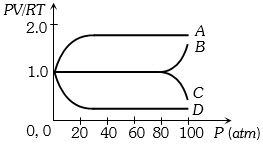
- 6An experiment is carried on a fixed amount of gas at different temperatures and at high pressure such that it deviates from the ideal gas behaviour. The variation of $\frac{{PV}}{{RT}}$ with $P$ is shown in the diagram. The correct variation will correspond toView Solution
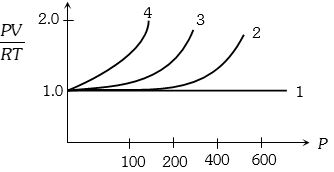
- 7A fix amount of nitrogen gas ($1$ mole) is taken and is subjected to pressure and temperature variation. The experiment is performed at high pressure as well as high temperatures. The results obtained are shown in the figures. The correct variation of $PV/RT$ with $P$ will be exhibited byView Solution
- 8The respective speeds of five molecules are $2, 1.5, 1.6, 1.6$ and $1.2 \,km/sec.$ The most probable speed in $km/sec$ will beView Solution
- 9A gas mixture consists of $2$ moles of $O_2$ and $4$ moles of $Ar$ at temperature $T$. Neglecting all vibrational modes, the total internal energy of the system isView Solution
- 10$C_v$ and $C_p$ denote the molar specific heat capacities of a gas at constant volume and constant pressure, respectively. ThenView Solution