MCQ
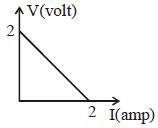
Potential difference across a cell and current through a cell is shown in graph. A battery consists of such identical $40$ cells. Max current supplied by the battery through a load of $2.5\,\Omega $ equal to .............. $A$
  • A
    $20$
  • B
    $12$
  • $4$
  • D
    $15$

Answer

Correct option: C.
$4$
c
$\varepsilon=2$ $\mathrm{volt},$ $\mathrm{r}=1 \,\Omega$

$m n=40$

Current is maximum

$\mathrm{R}=\frac{\mathrm{nr}}{\mathrm{m}} \Rightarrow 2.5=\frac{\mathrm{n}}{\mathrm{m}} 1$

$\mathrm{n}=\mathrm{m}(2.5)$

$m=4, n=10$

$I=\frac{10 E}{5}=4 \,A$

Need a full question paper?

Generate a complete, print-ready paper with questions like this in minutes — across 16+ boards, with answer keys.

Start Generating Free

Similar questions

Which of the following particles will have minimum frequency of revolution when projected with the same velocity perpendicular to a magnetic field?
A square loop of side $2\, a ,$ and carrying current I, is kept in $XZ$ plane with its centre at origin. A long wire carrying the same current $I$ is placed parallel to the $z-$axis and passing through the point $(0, b, 0),(b>>a)$. The magnitude of the torque on the loop about $z-$axis is given by:
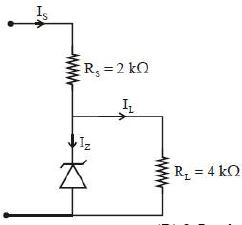
Figure shown a $DC$ voltage regulator circuit, with a Zener diode of breakdown voltage $= 6\,V$. If the unregulated input voltage varies between $10\, V$ to $16\, V$, then what is the maximum Zener current ?.......$mA$
In a Young's double slit experiment, the central point on the screen is
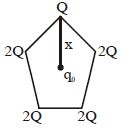
For regular pentagon system shown in figure, find force on $q_0$
If two waves represented by ${y_1} = 4\sin \omega t$ and ${y_2} = 3\sin \left( {\omega t + \frac{\pi }{3}} \right)$ interfere at a point, the amplitude of the resulting wave will be about
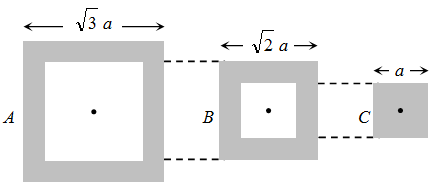
Following figure shows cross-sections through three long conductors of the same length and material, with square cross-section of edge lengths as shown. Conductor B will fit snugly within conductor A, and conductor C will fit snugly within conductor B. Relationship between their end to end resistance is
The collector plate in an experiment on photoelectric effect is kept vertically above the emitter plate. Light source is put on and a saturation photocurrent is recorded. An electric field is switched on which has a vertically downward direction.
To convert a galvanometer into a voltmeter, one should connect a
Find the potential $V$ of an electrostatic field $\vec E = a\left( {y\hat i + x\hat j} \right)$, where $a$ is a constant.