MCQ
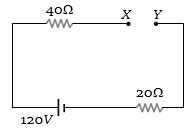
Potential difference across the $40\,\Omega $ resistance will be ............ $V$
  • $0$
  • B
    $80$
  • C
    $40$
  • D
    $120$

Answer

Correct option: A.
$0$
a
(a) Zero (Circuit open means no current and hence no potential difference across resistance).

Need a full question paper?

Generate a complete, print-ready paper with questions like this in minutes — across 16+ boards, with answer keys.

Start Generating Free

Similar questions

In series $LCR$ circuit, the capacitance is changed from $\mathrm{C}$ to $4 \mathrm{C}$. To keep the resonance frequency unchanged, the new inductance should be :
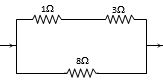
Power dissipated across the $8 \,\,\Omega$ resistor in the circuit shown here is $2\,\, watt.$ The power dissipated in watt units across the $3 \,\,\Omega$ resistor is 
In Young's double slit experiment, if one of the slit is closed fully, then in the interference pattern
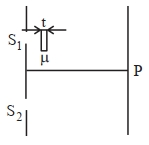
As shown in the figure, in Young's double slit experiment, a thin plate of thickness $t =10\,\mu m$ and refractive index $\mu _{1}=1.2$ is inserted infront of slit $S _1$. The experiment is conducted in air $(\mu=1)$ and uses a monochromatic light of wavelength $\lambda=500\,nm$. Due to the insertion of the plate, central maxima is shifted by a distance of $x \beta_0 . \beta_0$ is the fringe-width before the insertion of the plate.The value of the $x$ is $.............$
Which of the following is wrong statement
A biconvex lens of focal length $15 \mathrm{~cm}$ is in front of a plane mirror. The distance between the lens and the mirror is $10 \mathrm{~cm}$. A small object is kept at a distance of $30 \mathrm{~cm}$ from the lens. The final image is
The fringe width in Young's double-slit experiment can be increased if we decrease
The diameter of the objective lens of a telescope is $5.0\, m$ and wavelength of light is $6000 Å$. The limit of resolution of this telescope will be......$sec$
In a wire of circular cross-section with radius r, free electrons travel with a drift velocity V when a current I flows through the wire. What is the current in another wire of half the radius and of the same material when the drift velocity is 2V
Two charges of equal magnitudes and at a distance r exert a force F on each other. If the charges are halved and distance between them is doubled, then the new force acting on each charge is