Question
Potential difference $(\triangle\text{V})$ between two points A and B separated by a distance x, in a uniform electric field E is given by $\triangle\text{V}=-\text{Ex},$ where xis measured parallel to the field lines. If a charge q0 moves from P to Q, the change in potential energy $(\triangle\text{U})$ is given as $\triangle\text{U}=-\text{q}_0\triangle\text{V}.$ A proton is released from rest in uniform electric field of magnitude 4.0 × 108Vm-1 directed along the positive X-axis. The proton undergoes a displacement of 0.25m in the direction of E.

Mass of a proton = 1.66 × 10-27kg and charge of proton = 1.6 × 10-19C.
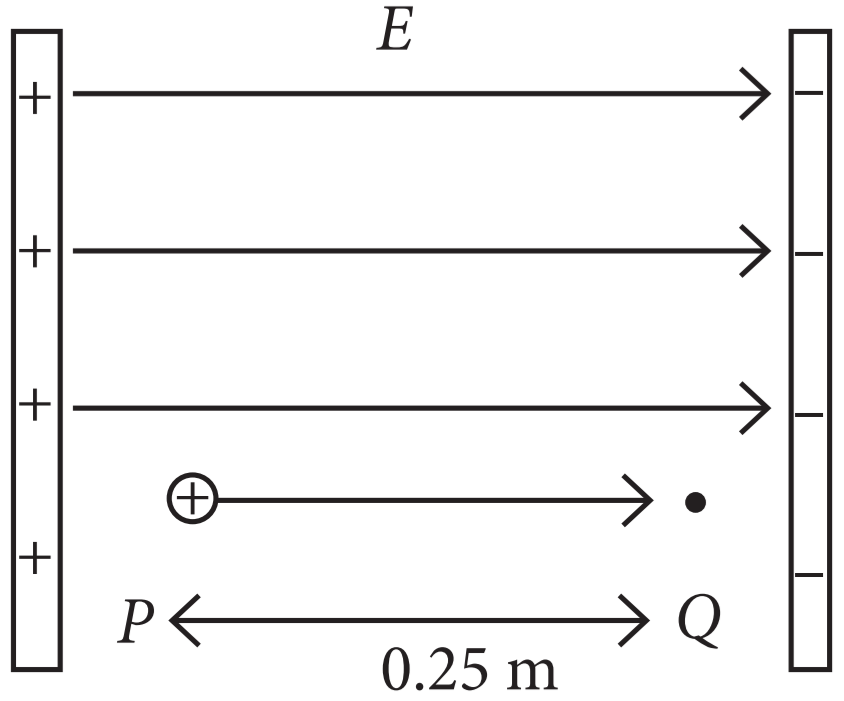
  1. The change in electric potential of the proton between the points A and B is:
  1. -1 × 108V
  2. 1 × 108V
  3. 6.4 × 10⁻¹⁹V
  4. -6.4 × 10⁻¹⁹V
  1. The change in electric potential energy of the proton for displacement from A to B is:
  1. 1.6 × 1011J
  2. 0.5 × 10²³J
  3. -1.6 × 10-11J
  4. 3.2 × 1022J
  1. The mutual electrostatic potential energy between two protons which are at a distance of 9 × 10-15m, in 92U235 nucleus is:
  1. 1.56 × 10-14J
  2. 5.5 × 10-14J
  3. 2.56 × 10-14J
  4. 4.56 × 10-14J
  1. If a system consistsoftwocharges 4mC and -3mC with no external field placed at (-5cm, 0, 0) and (5cm, 0, 0) respectively. The amount of work required to separate the two charges infinitely away from each other is:
  1. -1.1J
  2. 2J
  3. 2.5J
  4. 3J
  1. As the proton moves from P to Q, then:
  1. The potential energy of proton decreases.
  2. The potential energy of proton increases.
  3. The proton loses kinetic energy.
  4. Total energy of the proton increases.
Answer

  1. (a) -1 × 108V

Explanation:

As $\triangle\text{V}=-\text{E}\triangle\text{x}=-(4.0\times10^8\frac{\text{V}}{\text{m}})(0.25\text{m})$

$=-10^8\text{V}.$

  1. (c) -1.6 × 10-11J

Explanation:

As $\triangle\text{U}=\text{q}_0\triangle\text{V}$

$=-(1.6\times10^{-19})\times(-1.0\times10^8\text{V})$

$=-1.6\times10^{-11}\text{V}.$

  1. (c) 2.56 × 10-14J

​​​​​​​​​​​​​​​​​​​​​Explanation:

Here, q1 = q2 = 1.6 × 10-19C, r = 9 × 10-15m

$\text{U}=\frac{9\times10^9\times1.6\times10^{-19}\times1.6\times10^{-19}}{9\times10^{-15}}$

$=2.56\times10^{-14}\text{J}.$

  1. (a) -1.1J

​​​​​​​​​​​​​​​​​​​​​​​​​​​​Explanation:

Here, $\text{q}_1=4\mu\text{C},\text{ q}_2=3\mu\text{C}$

r = 10cm = 0.1m

Electrostatic potential energy,

$\text{U}=\frac{1}{4\pi\in_0}\frac{\text{q}_1\text{q}_2}{\text{r}}$

$=9\times10^9\times\frac{4\times10^{-6}\times(-3)\times10^{-6}}{0.1}$

= -1.1J

  1. (a) The potential energy of proton decreases.

​​​​​​​​​​​​​​​​​​​​​​​​​​​​​​​​​​​Explanation:

As proton moves in the direction of the electric field, then its potential energy decreases.

Need a full question paper?

Generate a complete, print-ready paper with questions like this in minutes — across 16+ boards, with answer keys.

Start Generating Free

Similar questions

Wavefront is a locus of points which vibratic in same phase. A ray of light is perpendicular to the wavefront. According to Huygens principle, each point of the wavefront is the source of a secondary disturbance and the wavelets connecting from these points spread out in all directions with the speed of wave.
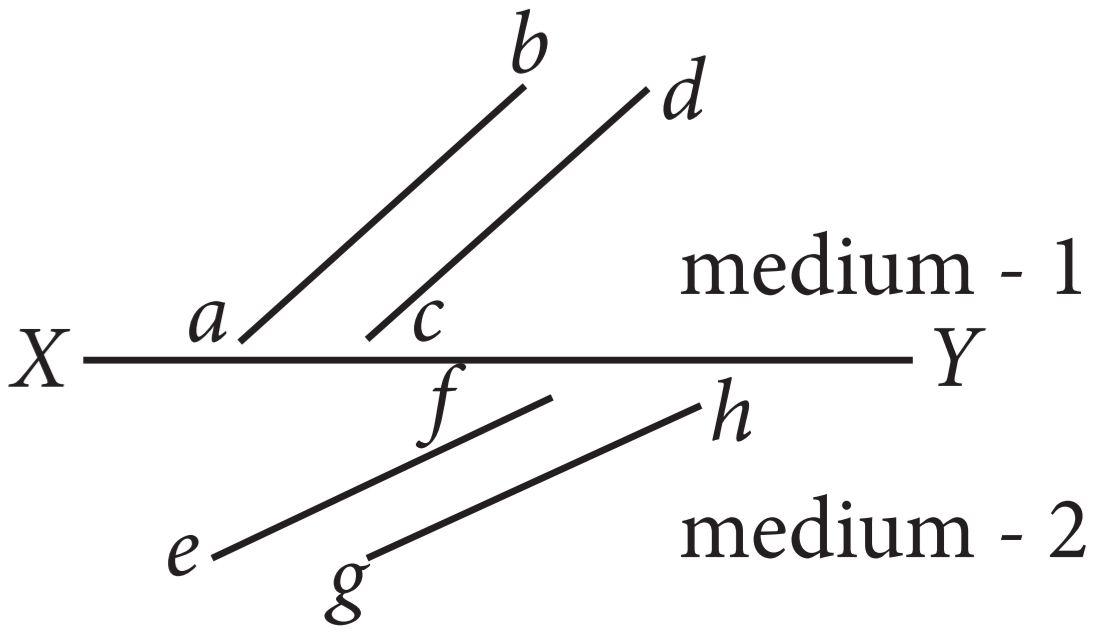
The figure shows a surface XY separating two transparent media, medium-I and medium-2. The lines ab and cd represent wavefronts of a light wave travelling in medium- 1 and incident on XY. The lines ef and gh represent wavefronts of the light wave in medium-2 after refraction.

  1. Light travels as a:
  1. Parallel beam in each medium.
  2. Convergent beam in each medium.
  3. Divergent beam in each medium.
  4. Divergent beam in one medium and convergent beam in the other medium.
  1. The phases of the light wave at c, d, e and f are $\phi_\text{c},\phi_\text{d},\phi_\text{e}$ and $\phi_\text{f}$ respectively. It is given that $\phi_\text{c}\not=\phi_\text{f}$
  1. $\phi_\text{c}$ cannot be equal $\phi_\text{d}$
  2. $\phi_\text{d}$ cannot be equal $\phi_\text{e}$
  3. $(\phi_\text{d}-\phi_\text{f})$ is equal to $(\phi_\text{c}-\phi_\text{e})$
  4. $(\phi_\text{d}-\phi_\text{c})$ is not equal to $(\phi_\text{f}-\phi_\text{e})$
  1. Wavefront is the locus of all points, where the particles of the medium vibrate with the same.
  1. Phase
  2. Amplitude
  3. Frequency
  4. Period
  1. A point source that emits waves uniformly in all directions, produces wavefronts that are:
  1. Spherical
  2. Elliptical
  3. Cylindrical
  4. Planar
  1. What are the types of wavefronts?
  1. Spherical
  2. Cylindrical
  3. Plane
  4. All of these.
  1. A point-object is placed on the principal axis of a convex spherical surface of radius of curvature R, which separates the two media of refractive indices n 1 and n 2 (n 2 > n 1). Draw the ray diagram and deduce the relation between the distance of the object (u),distance of the image (v) and the radius of curvature (R) for refraction to take place at the convex spherical surface from rarer to denser medium.
  2. Use the above relation to obtain the condition on the position of the object and the radius of curvature in terms of n1 and n2 when the real image is formed.
A metal rod is placed along the axis of a solenoid carrying a high-freqμency alternating current. It is found that the rod gets heated. Explain why the rod gets heated.
Derive lens Maker formula $\frac{1}{f}=\left(n_{21}-1\right)\left(\frac{1}{R_1}-\frac{1}{R_2}\right)$. Here are the general meanings of the symbols used in the formula. Draw necessary diagram.
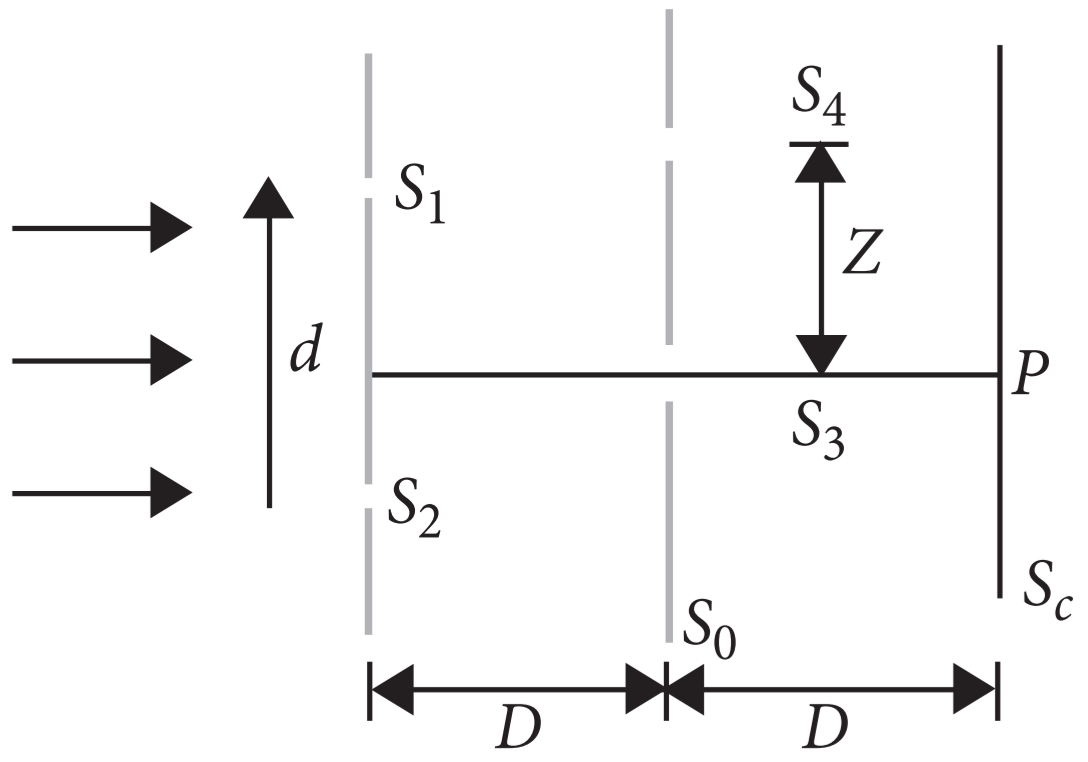
Consider the situation shown in figure. The two slits S1 and S1 placed symmetrically around the central line are illuminated by monochromatic light of wavelength $\lambda$. The separation between the slits is d. The light transmitted by the slits falls on a screen S0 place at a distance D from the slits. The slits S3 is at the central line and the slit S4 is at a distance from S3. Another screen Sc is placed a further distance D away from Sc.

  1. Find the path difference if $\text{z}=\frac{\lambda\text{D}}{2\text{d}}$.

  1. $\lambda$

  2. $\frac{\lambda}{2}$

  3. $\frac{3}{2\lambda}$

  4. $2\lambda$

  1. Find the ratio of the maximum to minimum intensity observed on Sc if $\text{z}=\frac{\lambda\text{D}}{\text{d}}$

  1. 4
  2. 2
  3. $\infty$

  4. 1
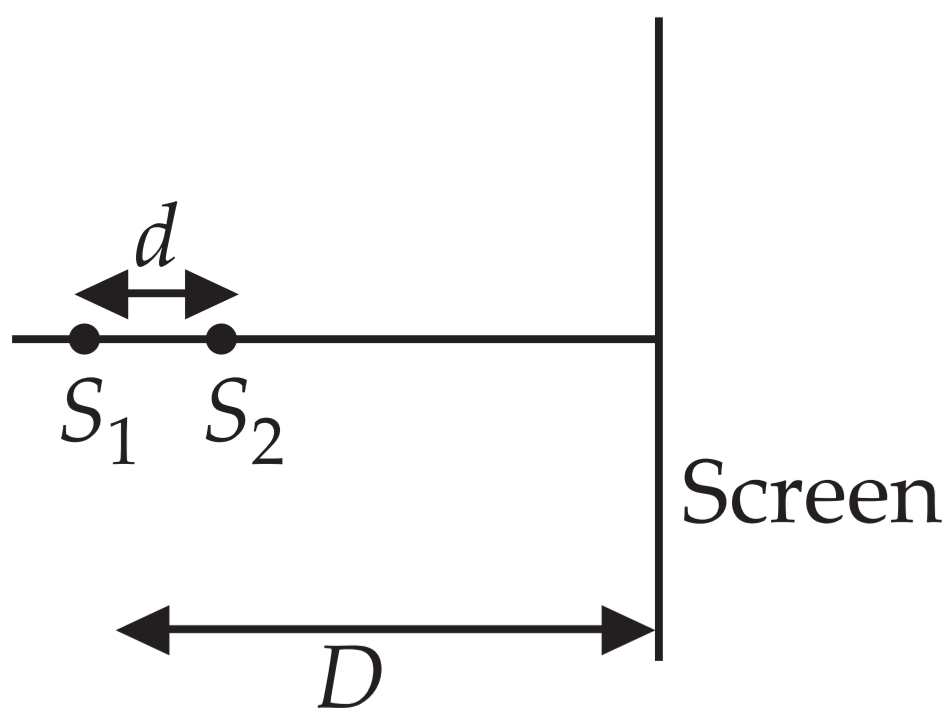
  1. Two coherent point sources S1 and S2 are separated by a small distanced as shown in figure. The fringes obtained on the screen will be:

  1. Concentric circles.
  2. Points.
  3. Straight lines.
  4. Semi-circles.
  1. ln the case of light waves from two coherent sources S1 and S2, there will be constructive interference at an arbitrary point P, if the path difference S1P - S2P is:
  1. $\Big(\text{n}+\frac{1}{2}\Big)\lambda$

  2. $\text{n}\lambda$

  3. $\Big(\text{n}-\frac{1}{2}\Big)\lambda$

  4. $\frac{\lambda}{2}$

  1. Two monochromatic light waves of amplitudes 3A and 2A interfering at a point have a phase difference of 60º. The intensity at that point will be proportional to:
  1. 5A2
  2. 13A2
  3. 7A2
  4. 19A2
In pair annihilation, an electron and a positron destroy each other to produce gamma radiation. How is the momentum conserved?
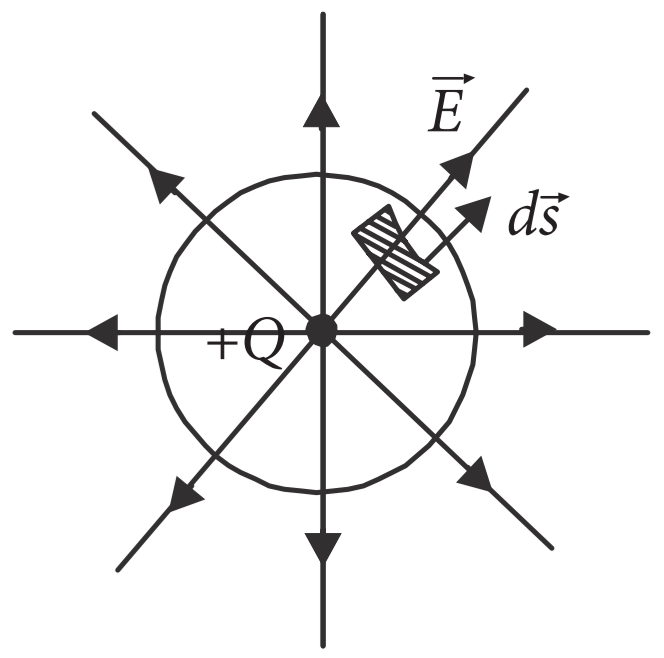
Gauss's law and Coulomb's law, although expressed in different forms, are equivalent ways of describing the relation between charge and electric field in static conditions. Gauss's law is $\in_0\phi=\text{q}_{\text{end},}$ when $\text{q}_{\text{encl}}$ is the net charge inside an imaginary closed surface called Gaussian surface. $\phi=\oint\vec{\text{E}}\cdot\text{d}\vec{\text{A}}$ gives the electric flux through the Gaussian surface. The two equations hold only when the net charge is in vacuum or air.

  1. If there is only one type of charge in the universe, then ($\vec{\text{E}}\rightarrow$ Electric field, $\text{d}\vec{\text{s}}\rightarrow$ Area vector).
  1. $\oint\vec{\text{E}}\cdot\text{d}\vec{\text{s}}\not=0$ on any surface.

  2. $\oint\vec{\text{E}}\cdot\text{d}\vec{\text{s}}$ could not be defined.

  3. $\oint\vec{\text{E}}\cdot\text{d}\vec{\text{s}}=\infty$ if charge is inside.

  4. $\oint\vec{\text{E}}\cdot\text{d}\vec{\text{s}}=0$ if charge is outside, $\oint\vec{\text{E}}\cdot\text{d}\vec{\text{s}}=\frac{\text{q}}{\in_0}$ if charge is inside.

  1. What is the nature of Gaussian surface involved in Gauss law of electrostatic?
  1. Magnetic.
  2. Scalar.
  3. Vector.
  4. Electrical.
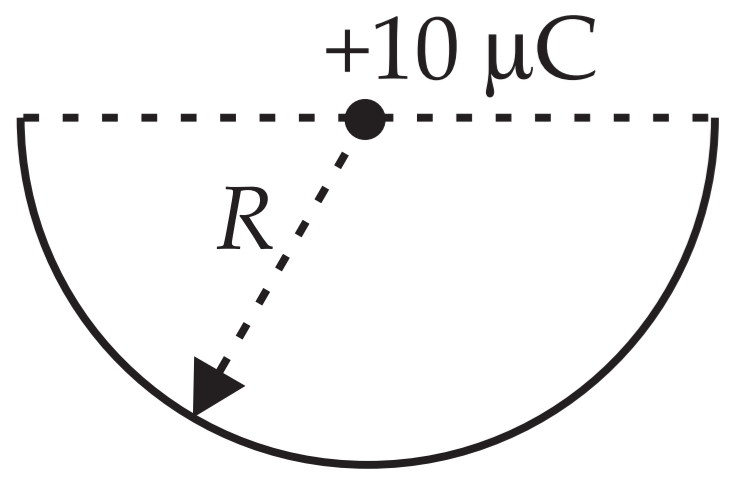
  1. A charge $10\mu\text{C}$ is placed at the centre of a hemisphere of radius R = 10cm as shown. The electric flux through the hemisphere (in MKS units) is:

  1. 20 × 105
  2. 10 × 105
  3. 6 × 10⁵
  4. 2 × 10⁵
  1. The electric flux through a closed surface area S enclosing charge Q is $\phi$. If the surface area is doubled, then the flux is:
  1. $2\phi$

  2. $\frac{\phi}{2}$

  3. $\frac{\phi}{4}$

  4. $\phi$

  1. A Gaussian surface encloses a dipole. The electric flux through this surface is:
  1. $\frac{\text{q}}{\in_0}$

  2. $\frac{\text{2q}}{\in_0}$

  3. $\frac{\text{q}}{2\in_0}$

  4. $\text{Zero}$

A closed bottle contains some liquid. The bottle is shaken vigorously for 5 minutes. It is found that the temperature of the liquid is increased. Is heat transferred to the liquid? Is work done on the liquid? Neglect expansion on heating.
A narrow pencil of parallel light is incident normally on a solid transparent sphere of radius r. What should be the refractive index if the pencil is to he focused.
  1. At the surface of the sphere.
  2. At the centre of the sphere.
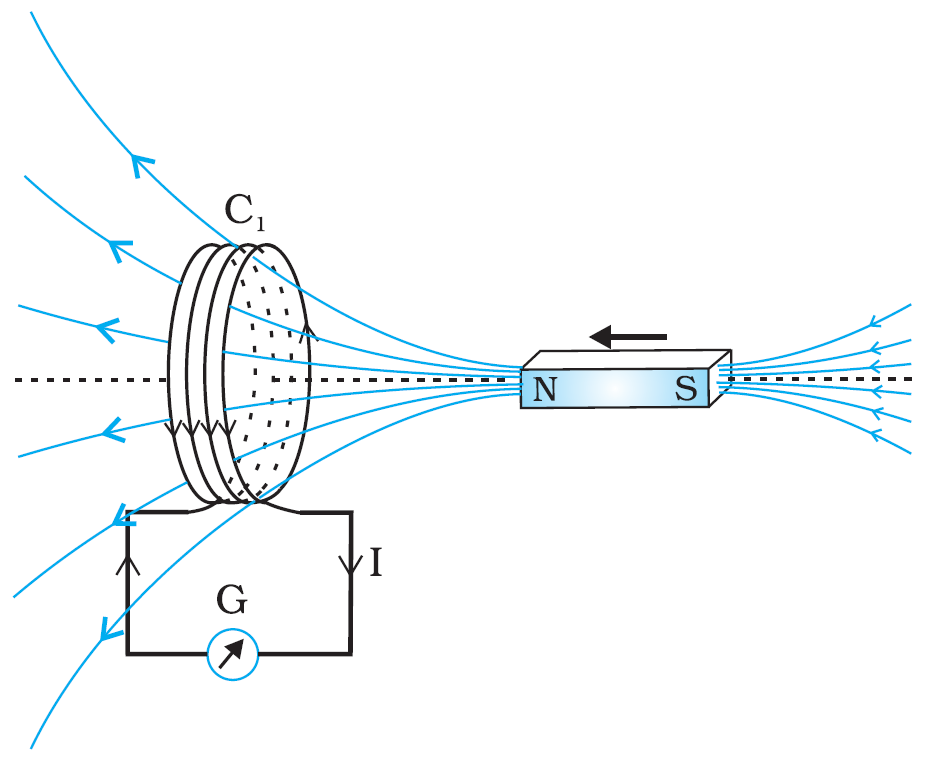
In year 1820 Oersted discovered the magnetic effect of current. Faraday gave the thought that reverse of this phenomenon is also possible i.e., current can also be produced by magnetic field. Faraday showed that when we move a magnet towards the coil which is connected by a sensitive galvanometer. The galvanometer gives instantaneous deflection showing that there is an electric current in the loop.

Whenever relative motion between coil and magnet takes place an emf induced in coil. If coil is in closed circuit then current is also induced in the circuit. This phenomenon is called electromagnetic induction.

  1. The north pole of a long bar magnet was pushed slowly into a short solenoid connected to a galvanometer. The magnet was held stationary for a few seconds with the north pole in the middle of the solenoid and then withdrawn rapidly. The maximum deflection of the galvanometer was observed when the magnet was:
  1. Moving towards the solenoid.
  2. Moving into the solenoid.
  3. At rest inside the solenoid.
  4. Moving out of the solenoid.
  1. Two similar circular loops carry equal currents in the same direction. On moving the coils further apart, the electric current will.
  1. Remain unaltered.
  2. Increases in one and decreases in the second.
  3. Increase in both.
  4. Decrease in both.
  1. A closed iron ring is held horizontally and a bar magnet is dropped through the ring with its length along the axis of the ring. The acceleration of the falling magnet is.
  1. Equal to g.
  2. Less than g.
  3. More than g.
  4. Depends on the diameter of the ring and length of magnet.
  1. Whenever there is a relative motion between a coil and a magnet, the magnitude of induced emf set up in the coil does not depend upon the:
  1. Relative speed between the coil and magnet.
  2. Magnetic moment of the coil.
  3. Resistance of the coil.
  4. Number of turns in the coil.
  1. A coil of metal wire is kept stationary in a non-uniform magnetic field:
  1. A n emf and current both are induced in the coil.
  2. A current but no emf is induced in the coil.
  3. An emf but no current is induced in the coil.
  4. Neither emf nor current is induced in the coil.