Potential gradient is defined as
Easy
Download our app for free and get started
(a) Potential gradient $ = \frac{{{\rm{Potential difference }}}}{{{\rm{Length}}}}$

Download our appand get started for free
Experience the future of education. Simply download our apps or reach out to us for more information. Let's shape the future of learning together!No signup needed.*
Similar Questions
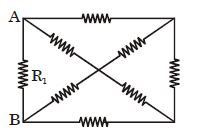
- 1As shown, the circuit is made of $8$ different resistors. It is found that when $R_1 = 4\,\,\Omega,$ the resistance between $A$ and $B$ is $2\,\,\Omega.$ Now replace $R_1$ by a $6\,\,\Omega$ resistor, what is the resistance between $A$ and $B$?View Solution
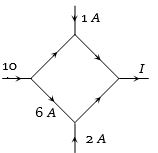
- 2The figure shows a network of currents. The magnitude of currents is shown here. The current $I$ will be ........... $A$View Solution
- 3Two cells of same emf but different internal resistances $I_{1}$ and $I_{2}$ are connected in series with a resistance $R$. The value of resistance $R$, for which the potential difference across second cell is zero, isView Solution
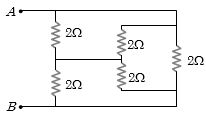
- 4Find the equivalent resistance across $AB$ .............. $\Omega$View Solution
- 5In a potentiometer wire experiment the $\mathrm{emf}$ of a battery in the primary circuit is $20\,V$ and its internal resistance is $5\,\Omega$ . There is a resistance box in series with the battery and the potentiometer wire, whose resistance can be varied from $120\,\Omega$ to $170\,\Omega$ . Resistance of the potentiometer wire is $75\,\Omega$ . The following potential differences can be measured using this potentiometer.View Solution
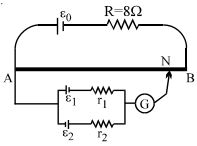
- 6$A$ battery of $\mathrm{emf}$ $E_0 = 12\, V$ is connected across a $4\,m$ long uniform wire having resistance $4\,\Omega /m$. The cells of small $\mathrm{emfs}$ $\varepsilon_1 = 2\,V$ and $\varepsilon_2 = 4\,V$ having internal resistance $2\Omega$ and $6\Omega$ respectively, are connected as shown in the figure. If galvanometer shows no deflection at the point $N$, the distance of point $N$ from the point $A$ is equal toView Solution
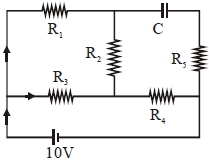
- 7An ideal cell of emf $10\, V$ is connected in circuit shown in figure. Each resistance is $2\, \Omega .$ The potential difference (in $V$) across the capacitor when it is fully charged isView Solution
- 8The specific resistance of manganin is $50 \times {10^{ - 8}}\,ohm \times m$. The resistance of a cube of length $50\,cm$ will beView Solution
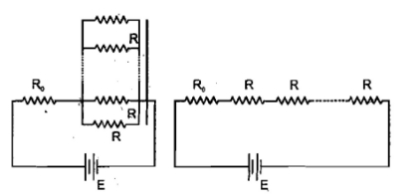
- 9In the circuit shown, $n$-identical resistors $R$ are connected in parallel $(n > 1)$ and the combination is connected in series to another resistor $R_0$. In the adjoining circuit $n$ resistors of resistance $R$ are all connected in series alongwith $R_0$. The batteries in both circuits are identical and net power dissipated in the $n$ resistors in both circuits is same. The ratio $R_0 / R$ isView Solution
- 10An insulating pipe of cross-section area $'A'$ contains an electrolyte which has two types of ions $\rightarrow$ their charges being $-e$ and $+2e$. $A$ potential difference applied between the ends of the pipe result in the drifting of the two types of ions, having drift speed $= v$ ($-ve$ ion) and $v/4$ ($+ve$ ion). Both ions have the same number per unit volume $= n$. The current flowing through the pipe isView Solution