MCQ
Potential gradient is defined as
  • Fall of potential per unit length of the wire
  • B
    Fall of potential per unit area of the wire
  • C
    Fall of potential between two ends of the wire
  • D
    Potential at any one end of the wire

Answer

Correct option: A.
Fall of potential per unit length of the wire
a
(a) Potential gradient $ = \frac{{{\rm{Potential difference }}}}{{{\rm{Length}}}}$

Need a full question paper?

Generate a complete, print-ready paper with questions like this in minutes — across 16+ boards, with answer keys.
Start Generating Free

Similar questions

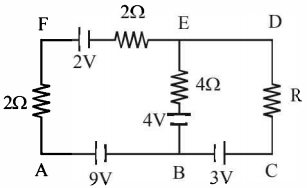
In the electric network shown, when no current flows through the $4 \Omega$ resistor in the arm EB, the potential difference between the points $A$ and $D$ will be $.............\,V$
An intrinsic semiconductor is                         :
Band spectrum is characteristic of
Which one of the following gives the resultant capacitor when capacitors are joined in series?
A magnetic dipole of length 10cm has pole strength of 20Am. Find the magnetic moment of the dipole.
Time period of oscillation of a magnetic needle is
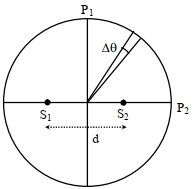
Two coherent monochromatic point sources $S_1$ and $S_2$ of wavelength $\lambda=600 \mathrm{~nm}$ are placed symmetrically on either side of the centre of the circle as shown. The sources are separated by a distance $d=1.8 ~mm$. This arrangement produces interference fringes visible as alternate bright and dark spots on the circumference of the circle. The angular separation between two consecutive bright spots is $\Delta \theta$. Which of the following options is/are correct?

(image)

$[A]$ A dark spot will be formed at the point $\mathrm{P}_2$

$[B]$ At $P_2$ the order of the fringe will be maximum

$[C]$ The total number of fringes produced between $P_1$ and $P_2$ in the first quadrant is close to $3000$

$[D]$ The angular separation between two consecutive bright spots decreases as we move from $P_1$ to $P_2$ along the first quadrant
Two coils have of self inductance $L_1 = 4\, mH$ and $L_2 = 1\, mH$ respectively. The currents in the two coils are increased at the same rate. At a certain instant of time both coils are given the same power. If $I_1$ and $I_2$ are the currents in the two coils at that instant of time respectively, then the value of $\frac{{{I_1}}}{{{I_2}}}$ is
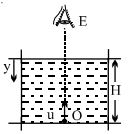
An insect starts moving up in a liquid from point $O$ of variable refractive index $\mu = \mu_0(1 + ay)$ where $y$ is depth of liquid from the surface. If $u$ is the speed of insect, its apparent speed to the observer $E$ is
In $Y.D.S.E.,$ the slits are $0.2\,cm$ apart and are illuminated by yellow light $(\lambda  = 600\,nm).$ What would be the fringe width on a screen placed $1\,m$ from the plane of the slits if the whole system is immersed in water of index $\frac {4}{3}$