Question
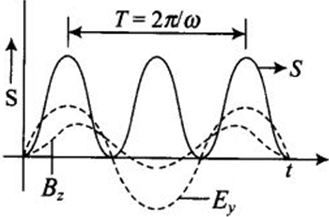
Poynting vectors S is defined as a vector whose magnitude is equal to the wave intensity and whose direction is along the direction of wave propogation. Mathematically, it is given by $\text{S}=\frac{1}{\mu_0}\text{E}\times\text{B}$. Show the nature of S vs t graph.
Answer

In an electromagnetic waves, let $\vec{\text{E}}$ be varying along y-axis, $\vec{\text{B}}$ is along z-axis and propagation of wave be along x-axis. Then $\vec{\text{E}}\times\vec{\text{B}}$ will tell the direction of propagation of energy flow in eletromagnetic wave, along x-axis.
Let $\vec{\text{E}}=\text{E}_0\sin(\omega\text{t}-\text{kx})\hat{\text{j}}$
$\vec{\text{B}}=\text{B}_0\sin(\omega\text{t}-\text{kx})\hat{\text{k}}$
$\text{S}=\frac{1}{\mu_0}(\vec{\text{E}}\times\vec{\text{B}})=\frac{1}{\mu_0}\text{E}_0\text{B}_0\sin(\omega\text{t}-\text{kx})(\hat{\text{j}}\times\hat{\text{k}})$
$\Rightarrow\ \text{S}=\frac{\text{E}_0\text{B}_0}{\mu_0}\sin^2(\omega\text{t}-\text{kx})\hat{\text{i}}\ \ (\text{As}\ \hat{\text{j}}\times\hat{\text{k}}=\hat{\text{i}})$
Since $\sin^2(\omega\text{t}-\text{kx})$ is never negative, $\vec{\text{S}}(\text{x},\text{t})$ always points in the positive X-direction, i.e, in the direction of wave propagation.
The variation of |S| with time T will be as given in the figure below:

Need a full question paper?

Generate a complete, print-ready paper with questions like this in minutes — across 16+ boards, with answer keys.

Start Generating Free

Similar questions

In many experimental set-ups the source and screen are fixed at a distance say D and the lens is movable. Show that there are two positions for the lens for which an image is formed on the screen. Find the distance between these points and the ratio of the image sizes for these two points.
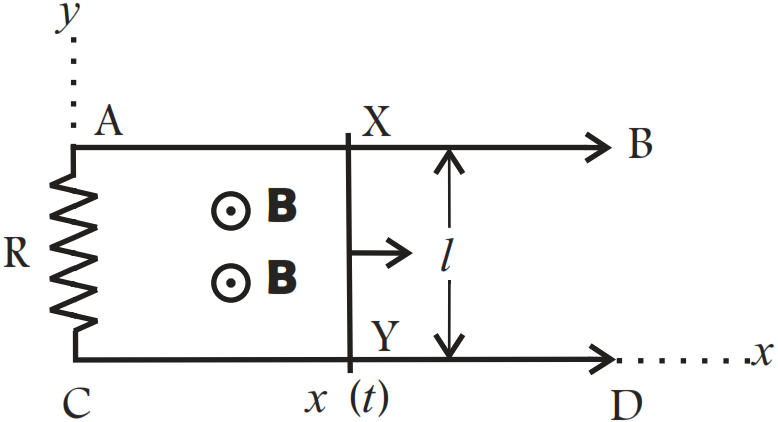
A conducting wire XY of mass m and neglibile resistance slides smoothly on two parallel conducting wires as shown in Fig. The closed circuit has a resistance R due to AC. AB and CD are perfect conductors. There is a magnetic field $\text{B}=\text{B}(\text{t})\hat{\text{k}}$.

  1. Write down equation for the acceleration of the wire XY.
  2. If B is independent of time, obtain v(t), assuming v(0) = u0.
  3. For (b), show that the decrease in kinetic energy of XY equals the heat lost in R.
A parallel-plate capacitor of plate area A and plate separation d is charged to a potential difference V and then the battery is disconnected. A slab of dielectric constant K is then inserted between the plates of the capacitor so as to fill the space between the plates. Find the work done on the system in the process of inserting the slab.
A wire of length l is bent in the form of an equilateral triangle and carries an electric currrent i.
  1. Find the magnetic field B at the centre.
  2. If the wire is bent in the form of a square, what would be the value of B at the centre?
Two point charges $q_1$ and $q_2$, of magnitude $+10^{-8} C$ and $-10^{-8} C$, respectively, are placed $0.1 m$ apart. Calculate the electric fields at points A, B and C shown in Fig. 1.11.
Image
Consider a wire of length 4m and cross-sectional area 1mm2 carrying a current of 2A. If each cubic metre of the material contains 1029 free electrons, find the average time taken by an electron to cross the length of the wire.
Figure shows three equidistant slits being illuminated by a monochromatic parallel beam of light. Let $\text{BP}_0-\text{AP}=\frac{\lambda}{3}$ and $\text{D}>\lambda.$
  1. Show that in this case $\text{d}=\sqrt{\frac{2\lambda\text{D}}{3}}.$
  2. Show that the intensity at P, is three times the intensity due to any of the three slits individually.

Find the current in the sliding rod AB (resistance = R) for the arrangement shown in Fig. B is constant and is out of the paper. Parallel wires have no resistance. v is constant. Switch S is closed at time t = 0.

A hollow tube has a length l1 inner radius R1 and outer radius R2. The material has a thermal conductivity K. Find the heat flowing through the walls of the tube if.
  1. The flat ends are maintained at temperatures T1 and T2(T2 > T1)
  2. The inside of the tube is maintained at temperature T1 and the outside is maintained at T2.
When a p-n junction is reverse-biased, the current becomes almost constant at $25\mu\text{A}.$ When it is forwardbiased at 200mV, a current of $75\mu\text{A}$ is obtained. Find the magnitude of diffusion current when the diode is,
  1. Unbiased.
  2. Reverse-biased at 200mV.
  3. Forward-biased at 200mV.