Question
When a p-n junction is reverse-biased, the current becomes almost constant at $25\mu\text{A}.$ When it is forwardbiased at 200mV, a current of $75\mu\text{A}$ is obtained. Find the magnitude of diffusion current when the diode is,
  1. Unbiased.
  2. Reverse-biased at 200mV.
  3. Forward-biased at 200mV.

Answer

  1. $\text{i}_1=25\mu\text{A},\text{V}=200\text{mV},\text{i}_2=75\mu\text{A}$

When in unbiased condition drift current = diffusion current

$\therefore$ Diffusion current $=25\mu\text{A}.$

  1. On reverse biasing the diffusion current becomes ‘O’.
  2. On forward biasing the actual current be x.

x - Drift current = Forward biasing current

$\Rightarrow\text{x}-25\mu\text{A}=75\mu\text{A}$

$\Rightarrow\text{x}=(75+25)\mu\text{A}=100\mu\text{A}.$

Need a full question paper?

Generate a complete, print-ready paper with questions like this in minutes — across 16+ boards, with answer keys.

Start Generating Free

Similar questions

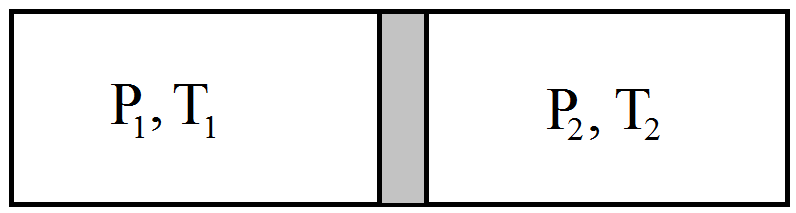
The figure shows an adiabatic cylindrical tube of volume V0 divided in two parts by a frictionless adiabatic separator. Initially, the separator is kept in the middle, an ideal gas at pressure p1 and temperature T1 is injected into the left part and another ideal gas at pressure p2 and temperature T2 is injected into the right part. $\frac{\text{C}_\text{P}}{\text{C}_\text{V}}=\gamma$ is the same for both the gases. The separator is slid slowly and is released at a position where it can stay in equilibrium. Find,

  1. The volumes of the two parts.
  2. The heat given to the gas in the left part.
  3. The final common pressure of the gases.

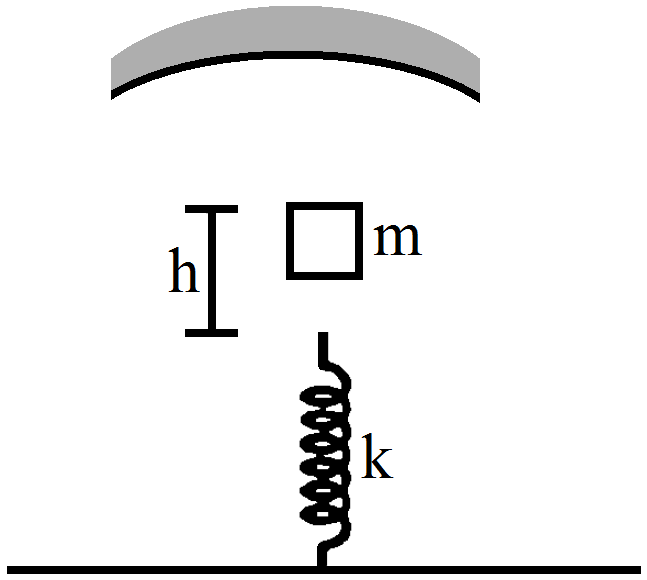
A mass m = 50g is dropped on a vertical spring of spring constant 500N/m from a height h = 10cm as shown in figure. The mass sticks to the spring and executes simple harmonic oscillations after that. A concave mirror of focal length 12cm facing the mass is fixed with its principal axis coinciding with the line of motion of the mass, its pole being at a distance of 30cm from the free end of the spring. Find the length in which the image of the mass oscillates.

A uniform ladder of length 10.0m and mass 16.0kg is resting against a vertical wall making an angle of 37° with it. The vertical wall is frictionless but the ground is rough. An electrician weighing 60.0kg climbs up the ladder. If he stays on the ladder at a point 8.00m from the lower end, what will be the normal force and the force of friction on the ladder by the ground? What should be the minimum coefficient of friction for the elctrician to work safely?
A particle of charge 2.0 × 10⁻⁸C and mass 2.0 × 10⁻¹⁰g is projected with a speed of 2.0 × 10³m/s-1in a region with a uniform magnetic field of 0.10T. The velocity is perpendicular to the field. Find the radius of the circle formed by the particle and also the time period.
Air is pumped into an automobile tyre's tube up to a pressure of 200kPa in the morning when the air temperature is 20°C. During the day the temperature rises to 40°C and the tube expands by 2%. Calculate the pressure of the air in the tube at this temperature.
A source of sound emitting a 1200Hz note travelg along a straight line at a speed of 170m/s. A detector is placed at a distance of 200m from the line of motion of the source.
  1. Find the frequency of sound received by the detector at the instant when the source gets closest to it.
  2. Find the distance between the source and the detector at the instant it detects the frequency 1200Hz. Velocity of sound in air = 340m/s.
A solid sphere of mass 0.50kg is kept on a horizontal surface. The coefficient of static friction between the surfaces in contact is $\frac{2}{7}.$ What maximum force can be applied at the highest point in the horizontal direction so that the sphere does not slip on the surface?
State and Prove Gauss theorem in electrostatics.
Define resonance. Explain resonant frequency and write characteristics of resonant circuit.
The neutron separation energy is defined as the energy required to remove a neutron from the nucleus. Obtain the neutron separation energies of the nuclei $^{41}_{20}\text{Ca }\text{ and }^{27}_{13}\text{Al}$ from the following data: 
$\text{m}(^{40}_{20}\text{Ca})=39.962591\text{ u}$
$\text{m}(^{41}_{20}\text{Ca})=40.962278\text{ u}$
$\text{m}(^{26}_{13}\text{Al})=25.986895\text{ u}$
$\text{m}(^{27}_{13}\text{Al})=26.981514\text{ u}$