Question
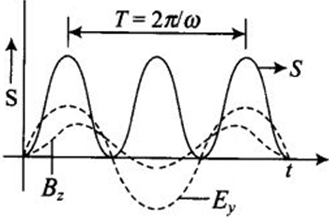
Poynting vectors S is defined as a vector whose magnitude is equal to the wave intensity and whose direction is along the direction of wave propogation. Mathematically, it is given by $\text{S}=\frac{1}{\mu_0}\text{E}\times\text{B}$. Show the nature of S vs t graph.
Answer

In an electromagnetic waves, let $\vec{\text{E}}$ be varying along y-axis, $\vec{\text{B}}$ is along z-axis and propagation of wave be along x-axis. Then $\vec{\text{E}}\times\vec{\text{B}}$ will tell the direction of propagation of energy flow in eletromagnetic wave, along x-axis.
Let $\vec{\text{E}}=\text{E}_0\sin(\omega\text{t}-\text{kx})\hat{\text{j}}$
$\vec{\text{B}}=\text{B}_0\sin(\omega\text{t}-\text{kx})\hat{\text{k}}$
$\text{S}=\frac{1}{\mu_0}(\vec{\text{E}}\times\vec{\text{B}})=\frac{1}{\mu_0}\text{E}_0\text{B}_0\sin(\omega\text{t}-\text{kx})(\hat{\text{j}}\times\hat{\text{k}})$
$\Rightarrow\ \text{S}=\frac{\text{E}_0\text{B}_0}{\mu_0}\sin^2(\omega\text{t}-\text{kx})\hat{\text{i}}\ \ (\text{As}\ \hat{\text{j}}\times\hat{\text{k}}=\hat{\text{i}})$
Since $\sin^2(\omega\text{t}-\text{kx})$ is never negative, $\vec{\text{S}}(\text{x},\text{t})$ always points in the positive X-direction, i.e, in the direction of wave propagation.
The variation of |S| with time T will be as given in the figure below:

Need a full question paper?

Generate a complete, print-ready paper with questions like this in minutes — across 16+ boards, with answer keys.

Start Generating Free

Similar questions

Find the reading of the spring balance shown in figure. The elevator is going up with an acceleration of $\frac{\text{g}}{10},$ the pulley and the string are light and the pulley is smooth.
If the nucleons of a nucleus are separated from each other, the total mass is increased. Where does this mass come from?
A current of 1.0A exists in a copper wire of cross-section $1.0mm^2$. Assuming one free electron per atom, calculate the drift speed of the free electrons in the wire. The density of copper is $9000kg/m^{-3}.$
There is another useful system of units, besides the SI/mks A system, called the cgs (centimeter-gram-second) system. In this system Coloumb’s law is given by
$\text{F}=\frac{\text{Qq}}{\text{r}^2}\hat{\text{r}}$
where the distance r is measured in cm $(= 10^{-2}m)$, F in dynes $(=10^{-5}N)$ and the charges in electrostatic units (es units), where
les unit of charge $=\frac{1}{[3]}\times10^{-9}\text{C}$
The number [3] actually arises from the speed of light in vaccum which is now taken to be exactly given by $c = 2.99792458 × 10⁸ m/s$. An approximate value of c then is c = [3] × 108 m/s.
  1. Show that the coloumb law in cgs units yields
1 esu of charge = 1 (dyne)1/2 cm.

Obtain the dimensions of units of charge in terms of mass M, length L and time T. Show that it is given in terms of fractional powers of M and L.
  1. Write 1 esu of charge = x C, where x is a dimensionless number. Show that this gives
$\frac{1}{4\pi\in_0}=\frac{10^{-9}}{\text{x}^2}\frac{\text{N.m}^2}{\text{C}^2}$

With $\text{x}=\frac{1}{[3]}\times10^{-9}$, we have

$\frac{1}{4\pi\in_0}=[3]^2\times10^9\frac{\text{Nm}^2}{\text{C}^2}$

Or, $\frac{1}{4\pi\in_0}=(2.99792458)^2\times10^{9}\frac{\text{Nm}^2}{\text{C}^2}\text{(exactly).}$
State ampere's law. Obtain expression for magnetic field at a point located (i) externally (ii) internally due to a long cylindrical solid current carrying conductor.###Calculate the value of magnetic field at points $(r>a)$ and $(r
A point object 'O' is kept in a medium of refractive index $n_1$ in front of a convex spherical surface of radius of curvature R which separates the second medium of refractive index $n_2$ from the first one, as shown in the figure.
  1. Draw the ray diagram showing the image formation and deduce the relationship between the object distance and the image distance in terms of $n_1, n_2$ and R.
  2. When the image formed above acts as a virtual object for concave spherical, surface separating the medium $n_2$ from $n_1 (n_2> n_1)$, draw this ray diagram and write the similar (similar to (a) relation. Hence obtain the expression for the lens maker's formula.
The earth revolves round the sun due to gravitational attraction. Suppose that the sun and the earth are point particles with their existing masses and that Bohr's quantization rule for angular momentum is valid in the case of gravitation. (a) Calculate the minimum radius the earth can have for its orbit. (b) What is the value of the principal quantum number n for the present radius? Mass of the earth $= 6.0 \times 10^{-24}$kg. Mass of the sun $= 2.0 \times 10^{30}$kg, earth-sun distance $= 1.5 \times 10^{11}$m.
Derive the expression for the magnetic field at the site of a point nucleus in a hydrogen atom due to the circular motion of the electron. Assume that the atom is in its ground state and give the answer in terms of fundamental constants.
In an experiment on photoelectric effect, the stopping potential is measured for monochromatic light beams corresponding to different wavelengths. The data collected are 11s follows:
wavelength (nm) 350 400 450 500 550
stopping potential(V): 1.45 1.00 0.66 0.38 0.16
Plot the stopping potential against inverse of wavelength $\big(\frac{1}{\lambda}\big) $ on a graph paper and find
  1. The Planck constant,
  2. The work function of the emitter and.
  3. The threshold wavelength.
A double convex lens has focal length 25cm. The radius of curvature of one of the surfaces is double of the other. Find the radii, if the refractive index of the material of the lens is 1.5.