A double convex lens has focal length 25cm. The radius of curvature of one of the surfaces is double of the other. Find the radii, if the refractive index of the material of the lens is 1.5.
Download our app for free and get started
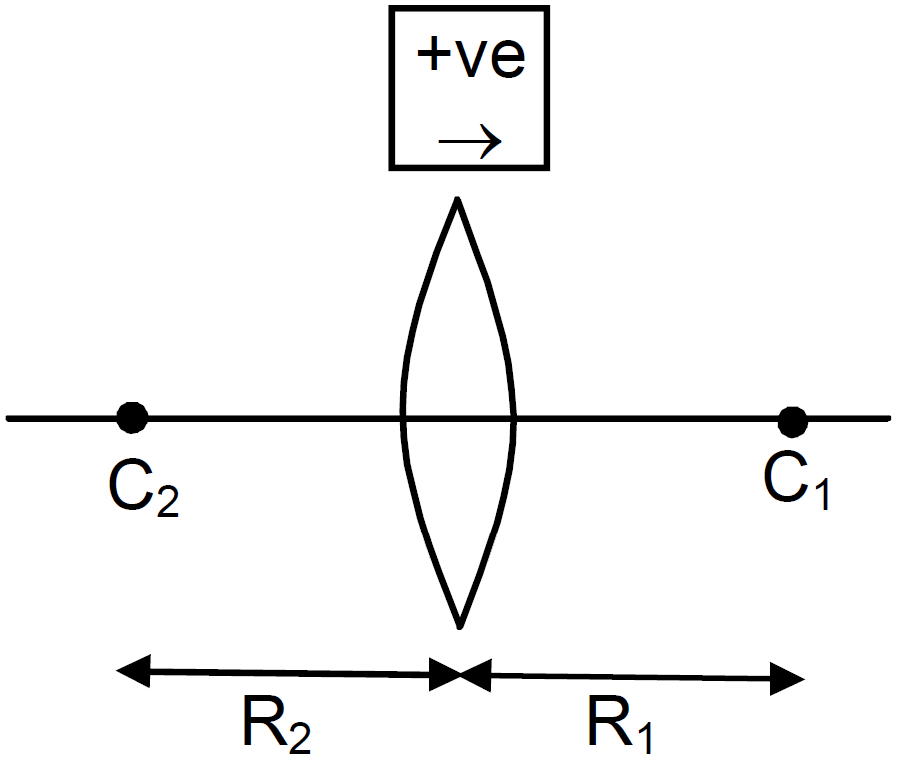
For the double convex lens
$f = 25cm, R_1= R$ and $R_2 = -2R$ (sign convention)
$\frac{1}{\text{f}}=(\mu-1)\Big(\frac{1}{\text{R}_1}-\frac{1}{\text{R}_2}\Big)$
$\Rightarrow\frac{1}{25}=(15-1)\Big(\frac{1}{\text{R}_1}-\frac{1}{-2\text{R}}\Big)=0.5\Big(\frac{3\text{R}}{2}\Big)$
$\Rightarrow\frac{1}{25}=\frac{3}{4}\frac{1}{\text{R}}\Rightarrow\text{R}=18.75\text{cm}$
$R_1= 18.75cm, R_2 = 2R = 37.5cm.$

Download our appand get started for free
Experience the future of education. Simply download our apps or reach out to us for more information. Let's shape the future of learning together!No signup needed.*
Similar Questions
- 1View SolutionA 5mm high pin is placed at a distance of 15cm from a convex lens of focal length 10cm. A second lens of focal length 5cm is placed 40cm from the first lens and 55cm from the pin. Find
- The position of the final image.
- Its nature.
- Its size.
- 2A point object 'O' is kept in a medium of refractive index $n_1$ in front of a convex spherical surface of radius of curvature R which separates the second medium of refractive index $n_2$ from the first one, as shown in the figure.View Solution
- Draw the ray diagram showing the image formation and deduce the relationship between the object distance and the image distance in terms of $n_1, n_2$ and R.
- When the image formed above acts as a virtual object for concave spherical, surface separating the medium $n_2$ from $n_1 (n_2> n_1)$, draw this ray diagram and write the similar (similar to (a) relation. Hence obtain the expression for the lens maker's formula.
- 3View SolutionA paperweight in the form of a hemisphere of radius 3.0cm is used to hold down a printed page. An observer looks at the page vertically through the paperweight. At what height above the page will the printed letters near the centre appear to the observer?
- 4View Solution
- Draw a ray diagram to show image formation when the concave mirror produces a real, inverted and magnified image of the object.
- Obtain the mirror formula and write the expression for the linear magnification.
- Explain two advantages of a reflecting telescope over a refracting telescope.
- 5View SolutionA particle executes a simple harmonic motion of amplitude 1.0cm along the principal axis of a convex lens of focal length 12cm. The mean position of oscillation is at 20cm from the lens. Find the amplitude of oscillation of the image of the particle.
- 6View SolutionA small bulb is placed at the bottom of a tank containing water to a depth of 80cm. What is the area of the surface of water through which light from the bulb can emerge out? Refractive index of water is 1.33. (Consider the bulb to be a point source).
- 7View SolutionThe separation between the objective and the eyepiece of a compound microscope can be adjusted between 9.8cm to 11.8cm. If the focal lengths of the objective and the eyepiece are 1.0cm and 6cm respectively, find the range of the magnifying power if the image is always needed at 24cm from the eye.
- 8View SolutionA myopic adult has a far point at 0.1m. His power of accomodation is 4 diopters.
- What power lenses are required to see distant objects?
- What is his near point without glasses?
- What is his near point with glasses? (Take the image distance from the lens of the eye to the retina to be 2cm.)
- 9View SolutionA compound microscope has a magnifying power of 100 when the image is formed at infinity. The objective has a focal length of 0.5cm and the tube length is 6.5cm. Find the focal length of the eyepiece.
- 10A ball is kept at a height h above the surface of a heavy transparent sphere made of a material of refractive index $\mu.$ The radius of the sphere is R. At t = 0, the ball is dropped to fall normally on the sphere. Find the speed of the image formed as a function of time for $\text{t}<\sqrt{\frac{2\text{h}}{\text{g}}}.$ Consider only the image by a single refraction.View Solution