Question
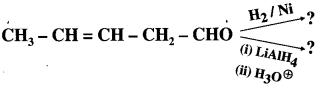
Predict the products for the following reaction.

Image

Answer

The substrate (A) contains an isolated
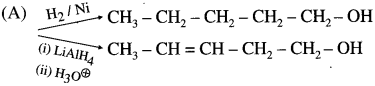
Image
 and an aldehyde group. $H_2/Ni$ can reduce both these functional groups while $LiAlH_4$ can reduce only $– CHO$ of the two, Hence

​​​​​​​Image

Need a full question paper?

Generate a complete, print-ready paper with questions like this in minutes — across 16+ boards, with answer keys.
Start Generating Free

Similar questions

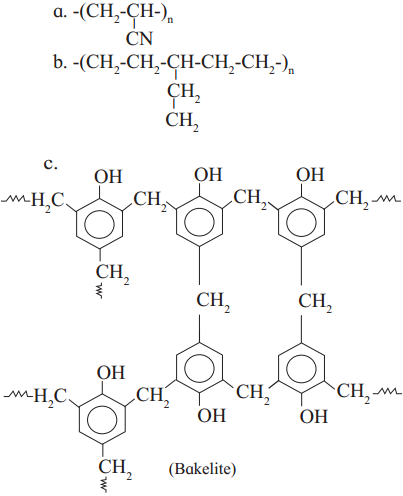
Classify the following polymers as straight-chain, branched-chain and cross-linked polymers.

Image

Why naphthalene dissolves in benzene but not in water ?
Write reactions to bring about the following conversions :
a. Aniline into p-nitroaniline
b. Aniline into sulphanilic acid?
While considering boiling point elevation and freezing point depression a solution concentration is expressed in molality and not in molarity. Why?
How will you determine activation energy: (a) graphically using Arrhenius equation (b) from rate constants at two different temperatures?
What are soaps ? How are they prepared ?
An organic compound A with molecular formula $C_4H_{10}O$ on treatment with phosphorus pentachloride gives alkyl chloride. Alkyl chloride on treatment with Mg in presence of dry ether gives a highly reactive compound B.
Compound B reacts with water to give hydrocarbon C. Alkyl chloride on treatment with Na in dry ether as a solvent gives alkane, $2,2,3,3$-tetramethylbutane. Identify ‘A’, ‘B’, ‘C’
A reaction occurs in the following steps:

Step 1:
$
NO _{2( g )}+ F _2 \longrightarrow NO _2 F _{( g )}+ F _{( g )}
$
(slow)

Step 2:
$
F _{( g )}+ NO _{2( g )} \longrightarrow NO _2 F
$
(Fast)
1. Write the equation of overall reaction.
2. Write the rate law.
3. Identify reaction intermediate.
Give the number of lattice points in one unit cell of the following crystal structures :
(1) Simple cubic
(2) Face-centred cubic
(3) Body-centred cubic.
Write the structure and give IUPAC names of following carboxylic acid.
(1) $\alpha, \beta$-Dimethyl butanoic acid :
(2) $\beta$-Phenylbutyric acid :
(3) $\gamma$-Chloro- $\alpha$-methyl valeric acid :