Question
How will you determine activation energy: (a) graphically using Arrhenius equation (b) from rate constants at two different temperatures?
Answer

(a) By Arrhenius equation,
Rate constant $== A \times e ^{- E _2 / R T}$ where A is a fre-quency factor.
$\therefore \ln k=\ln A-\frac{E_{ a }}{R T}$
$\therefore 2.303 \log _{10} k=2.303 \log _{10} A-\frac{E_{ a }}{R T}$​​​​​​​
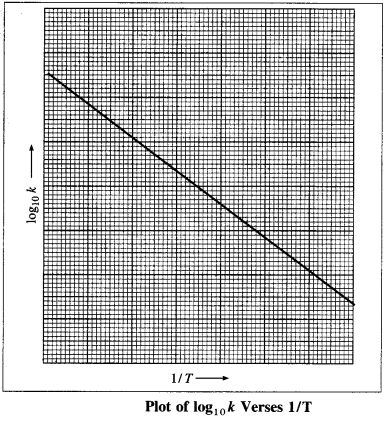
Image
$\therefore \log _{10} k=\log _{10} A-\frac{E_{ a }}{2.303 R T}$
$\therefore \log _{10} k=-\left(\frac{E_{ a }}{2.303 R}\right) \times \frac{1}{T}+\log _{10} A$
$\quad(y=-m x+ C )$
When $log_{10}k$ is plotted against 1/T a straight line with negative slope is obtained. From the slope of the graph, energy of activation $E_a$, is obtained as follows :
$ \text { Slope }=\frac{E_{ a }}{2.303 R}$
$\therefore \text { Ea }=2303 R \times \text { sloPe } $
(b) For the given reaction, rate constants $k _1$ and $k _2$ are measured at two different temperatures $T_1$ and $T_2$ respectively. Then $\log _{10} \frac{k_2}{k_1}=\frac{E_a\left(T_2-T_1\right)}{2.303 R \times T_1 \times T_2}$ where $E_a$ is the energy of activation.
Hence by substituting appropriate values, energy of activation $E_a$ for the reaction is determined.

Need a full question paper?

Generate a complete, print-ready paper with questions like this in minutes — across 16+ boards, with answer keys.
Start Generating Free

Similar questions