Question

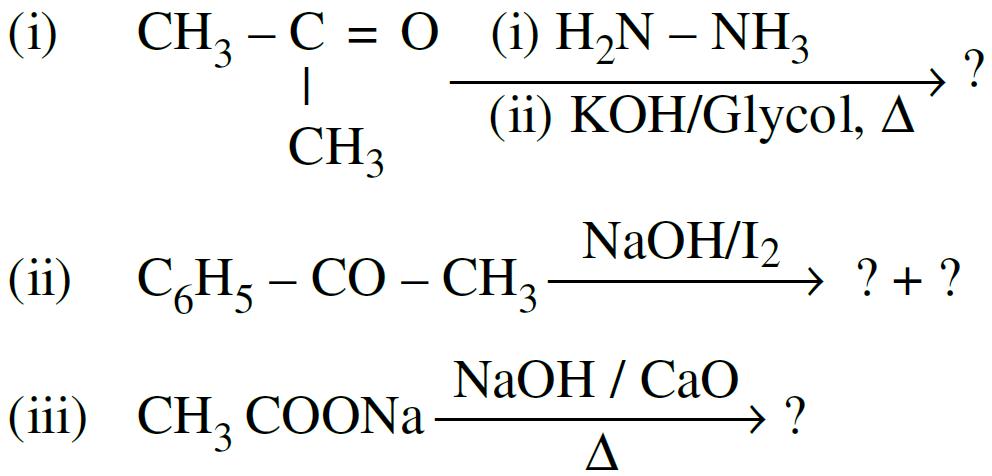
Predict the products of the following reactions:
Answer

  1. $CH_3CH_2CH_{3.}$
  2. $C_6H_5COONa+CHI_{3.}$
  3. $CH_{4.}$

Need a full question paper?

Generate a complete, print-ready paper with questions like this in minutes — across 16+ boards, with answer keys.
Start Generating Free

Similar questions

Explain the role of the following:
  1. $CO$ in the refining of $Ni.$
  2. Limestone in the metallurgy of $Fe.$
  3. Depressant in the froth floatation method.
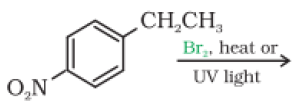
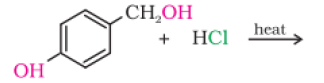
Write the major products in the following:
Image
Calculate the emf of the following cell at 298 K :
$\mathrm{Fe}(\mathrm{~s})\left|\mathrm{Fe}^{2+}(0.001 \mathrm{M})\right|\left|\mathrm{H}^{+}(1 \mathrm{M})\right| \mathrm{H}_2(\mathrm{~g})\left(1 \text { bar), Pt (s) (Given } \mathrm{E}_{\text {cell }}^0=+0.44 \mathrm{~V}\right. \text { ) }$
Write down the IUPAC name for the following complex and indicate the oxidation state, electronic configuration and coordination number. Also give stereochemistry and magnetic moment of the complex:
$CrCl_3(py)_3$
Draw the structures of major monohalo products in each of the following reactions:
(1)
Image
(2)
Image
(3)
Image
For the decomposition of azoisopropane to hexane and nitrogen at $543$ K, the following data are obtained.
t (sec) P(mm of Hg)
$0$ $35.0$
$360$ $54.0$
$720$ $63.0$
Calculate the rate constant.
Calculate the equilibrium constant for the reaction,$\text{Cd}^{2+}(\text{aq})+\text{Zn(s)}\xrightarrow{ \ \ \ \ \ \ \ }\text{Zn}^{2+}(\text{aq) + Cd(s)}$
If $\text{E}^{\circ}_{\text{Cd}^{2+}/\text{Cd}}=-0.403\text{V;}\text{ E}^{\circ}_{\text{Zn}^{2+}/\text{Zn}}=-0.763\text{V}$
The following data were obtained during the first order thermal decomposition of $SO_2Cl_2$ at a constant volume:
$SO_2Cl_2(g) \rightarrow SO_2(g) + Cl_2(g)$
Experiment
Time/s$^{–1}$
Total pressure/atm
$1$
$0$
$0.4$
$2$
$100$
$0.7$
Calculate the rate constant.
$($Given: $\log 4 = 0.6021, \log 2 = 0.3010).$
Define the following terms with an example in each:
  1. Lyophobic colloids.
  2. Homogeneous catalysis.
  3. O/W emulsion.
Describe the following types of colloids, giving an example for each:
  1. Multimolecular colloids.
  2. Macromolecular colloids.