Question

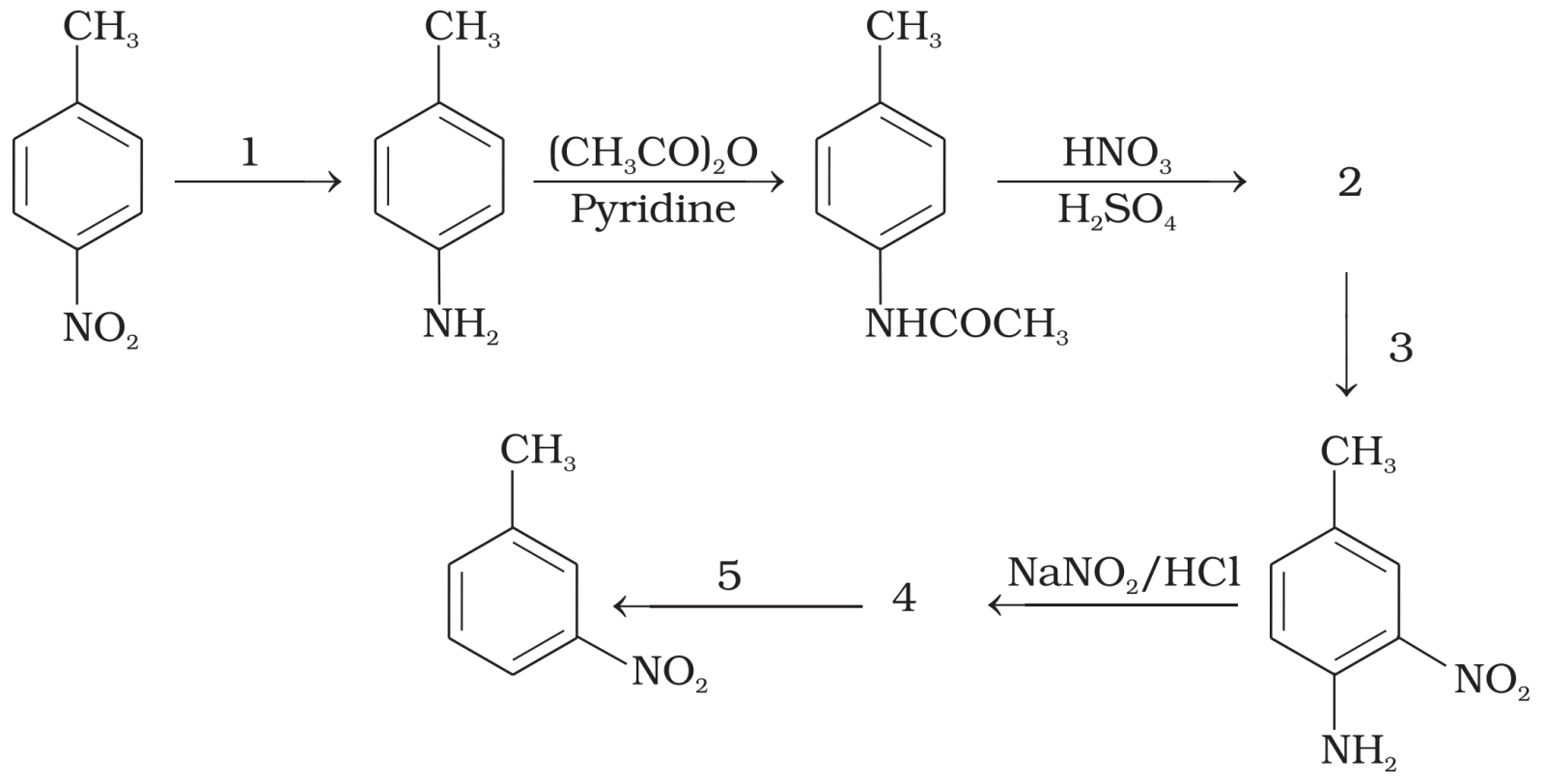
Predict the reagent or the product in the following reaction sequence.
Answer

Get the step-by-step solution for this question inside the Vidyadip app.

Get the answer in the app

Need a full question paper?

Generate a complete, print-ready paper with questions like this in minutes — across 16+ boards, with answer keys.

Start Generating Free

Similar questions

  1. Out of $(CH_3)_3C–Br$ and $(CH_3)_3C–I$, which one is more reactive towards $S_N1$ and why?
  2. Write the product formed when p-nitrochlorobenzene is heated with aqueous NaOH at $443K$ followed by acidification.
  3. Why dextro and laevo–rotatory isomers of Butan-2-ol are difficult to separate by fractional distillation?
Discuss the formation of amine compounds by reduction of nitrile and amide compounds.
Write overall cell reaction for lead storage battery when the battery is being charged.
In $PCl_5,$ phosphorus is in $sp^3d$ hybridised state but all its five bonds are not equivalent. Justify your answer with reason.
Calculate the mass percentage of benzene $(C_6H_6) $ and carbon tetrachloride $(CCl_4)$ if $22$ g of benzene is dissolved in $122$ g of carbon tetrachloride.
Neeta was experimenting in the lab to study the chemical reactivity of alcohols. She carried out a dehydration reaction of propanol at $140^\circ C$ to $180^\circ C.$ Different products were obtained at these two temperatures.
$a.$ Identify the major product formed at $140^\circ C$ and the substitution mechanism followed in this case.
$b.$ Identify the major product formed at $180^\circ C$ and the substitution mechanism followed in this case.
Explain why $[Fe(H_2O)_6]^{3+}$ has magnetic moment value of $5.92BM$ whereas $[Fe(CN)_6]^{3-}$ has a value of only $1.74BM$.
Give reasons:
  1. n-Butyl bromide has higher boiling point than t-butyl bromide.
  2. Racemic mixture is optically inactive.
  3. The presence of nitro group $(–NO_2)$ at o/p positions increases the reactivity of haloarenes towards nucleophilic substitution reactions.
How can you determine the atomic mass of an unknown metal if you know its density and the dimension of its unit cell? Explain.
A certain reaction is $50 \%$ complete in 20 minutes at 300 K and the same reaction is again $50 \%$ complete in 5 minutes at 350 K . Calculate the activation energy if it is a first order reaction. $\left[R=8.314 \mathrm{JK}^{-1} \mathrm{~mol}^{-1}\right.$, log $\left.4=0.602\right]$.