Question

Prem did an activity on tangents drawn to a circle from an external point using 2 straws and a nail for maths project as shown in figure.
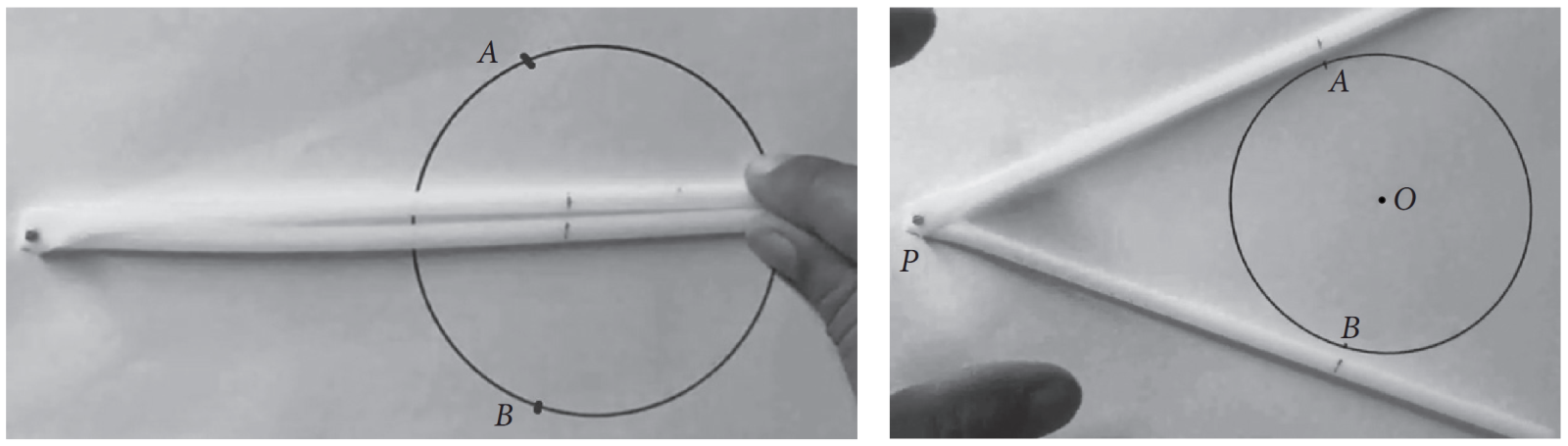
Based on the above information, answer the following questions.
  1. Number of tangents that can be drawn to a circle from an external point is:
  2. On the basis of which of the following congruency criterion, $\triangle\text{OAP}\cong\triangle\text{OBP}?$
  3. $\text{If }\angle\text{AOB}=150^\circ,\text{then }\angle\text{APB}=$
    Or
    $\text{If }\angle\text{APB}=40^\circ,\text{then }\angle\text{BAO}=$
Answer

1. 22. RHS
3. 30º
Or
20º
 

Need a full question paper?

Generate a complete, print-ready paper with questions like this in minutes — across 16+ boards, with answer keys.

Start Generating Free

Similar questions

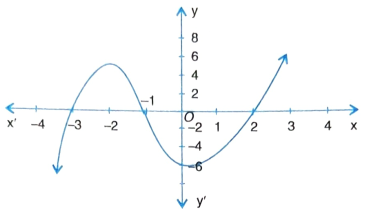
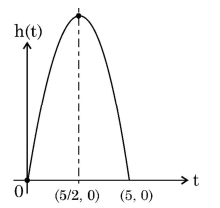
A ball is thrown in the air so that $t$ seconds after it is thrown, its height $h$ metre above its starting point is given by the polynomial $h=25 t-5 t^2$.
Image
Observe the graph of the polynomial and answer the following questions:
$(i)$ Write zeroes of the given polynomial.
$(ii)$ Find the maximum height achieved by ball.
$(iii) (a)$ After throwing upward, how much time did the ball take to reach to the height of $30 m ?$
$\text{OR}$
$(iii) (b)$ Find the two different values of $t$ when the height of the ball was $20 m.$
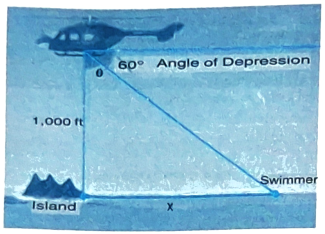
A helicopter lifts up 1000 feet over an island and spots a swimmer that need to be rescued. Using a distant land mark, the helicopter pilot determines the angle of depression.
Image
(i) As the angle of depression increases what will be the effect?
(a) The helicopter gets further from the island.
(b) The helicopter gets closer to the island.
(c) The swimmer gets closer to the island.
(d) The swimmer gets further from the island.
(ii) How does the swimmer's distance from island changes as the angle of depression is halved from $60^{\circ}$ to $30^{\circ}$ ?
(a) The swimmer's distance decreases to less than a quarter of his starting distance.
(b) The swimmer's distance from the island doubles
(c) The swimmer's distance from the island increases three times.
(d) The swimmer's distance from the island is halved.
(iii) For which angle of depression both the helicopter and swimmer's will be at same distance?
(a) $30^{\circ}$ $\qquad$ (b) $45^{\circ}$ $\qquad$ (c) $60^{\circ}$ $\qquad$ (d) $90^{\circ}$
(iv) Let the swimmer start out 1019 ft . from the island. If he swims half of the distance, what is angle of depression?)
(a) nearly $30^{\circ}$ $\qquad$ (b) nearly $45^{\circ}$ $\qquad$ (c) nearly $60^{\circ}$ $\qquad$ (d) nearly $90^{\circ}$
Read the text carefully and answer the questions:
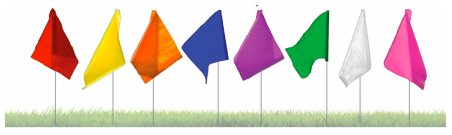
The students of a school decided to beautify the school on an annual day by fixing colourful flags on the straight passage of the school.They have $27$ flags to be fixed at intervals of every $2$ metre. The flags are stored at the position of the middlemost flag.Ruchi was given the responsibility of placing the flags. Ruchi kept her books where the flags were stored. She could carry only one flag at a time.
Image
$(a)$ How much distance did she cover in pacing $6$ flags on either side of center point?
$(b)$ Represent above information in Arithmetic progression
OR
How much distance did she cover in completing this job and returning to collect her books?
$(c)$ What is the maximum distance she travelled carrying a flag?
A man standing on the deck of a ship, which is 8m above water level. He observes the angle of elevation of the top of a hill as 60° and the angle of depression of the base of the hill as 30°. Calculate the distance of the hill from the ship and the height of the hill.

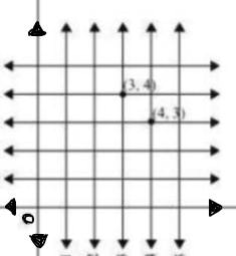
A group of mosquitoes were buzzing around in the playground at the evening. The playground is
considered in the region of the cartesian coordinate system where we mark a point on a graph by
how far along and how far up it is. The left-right (horizontal) direction is commonly called X-axis.The up-down (vertical) direction is commonly called Y-axis. Now, if two mosquitoes travel by the same path of coordinates, they will eventually collide and could not fly ahead. So, to ensure that each mosquito has its own unique path of travel. Refer the point O as origin.

(i)What will be the coordinates for the mosquito that flies in the middle of the playground ?
(ii)What is the distance between the two mosquitoes marked on the graph ?
OR
What is the difference between the distance of the two points marked on the graph
(iii) What is the value of ordinate for the mosquito flying just 1 unit below (4,3) ?
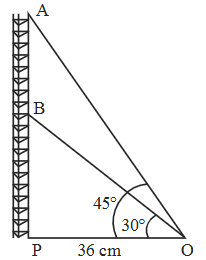
Radio towers are used for transmitting a range of communication services including radio and television. The tower will either act as an antenna itself or support one or more antennas on its structure. On a similar concept, a radio station tower was built in two Sections A and B. Tower is supported by wires from a point $O$.
Distance between the base of the tower and point O is 36 cm . From point O , the angle of elevation of the top of the Section B is $30^{\circ}$ and the angle of elevation of the top of Section $A$ is $45^{\circ}$.
Image
Based on the above information, answer the following questions:
(i) Find the length of the wire from the point O to the top of Section B.
(ii) Find the distance $A B$.
OR
Find the area of $\triangle OPB$.
(iii) Find the height of the Section A from the base of the tower.
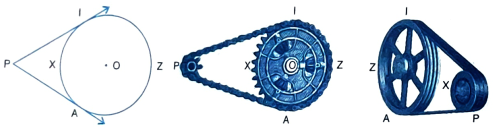
The chain and gears of bicycles or motorcycles or belt around pulleys are some real-life illustrations of tangents to circles.
Image
(i) $P I$ and $P A$ are tangents to the circle from point $P$. If arc $I Z A$ subtends an angle $240^{\circ}$ at the centre of the circle, then $\angle I P A=$
(a) $120^{\circ}$ $\qquad$ (b) $90^{\circ}$ $\qquad$ (c) $60^{\circ}$ $\qquad$ (d) $30^{\circ}$
(ii) If $I P=15 cm$, then $A I=$
(a) 7.5 cm $\qquad$ (b) 15 cm $\qquad$ (c) 30 cm $\qquad$ (d) 18 cm
(iii) If $I P=21 cm$ and measure of $A P$ is $x^2+5$, then $x=$
(a) 4 $\qquad$ (b) 16 $\qquad$ (c) $\sqrt{26}$ $\qquad$ (d) $\sqrt{30}$
(iv) $\angle O I P+\angle A P O=$
(a) $90^{\circ}$ $\qquad$ (b) $60^{\circ}$ $\qquad$ (c) $120^{\circ}$ $\qquad$ (d) $150^{\circ}$
Ajay wants to host a party on his $50^{\text {th }}$ birthday in a large banquet hall having a certain number of chairs. He wants that guests should sit in different groups like in pairs, triplets, quadruplets, fives and sixes etc. When the banquet hall manager arranges chairs in such pattern like in $2^{\prime S}, 3^{\prime S}, 4^S, 5^{\prime S}$ and $6^{\prime S}$ then $1,2,3,4$ and 5 chairs are left respectively. But, when he arranges in groups of $11^{\prime} S$ no chair is left.
(i) How many chairs are in the banquet hall?
(a) 407 $\qquad$ (b) 209 $\qquad$ (c) 539 $\qquad$ (d) 149
(ii) If three chairs are removed, then the remaining chairs can be arranged in groups of
(a) $2^{\prime s}$ $\qquad$ (b) $3^{\prime s}$ $\qquad$ (c) $4^{\prime s}$ $\qquad$ (d) $2^{\prime s}$
(iii) If one chair is added, then the total number of chairs can be arranged in groups of
(a) $2^{\prime s}$ $\qquad$ (b) $3^{\prime s}$ $\qquad$ (c) $4^{\prime s}$ $\qquad$ (d) $11^{\prime s}$
(iv) If one chair is added to the total number of chairs, how many chairs will be left when arranged in groups of $11^s$
(a) 1 $\qquad$ (b) 2 $\qquad$ (c) 3 $\qquad$ (d) 4