Question
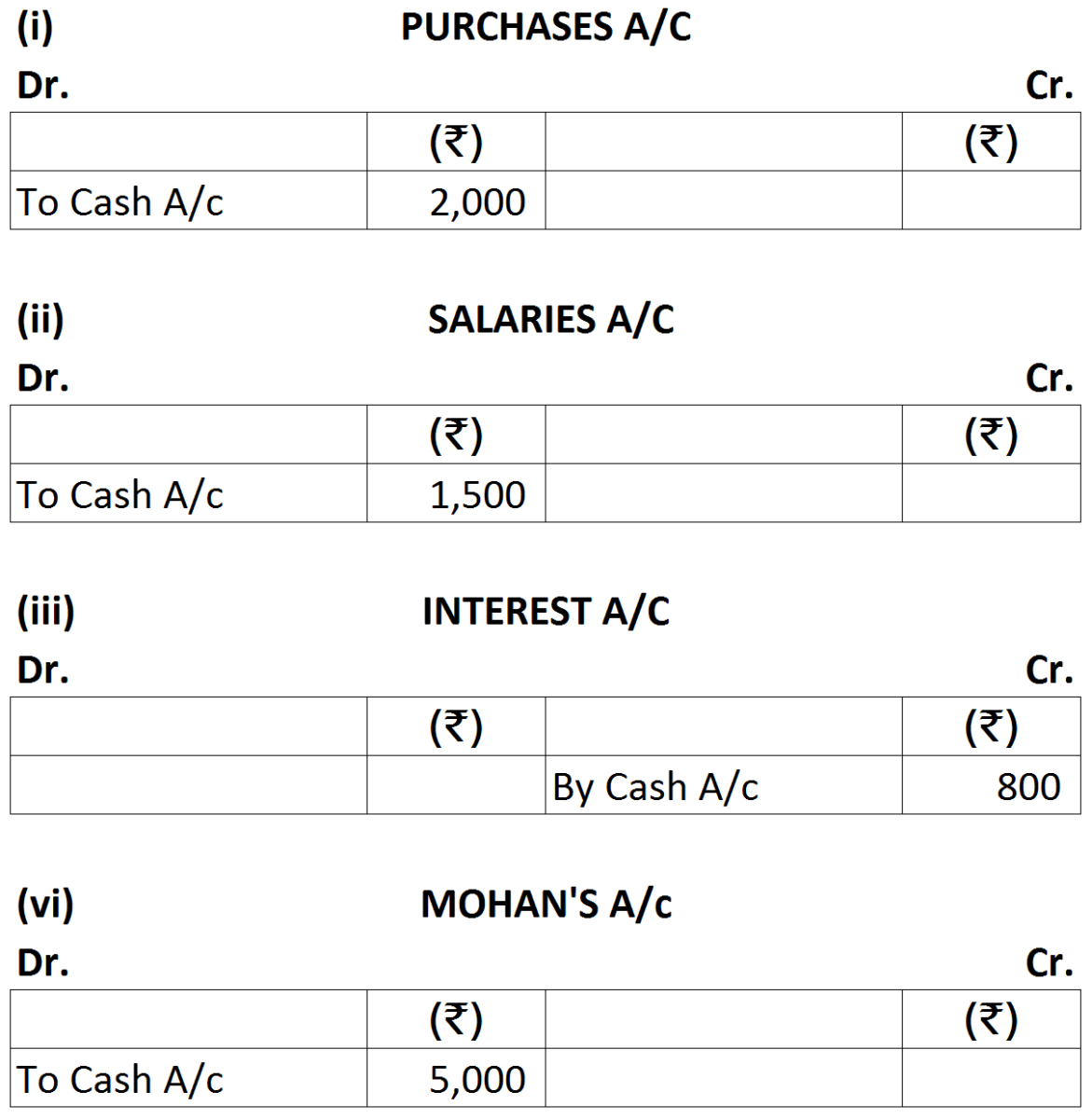
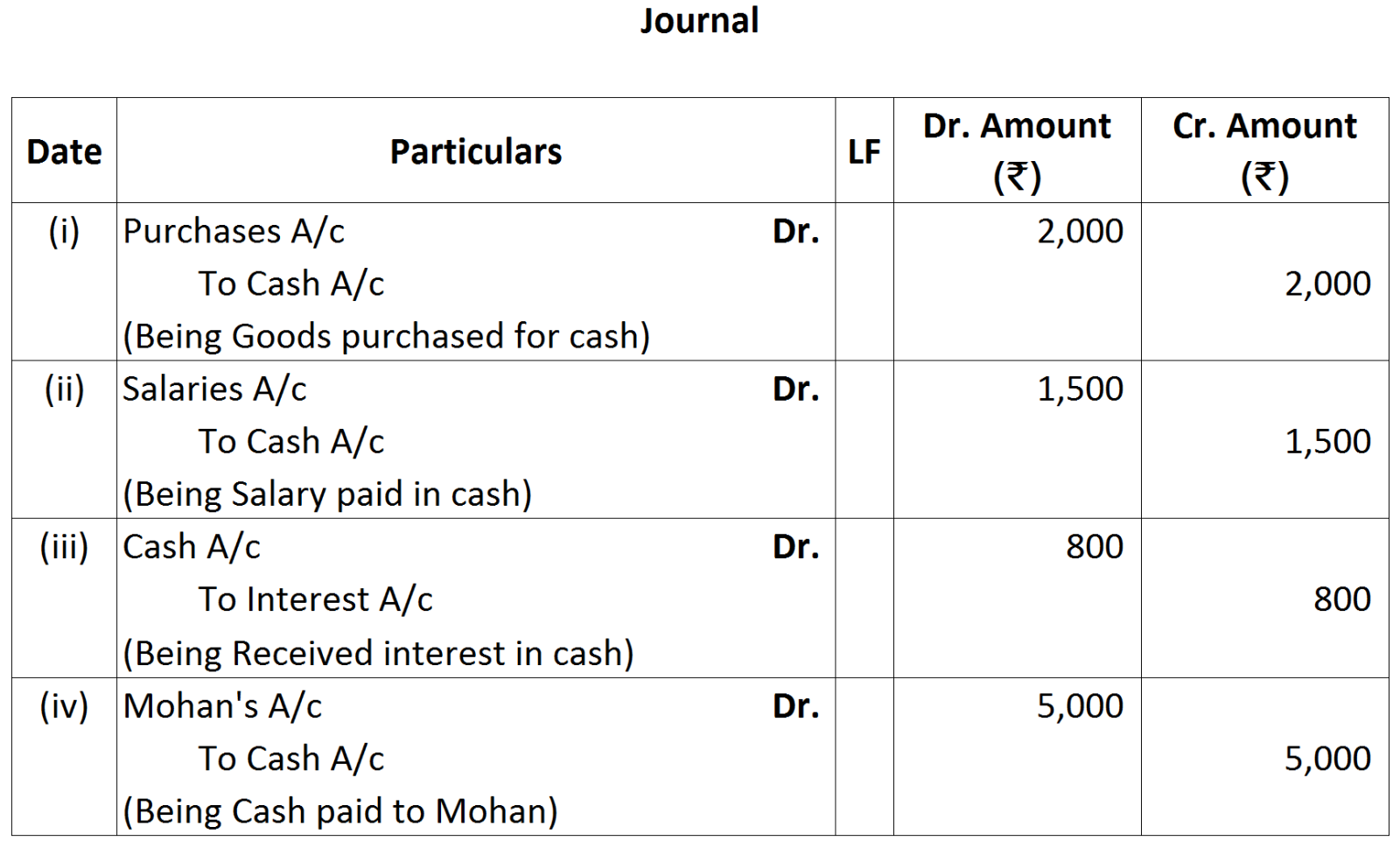
Prepare journal Entries of the following postings:
Answer

Solution is as follows.

Need a full question paper?

Generate a complete, print-ready paper with questions like this in minutes — across 16+ boards, with answer keys.

Start Generating Free

Similar questions

On 30th June 2014, the bank balance as per Sanjay Yadav's Cash Book was ₹ 1,500. On comparing with the Pass Book the following information was received:-
  1. Cheques amounting to ₹ 7,290 were issued on 28th June, of which one cheque of ₹ 1,300 was presented in the bank for payment on 4th July.
  2. Cheques deposited into bank for ₹ 10,000, but of these cheques for ₹ 4,000 were cleared and credited in July.
  3. Interest and Dividend on investments ₹ 580 collected by bank and credited to his account but he did not have any information for this.
  4. Life Insurance Premium ₹ 750 paid by bank according to his standing orders.
  5. Bank Charges ₹ 25 not recorded in the Cash Book.
Prepare a Bank Reconciliation Statement.
Prepare Accounting Equation from the following:
 
 
i.
Kunal started business with Cash
2,50,000
ii.
He purchased furniture for cash
35,000
iii.
He paid commission
2,000
iv.
He purchased goods on credit
40,000
v.
He sold goods (Costing ₹ 20,000) for cash
26,000
Rectify the following errors assuming that suspense account was opened. Ascertain the difference in trial balance.
  1. Depreciation provided on machinery ₹ 4,000 was not posted to Depreciation account.
  2. Bad debts written-off ₹ 5,000 were not posted to Debtors account.
  3. Discount allowed to a debtor ₹ 100 on receiving cash from him was not posted to discount allowed account.
  4. Goods withdrawn by proprietor for personal use ₹ 800 were not posted to Drawings account.
  5. Bill receivable for ₹ 2,000 received from a debtor was not posted to Bills receivable account.
Explain any three of the following:
  1. Retiring of Bills of Exchange.
  2. Holder in due course.
  3. Bills sent to bank for collection.
  4. Noting charges.
Enter the following transactions in a Cash Book with Cash and Bank Columns:
2017
 
March 1
Cash in Hand ₹ 15,000; Bank ₹ 8,000
March 2
Sold goods to X on credit for ₹ 10,000
March 5
Sold goods for ₹ 20,000; received cheque from them, discount allowed $2\frac{1}{2}\%$
Cheque was deposited into bank on 7th March
March 10
Purchased goods from Suresh on the terms of 5% Cash discount if the payment is made within 3 days ₹ 20,000
March 12
Payment made to Suresh; half in Cash and half by cheque
March 14
Received a Bank Draft for ₹ 6,820 from Siya Ram in full settlement of ₹ 7,000 due from him. Sent the draft to the Bank
March 16
Settled Pawan's account of ₹ 5,000 at a discount of 5%
March 17
Goods worth ₹ 8,000 were purchased from Sunil on 5th March. Its payment was made today by cheque after deducting 5% cash discount
March 18
Withdrawn from Bank ₹ 20,000 and Furniture was purchased for ₹ 15,000; the balance taken by the proprietor
March 20
Received a cheque from Ravi for ₹ 2,850 in settlement after deducting 5%
Endorsed the cheque to Gopal on 22nd March
March 22
Placed an order with 'Jai Traders' for goods of the value of ₹ 10,000 and sent a cheque of ₹ 8,000 with the order
March 23
Purchased furniture by cheque of ₹ 6,000
March 24
Cash sales ₹ 15,000; half of which deposited into bank
March 25
X settled his account by payment of ₹ 10,150; ₹ 150 being the interest charged
March 27
Paid rent to Landlord 'Rakesh' by cheque ₹ 2,000
March 28
Cashed a cheque for ₹ 10,000 and paid salaries in cash ₹ 8,000
March 31
Deposited into bank, balance of cash in excess of ₹ 5,000
Rajesh Kumar was unable to reconcile his Trial Balance as on 31st March 2014 and has opened a suspense account from the difference. Later on the following errors were discovered:-
  1. There were three compensating errors:-
  1. The total of Sales Return Book was overcast by ₹ 100.
  2. The total of one page of the Purchase Book was carried forward as ₹ 1,286 instead of ₹ 1,826.
  3. Goods purchased from C for ₹ 400 was debited to his account as ₹ 40.
  1. ₹ 425 paid for wages to workmen for making office table were debited to wages account.
  2. Rent paid ₹ 1,500 were posted to the credit of Rent account as ₹ 150.
  3. Cash received from Ghanshyam ₹ 500 were correctly recorded in cash book but were posted to his account as ₹ 50.
  4. ₹ 720 paid to Kamal has been debited to Kamlesh A/c as ₹ 520.
  5. The total of Purchase Return Book ₹ 2,500 was left unposted.
Pass rectifying entries and prepare Suspense A/c.
In taking out the Trial Balance, book-keeper finds that he is out ₹ 3,809 excess debit. Being desirous of closing his books he places the difference to a newly opened Suspense A/c which is carried forward. In the next period he discovered that :-
  1. ₹ 17,715 received from X has not been posted to his account.
  2. A sum of ₹ 9,500 written off as depreciation on fixtures has not been posted to the Depreciation A/c.
  3. ₹ 1,50,000 paid for furniture purchased has been charged to Ordinary Purchases A/c.
  4. A discount of ₹ 3,742 allowed to a customer has been credited to him as ₹ 3,648.
  5. The total of the Inwards return has been added ₹ 900 short.
  6. An item of Sale for ₹ 5,900 was posted as ₹ 9,500 in the Sales Account.
Give the rectifying entries and prepare the Suspense Account.
On 1st January, 2016, A Ltd. Purchased a machine for ₹ 2,40,000 and spent ₹ 10,000 on its erection. On 1st July, 2016 an additional machinery costing ₹ 1,00,000 was purchased. On 1st July, 2018 the machine purchased on 1st January, 2016 was sold for ₹ 1,43,000 and on the same date, a new machine was purchased at a cost of ₹ 2,00,000.
Show the Machinery Account for the first three calendar years after charging depreciation at 5% by the Straight Line Method.
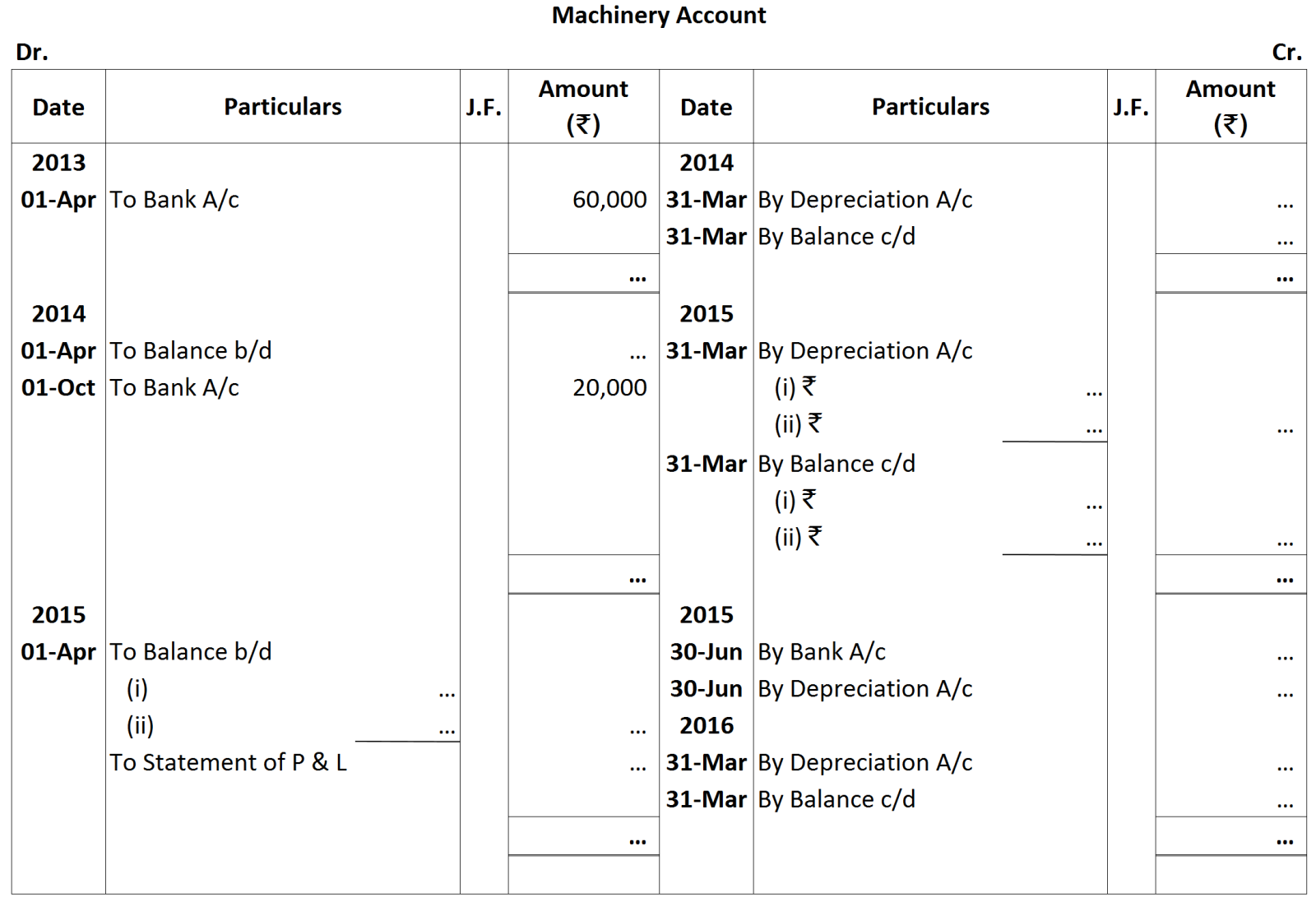
Fill up the missing information in the Machinery Account given below. You are informed that on $30^{\text {th }}$ June $2015$, the Company sold the first machine purchased in $2013$ for $₹ 38,500$. Depreciation is provided at $20 \%$ p.a. on the original cost each year. Account are closed on $31^{\text {st }}$ March every year.
On 1st April, 2015, a limited company purchased a Machine for ₹ 1,90,000 and spent ₹ 10,000 on its installation. At the date of purchase, it was estimated that the scrap value of the machine would be ₹ 50,000 at the end of sixth year.
Give Machine Account and Depreciation A/c in the books of the Company for 4 years after providing depreciation by Fixed Instalment Method. The books are closed on 31st March every year.