Pressure applied to an enclosed fluid is transmitted undiminished to every portion of the fluid and the walls of the containing vessel. This law was first formulated by
Easy
Download our app for free and get started
(d)

Download our appand get started for free
Experience the future of education. Simply download our apps or reach out to us for more information. Let's shape the future of learning together!No signup needed.*
Similar Questions
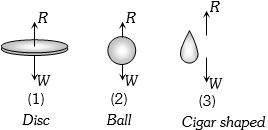
- 1When a body falls in air, the resistance of air depends to a great extent on the shape of the body, $ 3 $ different shapes are given. Identify the combination of air resistances which truly represents the physical situation. (The cross sectional areas are the same).View Solution
- 2Two capillary of length $L $ and $2L$ and of radius $R$ and $2R$ are connected in series. The net rate of flow of fluid through them will be (given rate of the flow through single capillary, $X = \pi P{R^4}/8\eta L)$View Solution
- 3There is a hole of area $A$ at the bottom of cylindrical vessel. Water is filled up to a height $ h$ and water flows out in $ t $ second. If water is filled to a height $4h,$ it will flow out in time equal toView Solution
- 4A air bubble of radius $1\,cm$ in water has an upward acceleration $9.8\, cm\, s ^{-2}$. The density of water is $1\, gm\, cm ^{-3}$ and water offers negligible drag force on the bubble. The mass of the bubble is$.......gm$View Solution
$\left( g =980 \,cm / s ^{2}\right)$
- 5Three capillaries of length $L, \frac{L}{2}$ and $\frac{L}{3}$ are connected in series. Their radii are $r, \frac{r}{2}$ and $\frac{r}{3}$ respectively. Then if stream-line flow is to be maintained and the pressure across the first capillary is $P$, then ............View Solution
- 6The two thigh bones (femures), each of cross-sectional area $10 \,cm ^2$ support the upper part of a person of mass $50 \,kg$. The average pressure sustained by the femures is ........... $N / m ^2$View Solution
- 7View SolutionA tank filled with fresh water has a hole in its bottom and water is flowing out of it. If the size of the hole is increased, then
- 8View SolutionThe Working of an atomizer depends upon
- 9Water flows in a stream line manner through a capillary tube of radius $a$. The pressure difference being $P$ and the rate of flow is $Q$. If the radius is reduced to $\frac{a}{4}$ and the pressure is increased to $4 P$. then the rate of flow becomes ................View Solution
- 10The weight of an empty balloon on a spring balance is $w_1$. The weight becomes $w_2$ when the balloon is filled with air. Let the weight of the air itself be $w$ .Neglect the thickness of the balloon when it is filled with air. Also neglect the difference in the densities of air inside $\&$ outside the balloon. Then :View Solution