MCQ
Pressure head in Bernoulli's equation is
  • A
    $\frac{{P\rho }}{g}$
  • $\frac{{P}}{\rho g}$
  • C
    $\rho g$
  • D
    $P\rho g$

Answer

Correct option: B.
$\frac{{P}}{\rho g}$
b
Bernoulli Equation is principally conservation of energy equation in fluids, relating the pressure, velocity of fluid flowing and gravitational potential of liquid at some point.

It is given as

$\frac{P}{\rho g}+h+\frac{1}{2} \frac{v^{2}}{g}=$ constant

where $\frac{P}{\rho g}$ is the pressure head.

Need a full question paper?

Generate a complete, print-ready paper with questions like this in minutes — across 16+ boards, with answer keys.
Start Generating Free

Similar questions

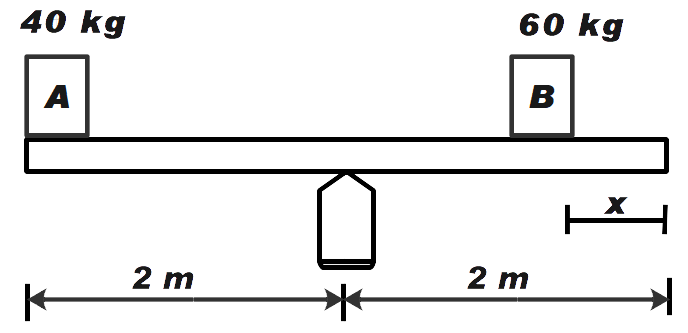
In the game of see$-$saw, what should be the displacement of boy $B$ from right edge to keep the see$-$saw in equilibrium? $(M = 40\ kg, M_2 = 60\ kg.)$
Image
The volume of an ideal gas is $1$ litre and its pressure is equal to $72cm$ of mercury column. The volume of gas is made $900\, cm^3$ by compressing it isothermally. The stress of the gas will be ...... $cm$ (mercury)
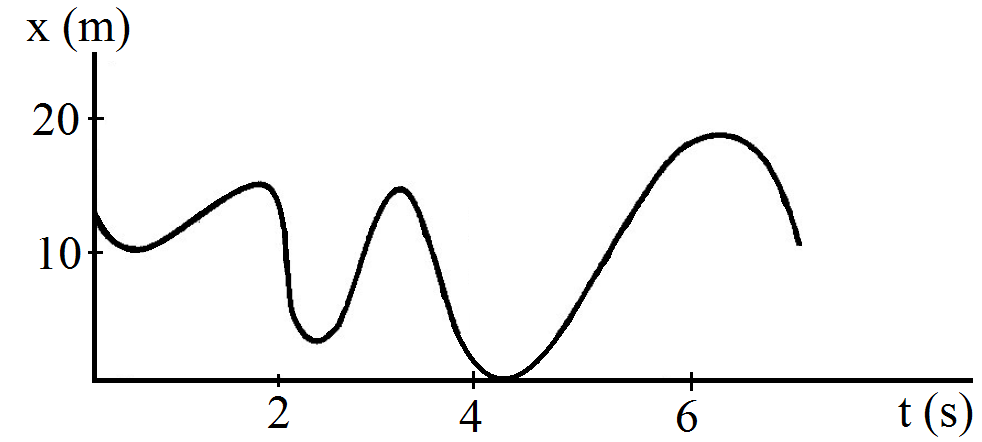
Figure shows the position of a particle moving on the $X-$axis as a function of time.
A force vector applied on a mass is represented as $\vec F = 6\hat i - 8\hat j + 10\hat k$ and accelerates with $1\,m/{s^2}$. What will be the mass of the body
Two trains $A$ and $B$ are moving with speeds $20 \mathrm{~m} / \mathrm{s}$ and $30 \mathrm{~m} / \mathrm{s}$ respectively in the same direction on the same straight track, with $B$ ahead of $A$. The engines are at the front ends. The engine of train  $A$ blows a long whistle.

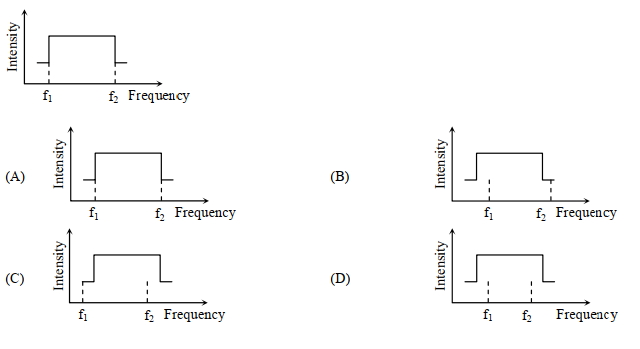
Assume that the sound of the whistle is composed of components varying in frequency from $f_1=800 \mathrm{~Hz}$ to $f_2=1120 \mathrm{~Hz}$, as shown in the figure. The spread in the frequency (highest frequency - lowest frequency) is thus $320 \mathrm{~Hz}$. The speed of sound in still air is $340 \mathrm{~m} / \mathrm{s}$.

$1.$  The speed of sound of the whistle is

$(A)$ $340 \mathrm{~m} / \mathrm{s}$ for passengers in $A$ and $310 \mathrm{~m} / \mathrm{s}$ for passengers in $B$

$(B)$ $360 \mathrm{~m} / \mathrm{s}$ for passengers in $A$ and $310 \mathrm{~m} / \mathrm{s}$ for passengers in $B$

$(C)$ $310 \mathrm{~m} / \mathrm{s}$ for passengers in $A$ and $360 \mathrm{~m} / \mathrm{s}$ for passengers in $B$

$(D)$ $340 \mathrm{~m} / \mathrm{s}$ for passengers in both the trains

$2.$  The distribution of the sound intensity of the whistle as observed by the passengers in train $\mathrm{A}$ is best represented by

$Image$

$3.$  The spread of frequency as observed by the passengers in train $B$ is

$(A)$ $310 \mathrm{~Hz}$ $(B)$ $330 \mathrm{~Hz}$ $(C)$ $350 \mathrm{~Hz}$ $(D)$ $290 \mathrm{~Hz}$

Give the answer question $1,2$ and $3.$
Which of the following circular rods. (given radius $ r$ and length $l$ ) each made of the same material as whose ends are maintained at the same temperature will conduct most heat
In a sonometer wire, the tension is maintained by suspending a $50.7 kg$ mass from the free end of the wire. The suspended mass has a volume of $ 0.0075 \, m^3$. The fundamental frequency of the wire is $260 Hz$. If the suspended mass is completely submerged in water, the fundamental frequency will become .... $Hz$ (take $g = 10 ms^{-2}$)
Solid cylinders of radii ${r_1},\,{r_2}$ and ${r_3}$ roll down an inclined plane from the same place simultaneously. If ${r_1} > {r_2} > {r_3}$, which one would reach the bottom first
A liquid boils when its vapour pressure is equal to:
How much force is required to produce an increase of $0.2\%$ in the length of a brass wire of diameter $0.6\, mm$ (Young’s modulus for brass = $0.9 \times {10^{11}}N/{m^2}$)