MCQ
Pressure inside a soap bubble is greater than the pressure outside by an amount :

(given : $\mathrm{R}=$ Radius of bubble, $\mathrm{S}=$ Surface tension of bubble)

  • $\frac{4 S}{R}$
  • B
    $\frac{4 R}{S}$
  • C
    $\frac{S}{R}$
  • D
    $\frac{2 S}{R}$

Answer

Correct option: A.
$\frac{4 S}{R}$
a
There are two liquid-air surfaces in bubble so

$\Delta \mathrm{P}=2\left(\frac{2 \mathrm{~S}}{\mathrm{R}}\right)=\frac{4 \mathrm{~S}}{\mathrm{R}}$

Need a full question paper?

Generate a complete, print-ready paper with questions like this in minutes — across 16+ boards, with answer keys.
Start Generating Free

Similar questions

A wave is represented by the equation-$\text{y}=(0.001\text{mm})\sin\Big[(50\text{s}^{-1})\text{t}+(2.0\text{m}^{-1})\text{x}\Big]$
  1. The wave velocity $= 100m/s.$
  2. The wavelength $= 2.0m.$
  3. The frequency $=\frac{25}{\pi}\text{Hz}$
  4. The amplitude $= 0.001mm.$
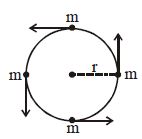
Four similar particles of mass $m$ are orbiting in a circle of radius $r$ in the same  direction because of their mutual gravitation attractive force. Velocity of a particle is  given by
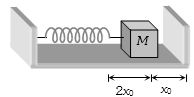
One end of a spring of force constant k is fixed to a vertical wall and the other to a block of mass m resting on a smooth horizontal surface. There is another wall at a distance ${x_0}$ from the black. The spring is then compressed by $2{x_0}$ and released. The time taken to strike the wall is
In a vessel, the gas is at pressure $P_0$. If the mass of all the molecules is halved and their speed is doubled, then the resultant pressure will be 
If the tension in the cable supporting an elevator is equal to the weight of the elevator, the elevator may be:
 A $10 \;N$ force is applied on a body produce in it an acceleration of $1 \;m / s ^{2} .$ The mass of the body is ...... $kg$
$STATEMENT-1$ For an observer looking out through the window of a fast moving train, the nearby objects appear to move in the opposite direction to the train, while the distant objects appear to be stationary. and

$STATEMENT-2$ If the observer and the object are moving at velocities $\vec{V}_1$ and $\vec{V}_2$ respectively with reference to a laboratory frame, the velocity of the object with respect to the observer is $\overrightarrow{\mathrm{V}}_2-\overrightarrow{\mathrm{V}}_1$.
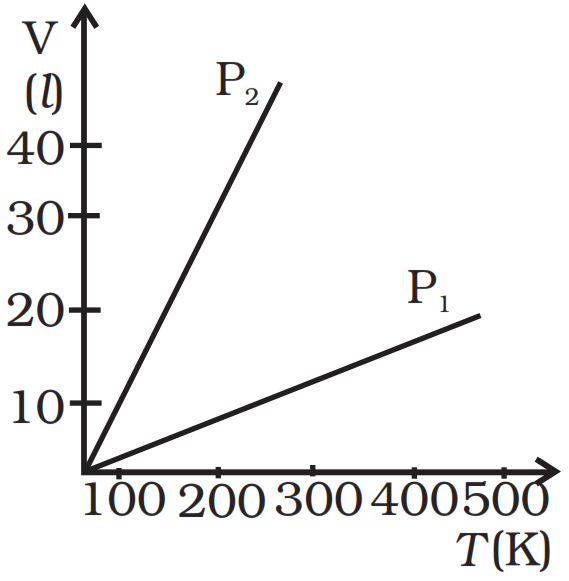
Volume versus temperature graphs for a given mass of an ideal gas are shown in figure. At two different values of constant pressure. What can be inferred about relation between $P_1$ and $P_2$?
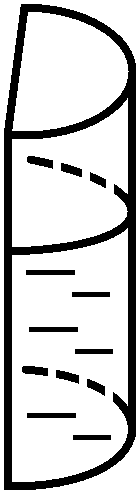
A liquid is contained in a vertical tube of semicircular cross-section The contact angle is zero. The forces of surface tension on the curved part and on the flat part are in ratio:
During the motion of a lift, apparent weight of a body becomes twice its actual weight when,