MCQ
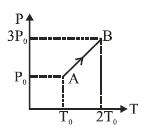
Pressure versus temperature graph of an ideal gas is as shown in figure. Density of the gas at point $A$ is ${\rho _0}$. Density at point $B$ will be
  • A
    $\frac{3}{4}\,{\rho _0}$
  • $\frac{3}{2}\,{\rho _0}$
  • C
    $\frac{4}{3}\,{\rho _0}$
  • D
    $2\,{\rho _0}$

Answer

Correct option: B.
$\frac{3}{2}\,{\rho _0}$
b
$\rho=\frac{P M}{R T}$ or $\rho \propto \frac{P}{T}$

$\left(\frac{P}{T}\right)_{A}=\frac{P_{0}}{T_{0}}$ and $\left(\frac{P}{T}\right)_{B}$

$=\frac{3}{2}\left(\frac{P_{0}}{T_{0}}\right)\left(\frac{P}{T}\right)_{B}=\frac{3}{2}\left(\frac{P}{T}\right)_{A}$

$\therefore \quad \rho_{B}=\frac{3}{2} \rho_{A}=\frac{3}{2} \rho_{0}$

Need a full question paper?

Generate a complete, print-ready paper with questions like this in minutes — across 16+ boards, with answer keys.

Start Generating Free

Similar questions

A planet revolving in elliptical orbit has

$(A)$ a constant velocity of revolution.

$(B)$ has the least velocity when it is nearest to the sun.

$(C)$ its areal velocity is directly proportional to its velocity.

$(D)$ areal velocity is inversely proportional to its velocity.

$(E)$ to follow a trajectory such that the areal velocity is constant.

Choose the correct answer from the options given below

A star is modeled as a uniform spherical distribution of matter keeping mass of star constant. How gravitational pressure on surface depends on volume of the star?
Two metal strips that constitute a thermostat must necessarily differ in their
A gas is collected over the water at $25°C.$ The total pressure of moist gas was $735 \,mm$ of mercury. If the aqueous vapour pressure at $25°C$ is $23.8\, mm.$ Then the pressure of dry gas is..... $mm$
Two masses of $1\,kg$ and $16\,kg$ are moving with equal K.E. The ratio of magnitude of the linear momentum is
Two discs having masses in the ratio $1: 2$ and radii in the ratio $1: 8$ roll down without slipping one by one from an inclined plane of height $h$. The ratio of their linear velocities on reaching the ground is ........
Equation of motion of a body is $\frac{d v}{d t}=-4 v+8$, where $v$ is the velocity in $m / s$ and $t$ is the time in second. Initial velocity of the particle was zero. Then,
A particle is forced to move on a straight line path. It returns to the starting point after $10$ seconds. The total distance covered by the particle during this time is $20m.$ Which of the following statements is false regarding the motion of the particles?
A stationary wave is represented by $y=A \sin (100 t) \cos (0.01 x)$, where $y$ and $A$ are in millimetres, $t$ is in second and $x$ is in metre. The velocity of the constituent wave is ........... $m / s$
A body is projected at an angle $\theta $ with horizontal, another body is projected with the same speed at an angle $\theta $ with the vertical then the ratio of the maximum height is