Question
Probability of solving specific problem independently by A and B are $\frac{1}{2}\ \text{and}\ \frac{1}{3}$ respectively.If both try to solve the problem independently, find the probability that
  1. The problem is solved.
  2. Exactly one of them solves the problem.
Answer

Probability of solving the problem by A, P(A) $=\frac{1}{2}$Probability of solving the problem by B, P(B) $=\frac{1}{3}$
Since the problem is solved independently by A and B,
$\therefore\text{P}(\text{AB})=\text{P}(\text{A})\cdot\text{P}(\text{B})=\frac{1}{2}\times\frac{1}{3}=\frac{1}{6}$
$\text{P}(\text{A}')=1-\text{P}(\text{A})=1-\frac{1}{2}=\frac{1}{2}$
$\text{P}(\text{B}')=1-\text{P}(\text{B})=1-\frac{1}{3}=\frac{2}{3}$
  1. Probability that the problem is solved $=\text{P}(\text{A}\cup\text{B})$
$=\text{P}(\text{A})+\text{P}(\text{B})-\text{P}(\text{AB})$
$=\frac{1}{2}+\frac{1}{3}-\frac{1}{6}$
$=\frac{4}{6}$
$=\frac{2}{3}$
  1. Probability that exactly one of them solves the problem is given by,
$\text{P}(\text{A}).\text{P}(\text{B}')+\text{P}(\text{B}).\text{P}(\text{A}')$
$ =\frac{1}{2}\times\frac{2}{3}+\frac{1}{2}\times\frac{1}{3}$
$=\frac{1}{3}+\frac{1}{6}$
$=\frac{1}{2}$

Need a full question paper?

Generate a complete, print-ready paper with questions like this in minutes — across 16+ boards, with answer keys.

Start Generating Free

Similar questions

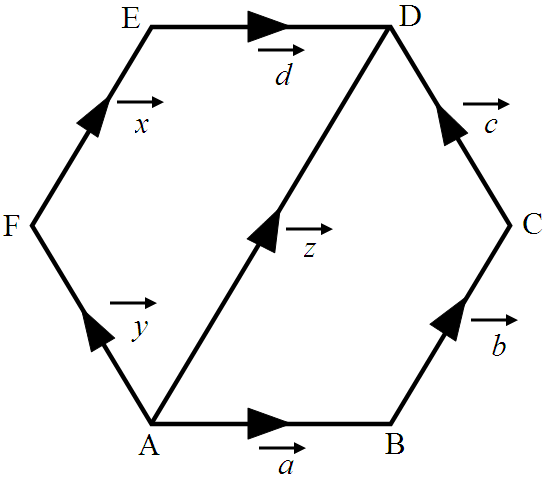
In Figure ABCD is a regular hexagon, which vectors are:
  1. Collinear.
  2. Equal.
  3. Co-initial.
  4. Collinear but not equal.
The two vectors $\hat{\text{j}}+\hat{\text{k}}$ and $3\hat{\text{i}}-\hat{\text{j}}+4\hat{\text{k}}$ represents the sides $\overrightarrow{\text{AB}}$ and $\overrightarrow{\text{AC}}$ respectively of a triangle ABC. Find the length of the median through A.
Find the position vector of a point A in space such that $\overrightarrow{\text{OA}}$ is is inclined at 60° to OX and at 45° to OY and $|\overrightarrow{\text{OA}}|=10$ units.
Write the values of 'a' for which the following distribution of probabilities becomes a probability distributioin:
$\text{X}=\text{x}_\text{i}:$ $-2$ $-1$ $0$ $1$
$\text{P}(\text{X}=\text{x}_\text{i}):$ $\frac{1-\text{a}}{4}$ $\frac{1+2\text{a}}{4}$ $\frac{1-2\text{a}}{4}$ $\frac{1+\text{a}}{4}$
If a young man drives his scooter at a speed of 25km/hr, he has to spend Rs. 2 per km on petrol. If he drives the scooter at a speed of 40km/hr, it produces air pollution and increases his expenditure on petrol to Rs. 5 per km. He has a maximum of Rs. 100 to spend on petrol and travel a maximum distance in one hour time with less polution. Express this problem as an LPP and solve it graphically. What value do you find here.
Evaluate the following integrals:
$\int\limits^{1}_0\big|\text{x}\sin\pi\text{x}\big|\text{dx}$
Solve the following differential equations:$\cos\text{x}\cos\text{y}\frac{\text{dy}}{\text{dx}}=-\sin\text{x}\sin\text{y}$
Relation R in the set A of human beings in a town at a particular time given by
  1. R = {(x, y) : x and y work at the same place}
  2. R = {(x, y) : x and y live in the same locality}
  3. R = {(x, y) : x is exactly 7 cm taller than y}
  4. R = {(x, y) : x is wife of y}
  5. R = {(x, y) : x is father of y}
Let A = R – {3} and B = R – {1}. Consider the function f: A → B defined by $f(\text{x})=\Big(\frac{\text{x}-2}{\text{x}-3}\Big).$ Is f one-one and onto? Justify your answer.
Evaluate the following integrals:
$\int\limits^2_{0}\big|\text{x}^2-3\text{x}+2\big|\text{dx}$