MCQ
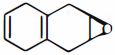
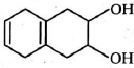
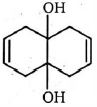
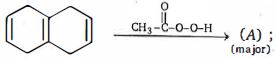
Product $(A)$ is
  • A


  • C

  • D

Answer

Correct option: B.

b
$\begin{matrix}
   O\,\,\,\,\,\,\,\,\,\,\,\,\,\,\,  \\
   ||\,\,\,\,\,\,\,\,\,\,\,\,\,\,\,\,  \\
   C{{H}_{3}}-C-O-O-H  \\
\end{matrix}$ will act as electrophile.
$\therefore$ alkene having more $\alpha $ -hydrogen is better nucleophile it will undergo reaction.

Need a full question paper?

Generate a complete, print-ready paper with questions like this in minutes — across 16+ boards, with answer keys.

Start Generating Free

Similar questions

$20\,mL$ of $0.02\,M$ hypo solution is used for the titration of $10\,mL$ of copper sulphate solution, in the presence of excess of $KI$ using starch as an indicator. The molarity of $Cu ^{2+}$ is found to be $\times 10^{-2}\,M$[nearest integer]Given : $2 Cu ^{2+}+4 I ^{-} \rightarrow Cu _{2} I _{2}+ I _{2}$ $I _{2}+2 S _{2} O _{3}{ }^{2-} \rightarrow 2 I ^{-}+ S _{4} O _{6}{ }^{2-}$
The energy of a photon is calculated by
The correct $IUPAC$ name of the compound :

$\begin{array}{*{20}{c}}
{C{H_3}\,\,\,\,\,\,\,\,\,\,\,\,\,\,\,\,\,\,\,\,\,\,C{H_3}\,\,\,\,\,\,\,\,\,\,}\\
{|\,\,\,\,\,\,\,\,\,\,\,\,\,\,\,\,\,\,\,\,\,\,\,\,\,\,\,\,\,\,|\,\,\,\,\,\,\,\,\,\,\,\,\,\,\,}\\
{C{H_3} - C{H_2} - C = C - CH - C - C{H_2} - C{H_2} - C{H_3}}\\
{|\,\,\,\,\,\,\,\,\,}\\
{{C_2}{H_5}}
\end{array}$

Which of the following reactions will not produce a racemic product ?
Mass number is also called as __________.
Dissociation of ${H_3}P{O_4}$ takes place in following steps
In the following reaction, $4P + 3KOH + 3{H_2}O \to 3K{H_2}P{O_2} + P{H_3}$
$p$ and $n-$type of semiconductors are formed due to
For the reaction $2N{O_2}_{(g)}$ $\rightleftharpoons$ $2N{O_{(g)}} + {O_2}_{(g)}$ ${K_c} = 1.8 \times {10^{ - 6}}$ at $185\,^oC$. At $185\,^oC$, the value of ${K_c}$ for the reaction $N{O_{\left( g \right)}} + \frac{1}{2}{O_2}_{\left( g \right)}$ $\rightleftharpoons$ $N{O_2}_{\left( g \right)}$ is
Considering the elements B, C, N, F, and Si, the correct order of their non-metallic character is: