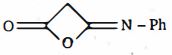
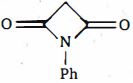
MCQ
Product $(B)$ is

  • A
    $\begin{matrix}
       \,\,\,\,\,\,\,\,O  \\
       \,\,\,\,\,\,\,||  \\
       Ph-NH-C-C{{O}_{2}}H  \\
    \end{matrix}$
  • $\begin{matrix}
       O\,\,\,\,\,\,  \\
       ||\,\,\,\,\,\,\,  \\
       Ph-NH-C-C{{H}_{2}}-C{{O}_{2}}H  \\
    \end{matrix}$
  • C

  • D

Answer

Correct option: B.
$\begin{matrix}
   O\,\,\,\,\,\,  \\
   ||\,\,\,\,\,\,\,  \\
   Ph-NH-C-C{{H}_{2}}-C{{O}_{2}}H  \\
\end{matrix}$
b

Need a full question paper?

Generate a complete, print-ready paper with questions like this in minutes — across 16+ boards, with answer keys.
Start Generating Free

Similar questions

The value of electric permittivity of free space is
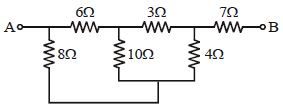
The equivalent resistance between the points $A$ and $B$ is :-
For a hydrogen atom, when electron jump from $n = 2$ to $n = 1$, then wave length of radiation emitted found to be ${\lambda _0}$ .Then, for which transion of electron of a $‘He’$ atom, the wavelength of radiation emitted will be equal to  '${\lambda _0}$ '
A block of steel of size $ 5 cm × 5 cm × 5 cm $ is weighed in water. If the relative density of steel is $7,$  its apparent weight is
An object is placed beyond the centre of curvature ${C}$ of the given concave mirror. If the distance of the object is ${d}_{1}$ from ${C}$ and the distance of the image formed is ${d}_{2}$ from ${C}$, the radius of curvature of this mirror is
A proton and an $\alpha$ -particle, having kinetic energies $K _{ p }$ and $K _{\alpha},$ respectively, enter into $a$ magnetic field at right angles.

The ratio of the radii of trajectory of proton to that of $\alpha$ -particle is $2: 1 .$ The ratio of $K _{ p }: K _{\alpha}$ is :

Two identical light sources $S_1$ and $S_2$ emit light of same wavelength $\lambda$. These light rays will exhibit interference if
If a lens is moved towards the object from a distance of $40 \,cm$ to $30 \,cm$, the magnification of the image remains the same (numarically). The focal length of the lens is ......... $cm$
A charged particle oscillates about its mean equilibrium position with a frequency of $10^9\ Hz$. The electromagnetic waves produced:
Two vibrating tuning forks produce progressive waves given by ${y_1} = 4\,\sin \,\left( {500\pi t} \right)$ and ${y_2} = 2\,\sin \,\left( {506\pi t} \right)$. These tuning forks are held near the ear of a person. The person will hear $\alpha \, beats/s$ with intensity ratio between maxima and minima equal to $\beta $. Find the value of $\beta  - \alpha $